
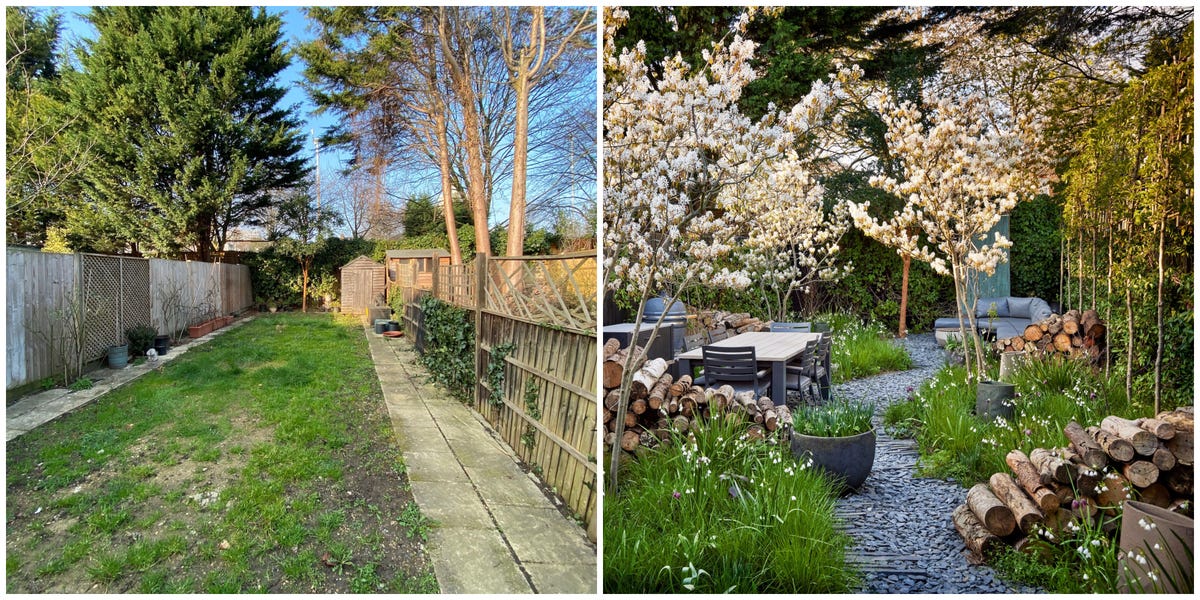
Gucheron Merton readily admits that she and her husband Peter are not gardeners. It wasn’t until 15 years after moving into their home in Chiswick, west London – having carried out extensive renovations – that they finally decided to do something about the garden. Turning to landscape architect Stefano Marinaz for help, they gave him a fairly general brief, their only stipulations being that they wanted a space that would be natural and wildlife-friendly, with separate seating and dining areas. One look at the results proves that Stefano has delivered just what they wanted and more…
The challenges
There were three main issues, common to many city gardens, that Stefano needed to tackle. The first was to avoid making the narrow, 30-metre space look long and thin. He then had to work out how to screen the couple’s seating area and get away from the classic ‘chair by the door’ arrangement. ‘If you put furniture right outside the house, that’s what you’ll be looking at for six months of the year,’ Stefano points out. Finally, he needed to mitigate the noise of the Great West Road – the busy dual carriageway that runs past the end of the garden.
Before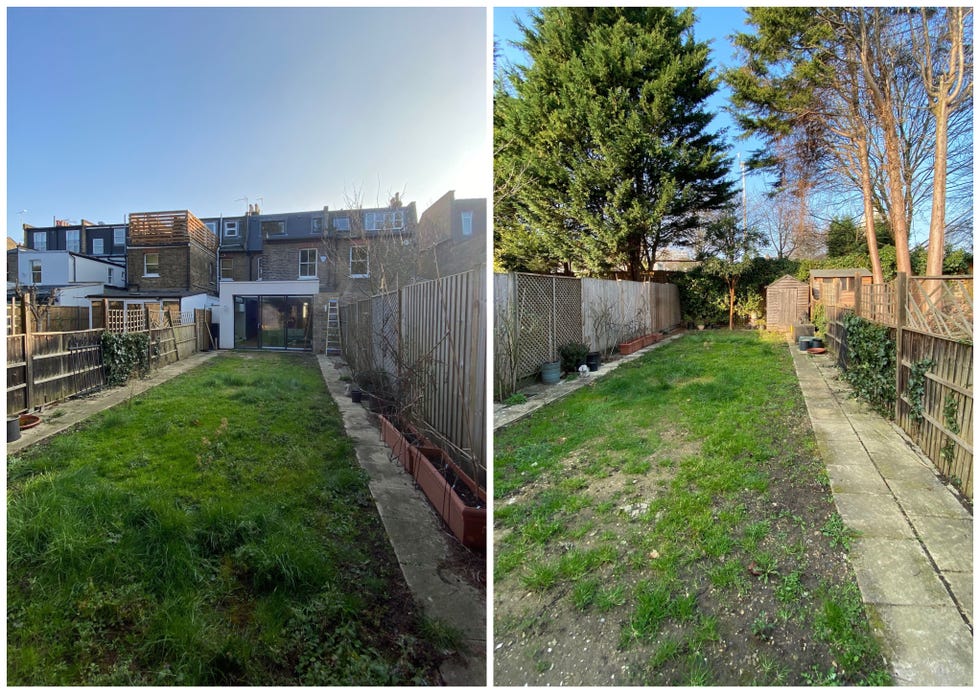

Stefano Marinaz
The solutions
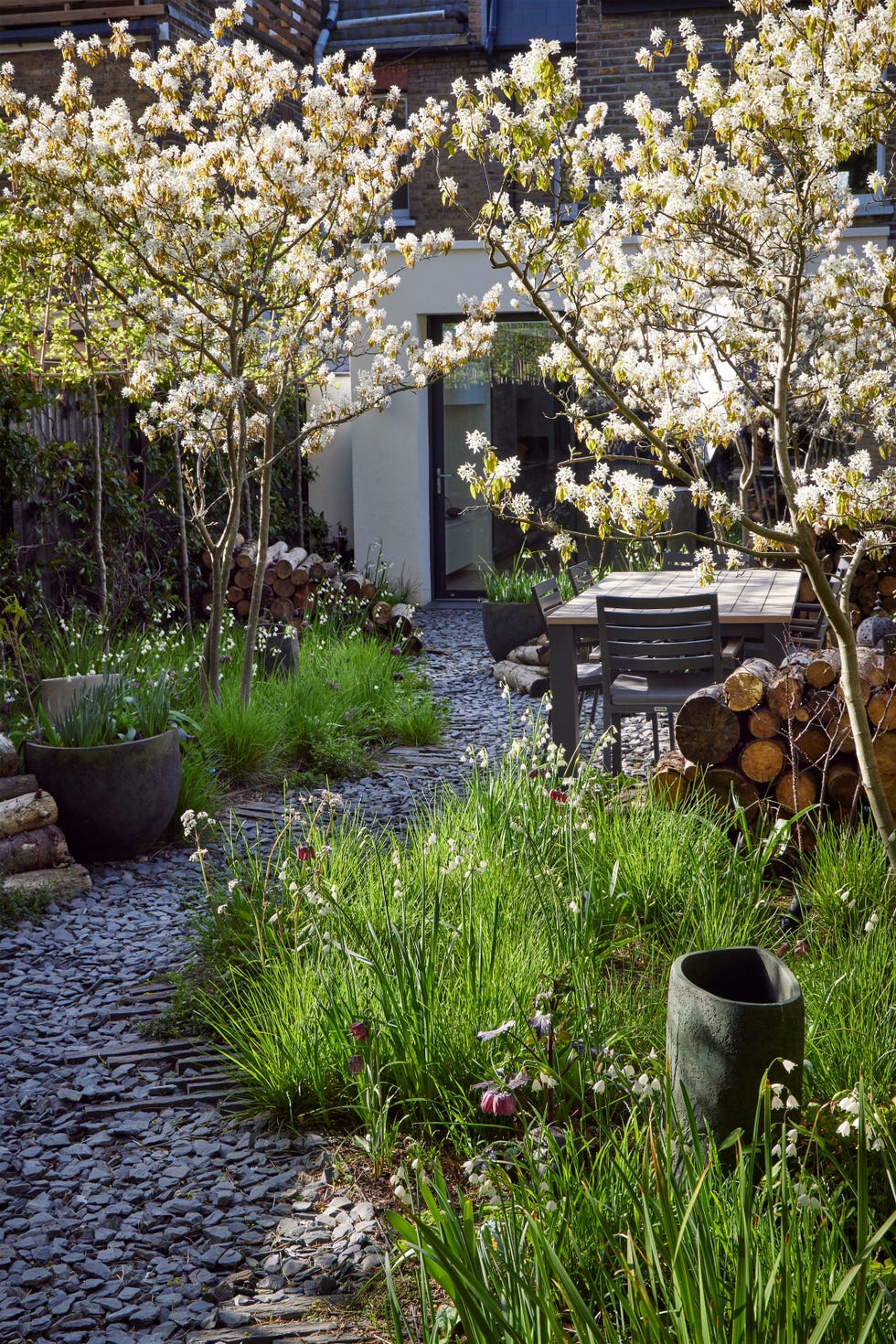
As Stefano explains: ‘The main concept was to consider the whole garden as a big planting bed that opens up at various points.’ He planted to within 60cm of the house and created a meandering path. From the house, you can’t see where it leads but, once outside, you drift along it, brushing past perennials and grasses.
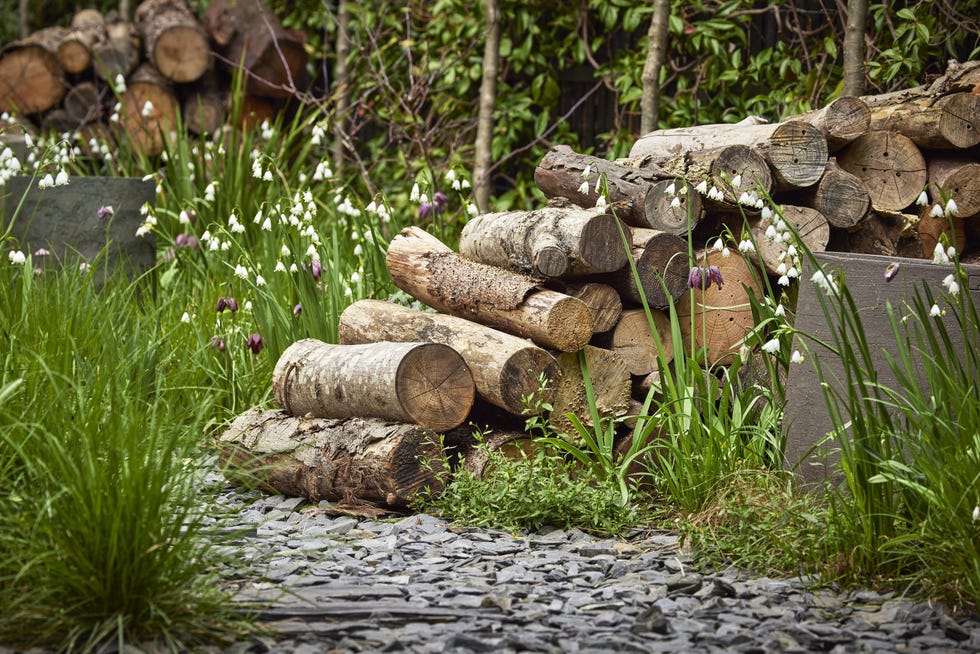
Eye-catching log ‘waves’ narrow the path at certain points, giving variety to the journey through the garden. A simple, cost-effective idea, the logs divide up the planting, partially obscuring the dining and lounge areas, as well as offering a habitat to wildlife. The moss and fungi growing on them are an attractive backdrop to other plants.
Alistair Thorpe
The new design
It was Stefano’s naturalistic, modern style that appealed to Gucheron and Peter, as well as his belief that ‘less is more’ – that hard landscaping should be kept to a minimum, with the only complexity being in the planting.
 Alistair Thorpe
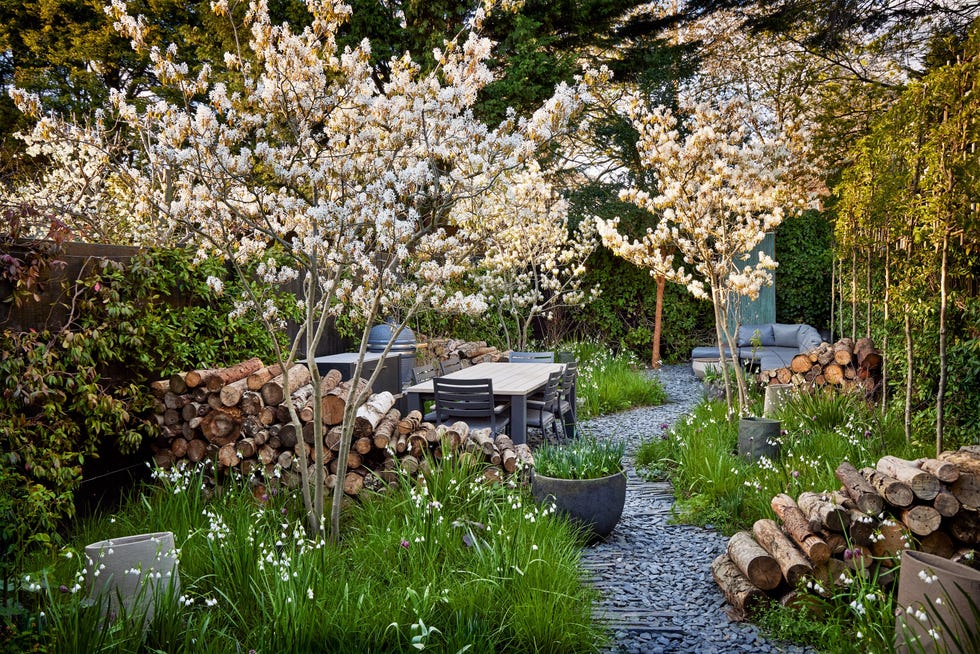
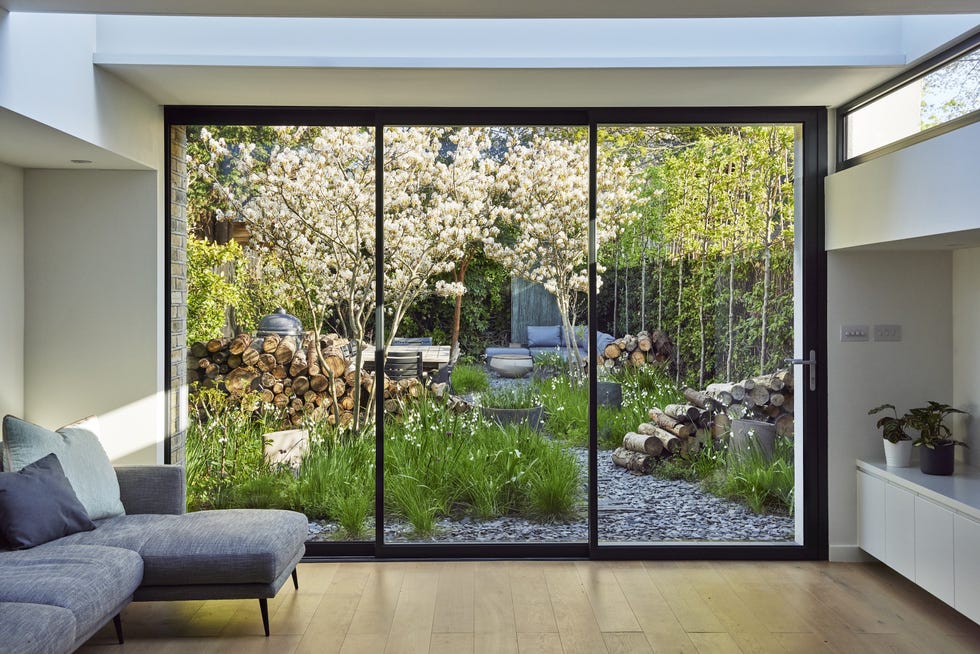
The garden has been designed so the planting is in the foreground rather than the furniture. Piles of logs, and amelanchier trees, help to screen the dining table and lounge chairs from the house
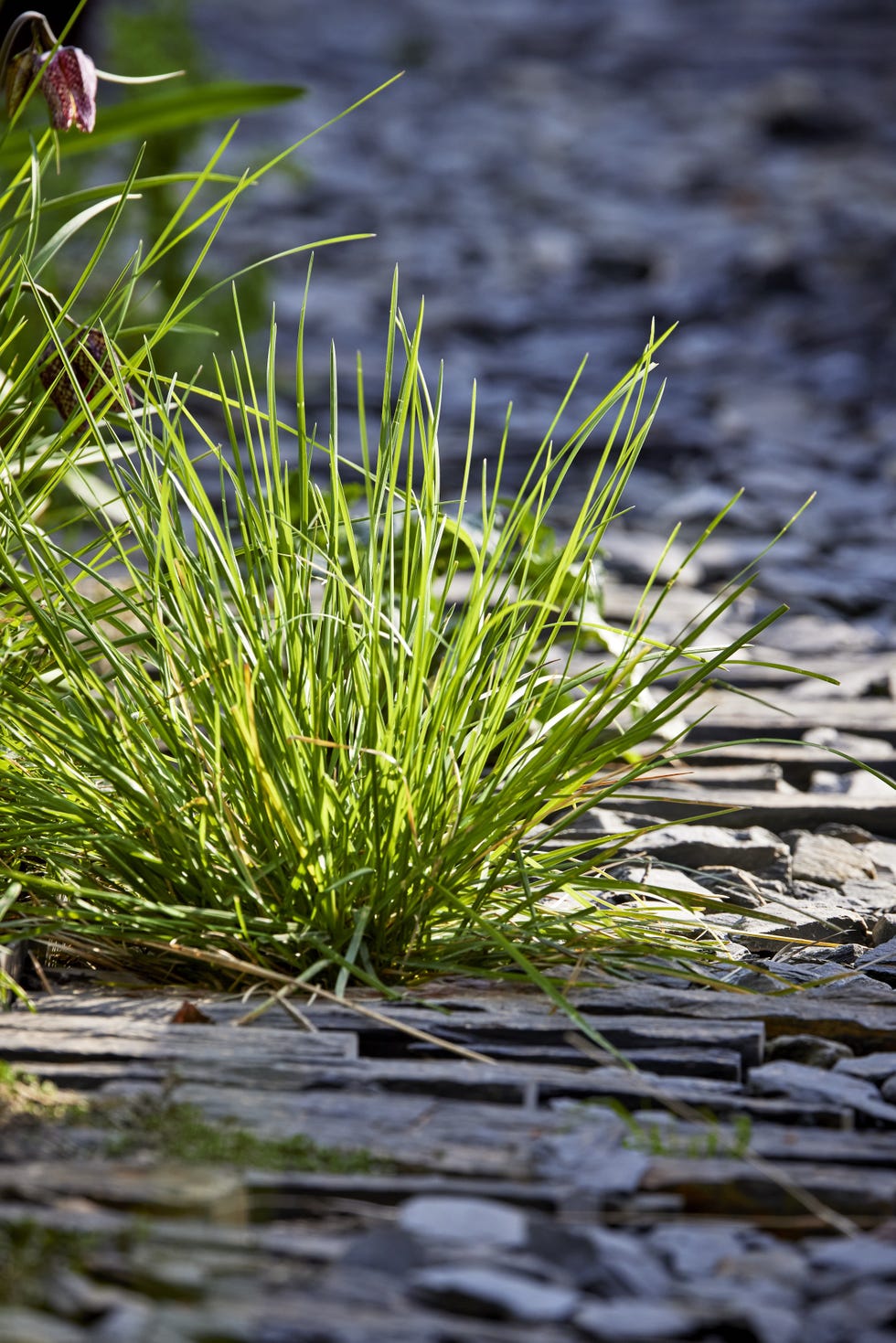
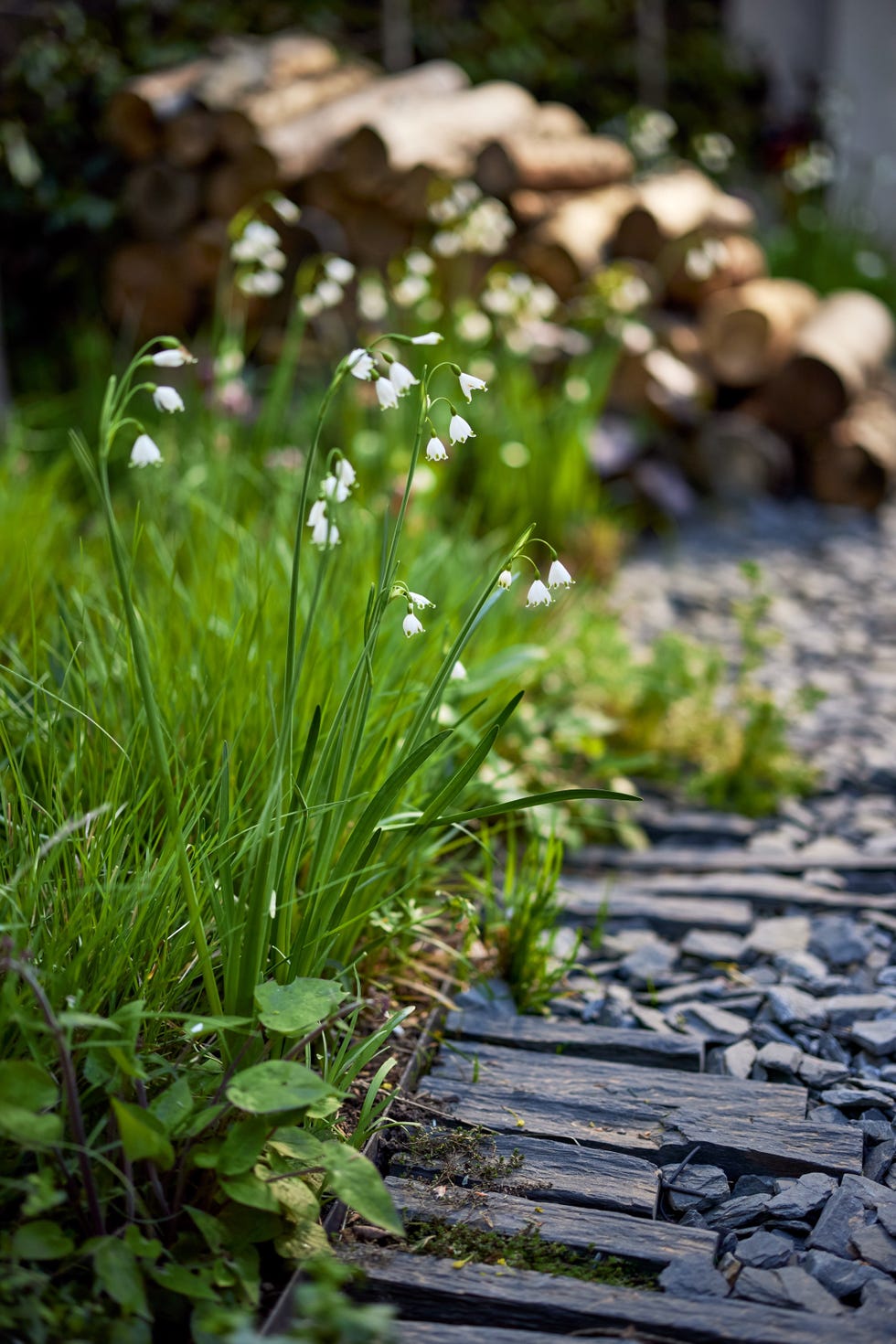
His use of slate in various forms illustrates this perfectly, with slate tiles forming the threshold from the house and additional chippings, and occasional planks inserted as markers, filling the path. Fences on either side are painted black, harmonising with the rock and emphasising the dense greenery, thereby encouraging the eye to focus on the planting.
 Alistair Thorpe
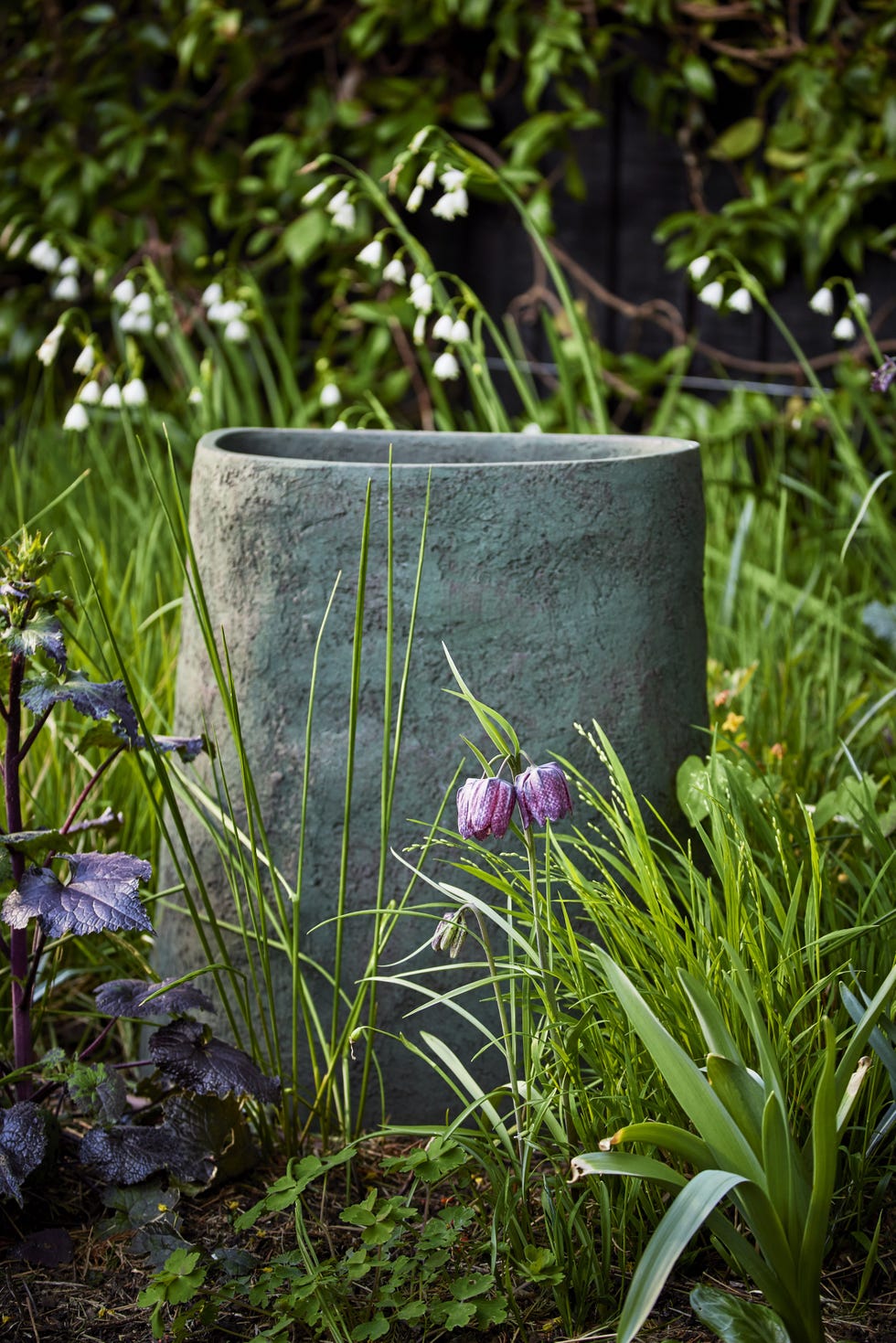
Looking back towards the house through the blossom-heavy branches of the amelanchiers. Individual pots are used as elements in the design
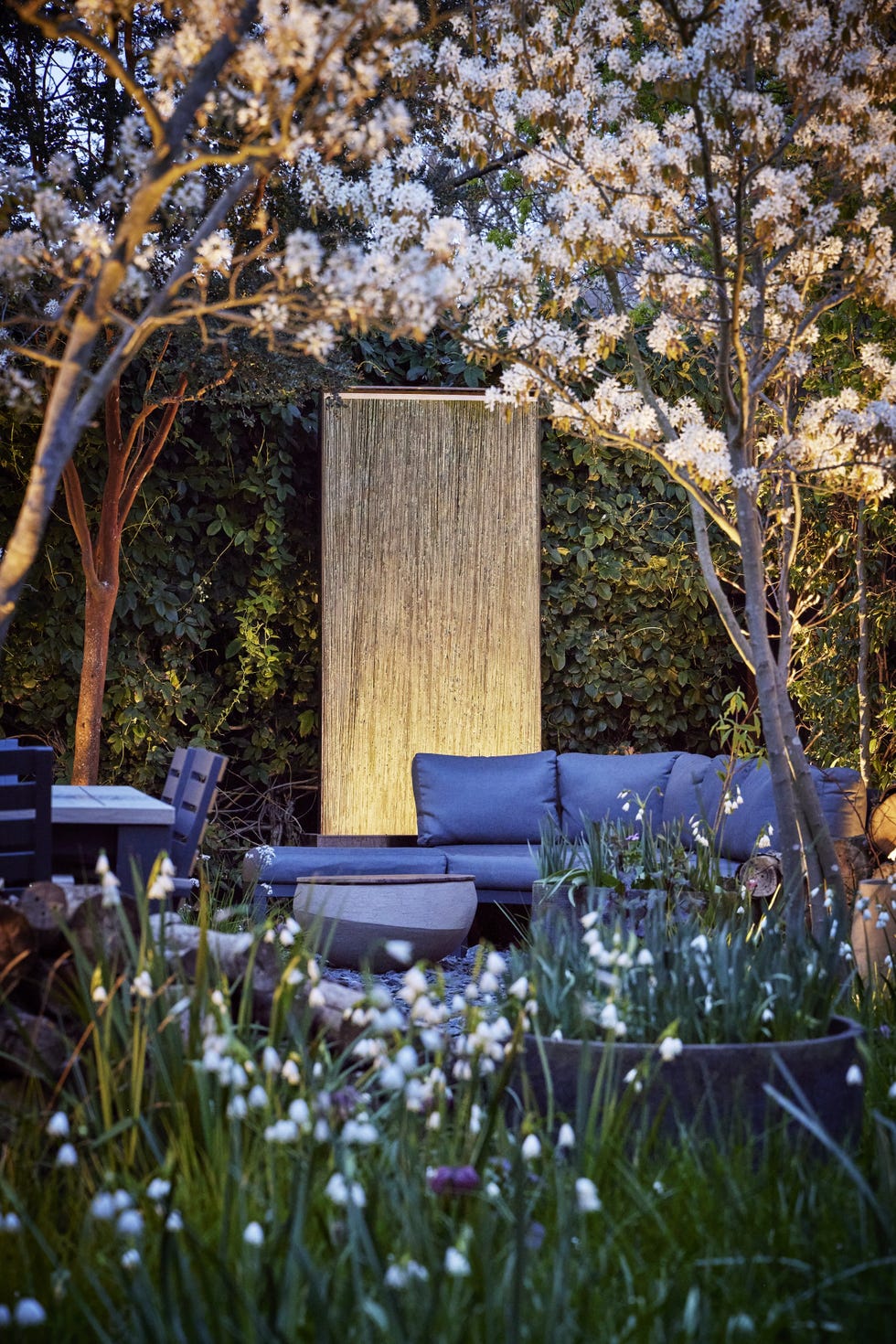
The garden’s focal point, and the winding path’s ultimate destination, is a water feature made from a raised moulded panel. With a pattern that resembles the slate, its bronze coating was turned bluey-grey by applying acid. Water cascading down the panel reflects the sunlight and the pleasing sound disguises traffic noise.
 Alistair Thorpe
The water feature turns into a pillar of gold when it is lit up after dark
The planting
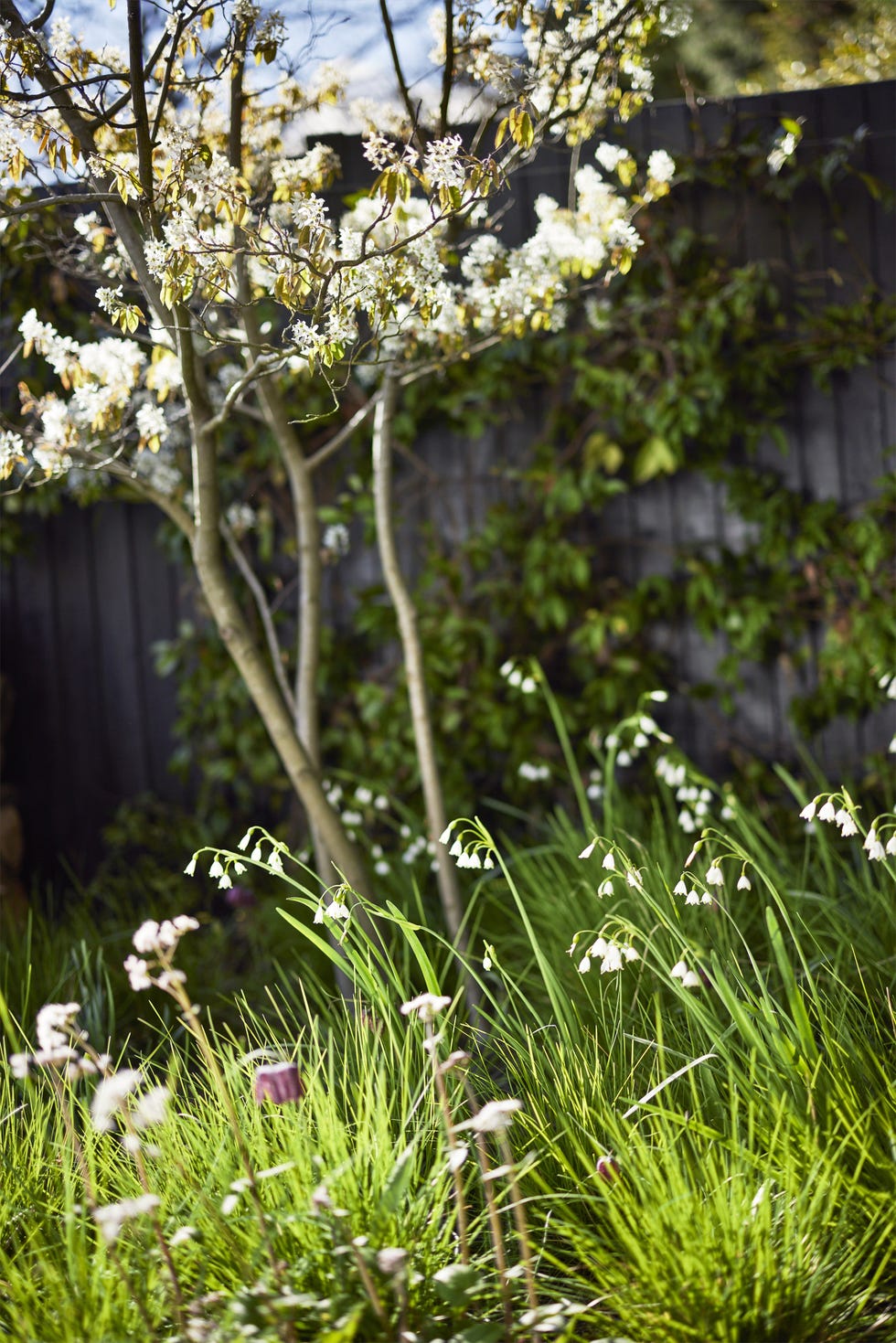
Multi-stemmed Amelanchier lamarckii, one on the right and two on the left, break up the length of the garden. They filter the view from the house and provide three seasons of interest: glorious blossom in early spring, summer berries for the birds and bright autumn colour.
Alistair Thorpe
Scented evergreens form the garden’s green perimeter with holboellia behind the water feature, and star jasmine (Trachelospermum jasminoides) climbing along both side fences. On the right of the garden, a screen of espaliered pear trees provides privacy – their blossom is part of a succession of spring flowers, and they’re cut back each year to maintain their structure and height of 2.3m.
 Alistair Thorpe
The evergreen climber holboellia
Evergreen grasses play a major role. Sesleria autumnalis, with lush, lime-green foliage in spring, thrives in the sunniest areas and in the slate path. Melica uniflora f. albida has rice-like flowers that emerge in late February among leucojum and gem-like fritillaries. The dark-purple stems of the early-flowering biennial Lunaria annua ‘Chedglow’ are a nice contrast in the predominantly green colour scheme. This, along with creeping thyme, valerian and cerinthe, is encouraged to self-seed and make itself at home in the cracks and crevices between the paving.
 Alistair Thorpe
Slate pieces of different thicknesses have been inserted into the path at intervals as an elegant design detail
The result
Gucheron and Peter are delighted with Stefano’s design, which works well for gatherings of family and friends. They held their daughter’s 16th birthday party in the garden, and on New Year’s Eve guests spilled out from the house, drawn out by the subtle lighting to cluster round the firepit.
 Alistair Thorpe
For the Mertons, the garden is an extension of their living space
‘The garden is a continuation of our living space with something of interest in every season,’ says Gucheron. Her young nieces and nephews love the adventure of exploring the twisting path. ‘They are quite safe,’ she says, ‘and the planting is so abundant that I am not at all worried about them damaging anything.’
Best of all, the garden attracts a wide range of wildlife. ‘We get birds, bees, insects – and frogs, even though we don’t have a pond!’
Stefano’s tips for creating winter interest
• Use a mix of evergreen grasses for a beautiful layered effect. Choose luzula for shade and sesleria for sunnier spots.
• Plant early-flowering perennials through the grasses, such as self-seeding aquilegia, as well as snowdrops and leucojum.
• One or two evergreen sarcococca bushes will give year-round interest in a limited space and scent in winter.
• Offering brightly coloured flowers and sweet fragrance, deciduous edgeworthia has lots of winter value.
• Large pots, dotted around the beds, can become sculptural elements when not much is in bloom.
Alistair Thorpe
See more of Stefano’s work at stefanomarinaz.com
Follow House Beautiful on Instagram, TikTok and Pinterest
Comments are closed.