
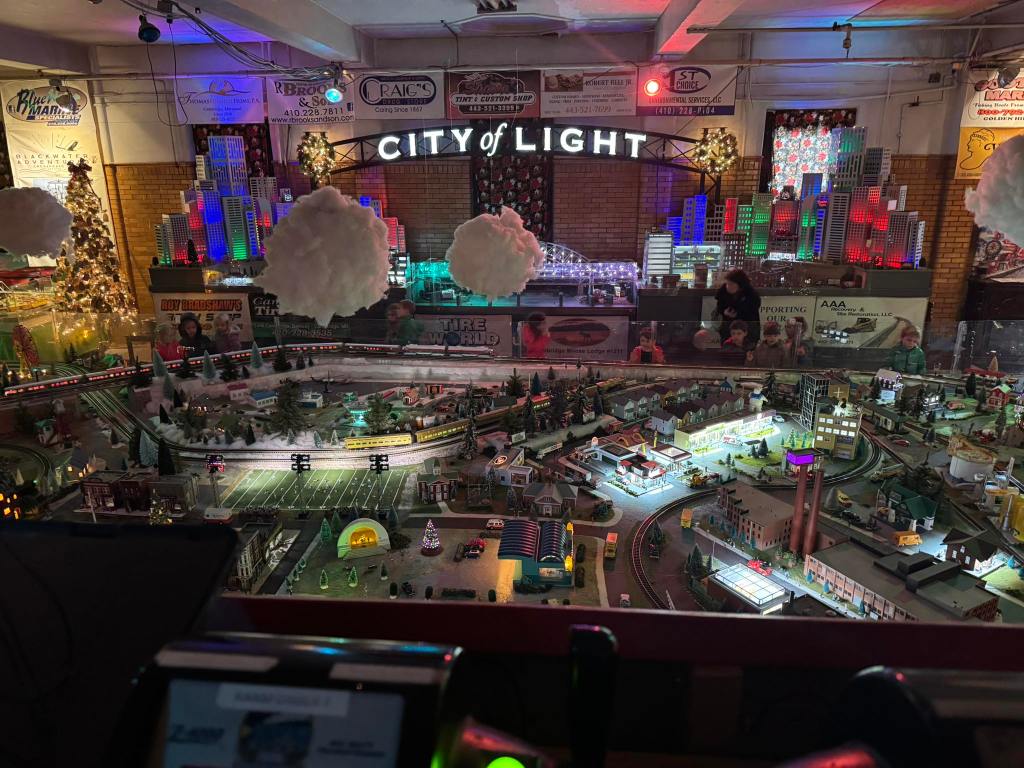
A dispute over Cambridge’s Rescue Fire Company Train Garden – a holiday tradition that dates back more than 90 years – erupted into a public feud last week after a city press release called for moving the historic display.
The RFC has operated the Train Garden for 91 years inside what residents still call Old City Hall – a landmark building on Gay Street that once housed RFC and city offices, and that has sat largely vacant for nearly two decades as Cambridge officials plan a long-awaited renovation.
Both sides were apparently working toward a compromise, but the conflict sharpened after the town released a statement that RFC officials said they were blindsided by.
“The Gay Street location was never planned as the permanent home for this display. As the renovation efforts begin, relocation of the exhibit is imperative,” the statement said.
The statement went on to say City Manager Glenn Steckman appreciated the historical significance of the train garden, and the city was working with RFC leadership “to preserve the 10s of thousands of dollars in trains and equipment that has been purchased by the Train Garden or donated by display by the public.”
“The goal of this collaboration is to secure a new home for the Train Garden,” the statement said.
RFC released its own statement accusing the city of moving ahead publicly without a final agreement.
“That release was issued without prior notice, consultation, or agreement with Rescue Fire Company,” the statement said.
The nonprofit said it submitted a formal proposal earlier this month and expected the issue to be addressed at the council level. RFC officials argued that any decision affecting the Train Garden should be handled in public and accused the city of undercutting negotiations. RFC said it will not accept a move, even temporarily.
“Rescue Fire Company’s position is clear and unwavering: the Train Garden will not be relocated from its original home. Relocation is not an acceptable outcome,” the statement said.
City manager weighs in
Steckman said the question is not whether the Train Garden should survive, but whether it can continue to occupy so much space in a building the city intends to renovate – and eventually reoccupy.
He said the Train Garden was once a seasonal setup that was assembled and then removed each year, and that it grew dramatically after city offices moved out.
“Up until 2008, it was put down and taken up every winter season,” Steckman said. “It was probably somewhere in the neighborhood of 300 square feet.”
Today, he said it’s ballooned into an 8,000 square-foot display taking up half the building – although RFC officials said that figure is overblown.
Steckman said the city is trying to rescue the town hall in phases, including roof work already completed, and asbestos mitigation needed before larger redevelopment can begin. The city’s long-term plan has been to return municipal offices to the building once it is renovated, in part because city operations are now split between an old police station and another building, complicating staff management.
Steckman said a compromise was floated to allow the Train Garden to remain temporarily in limited areas while asbestos work proceeds, with conditions designed to protect taxpayers from added costs.
Still, he said, construction would eventually require the Train Garden to move somewhere – even if only temporarily.
“We could work around them for a while, but, eventually, when construction starts, they’ve got to move someplace,” he said.
Steckman said he understands the cultural attachment – and that he does not want the Train Garden eliminated.
“I can promise you, I know the council, and I know me personally does not want to get rid of the train garden,” he said. “We just don’t know where it should be, whether it’s inside a portion of city hall when it’s finished. That’s a decision that the elected leadership has to make.”
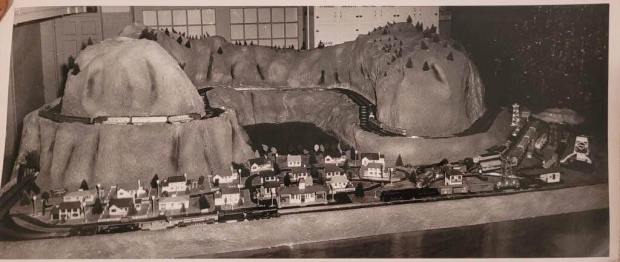 The original Rescue Fire Company Train Garden in Cambridge began more than 90 years ago inside Old City Hall, becoming one of Dorchester County’s most enduring holiday traditions. (Photo courtesy RFC)
RFC reacts
Andrew Bradshaw, the Train Garden chairperson and former Cambridge mayor, said he thought they had an agreement in place before the city issued a release suggesting otherwise.
Bradshaw has several issues with moving the display. He said the space they currently occupy tested negative for asbestos – but an alternate part of the building suggested by city officials tested positive.
“Until that’s remediated, we can’t have the public back there,” he said. “There’s no accessible entryway, there’s plywood over the windows, there’s no heat, no electric, no lighting, and open rafters ceiling … it would take a couple of years on its own to build that space out.”
Bradshaw said city officials greatly exaggerated claims the display had grown to 8,000 square feet.
“We occupy maybe a quarter of the first floor,” he said.
Bradshaw believes the way forward is to have future discussions during open public meetings.
“This is a hugely public-facing issue – as we saw when it blew up over the weekend,” he said. “We’ve asked repeatedly to present to the council or have a meeting where council members are present and been rebuffed by that. Ultimately, I think that this is something that needs to be handled in the more public sphere, and then we can each lay out our arguments and work toward them.”
Residents speak out
The dispute has drawn attention from state lawmakers, including Del. Tom Hutchinson, who said he has worked with the city for years to secure funding tied to the building’s design and renovation and believed there was a path that kept the Train Garden downtown.
“It has always been my understanding that the Rescue Fire Company Train Garden would need to temporarily relocate during the renovations, but would be welcomed back once renovations are completed, albeit it in a different location in the rear of the building, which once served as a livery stable over a century ago,” Hutchinson said. “The recent press release from the city seems to contradict that understanding and is concerning to me.”
“I am hopeful the Commissioners of Cambridge can resolve this dispute so that the train garden can remain a centerpiece of downtown Cambridge in the historic old fire house,” Hutchinson said. “It is a unique 91-year tradition that deserves the utmost respect and support from the community.”
For many residents, the Train Garden is not just a display – it’s a civic ritual that brings people downtown, packs restaurants, and creates memories.
“As someone who grew up around the firehouse, the RFC Train Garden means a lot to me,” resident Christina Brault said. “It is a place where you run into people you rarely see, a place where smiles abound on faces both young and old.
“Having it centered in the downtown brings people together and tourists to our community,” she said. “Right now, we all need joy where we can get it, and our community needs the train garden.”
Chris Brohawn, who operates several downtown businesses, said the Train Garden’s pull is real and removing it would gut a key piece of Cambridge’s holiday tradition.
“Besides the impact on tradition, the economic impact on our small downtown is intense,” Brohawn said. “Every year folks travel from all over to see the trains.
“To even consider removing this tradition is unfathomable,” he added.
Steckman said he’s hopeful for a compromise.
“I am still maintaining conversations with the RFC,” he said. “Actually, because of all the discussions, the train garden had the best attendance it’s had in years. So, if there is a little silver lining, it’s that.”
Have a news tip? Contact Josh Davis at jdavis@baltsun.com or on X as @JoshDavis4Shore.
Comments are closed.