
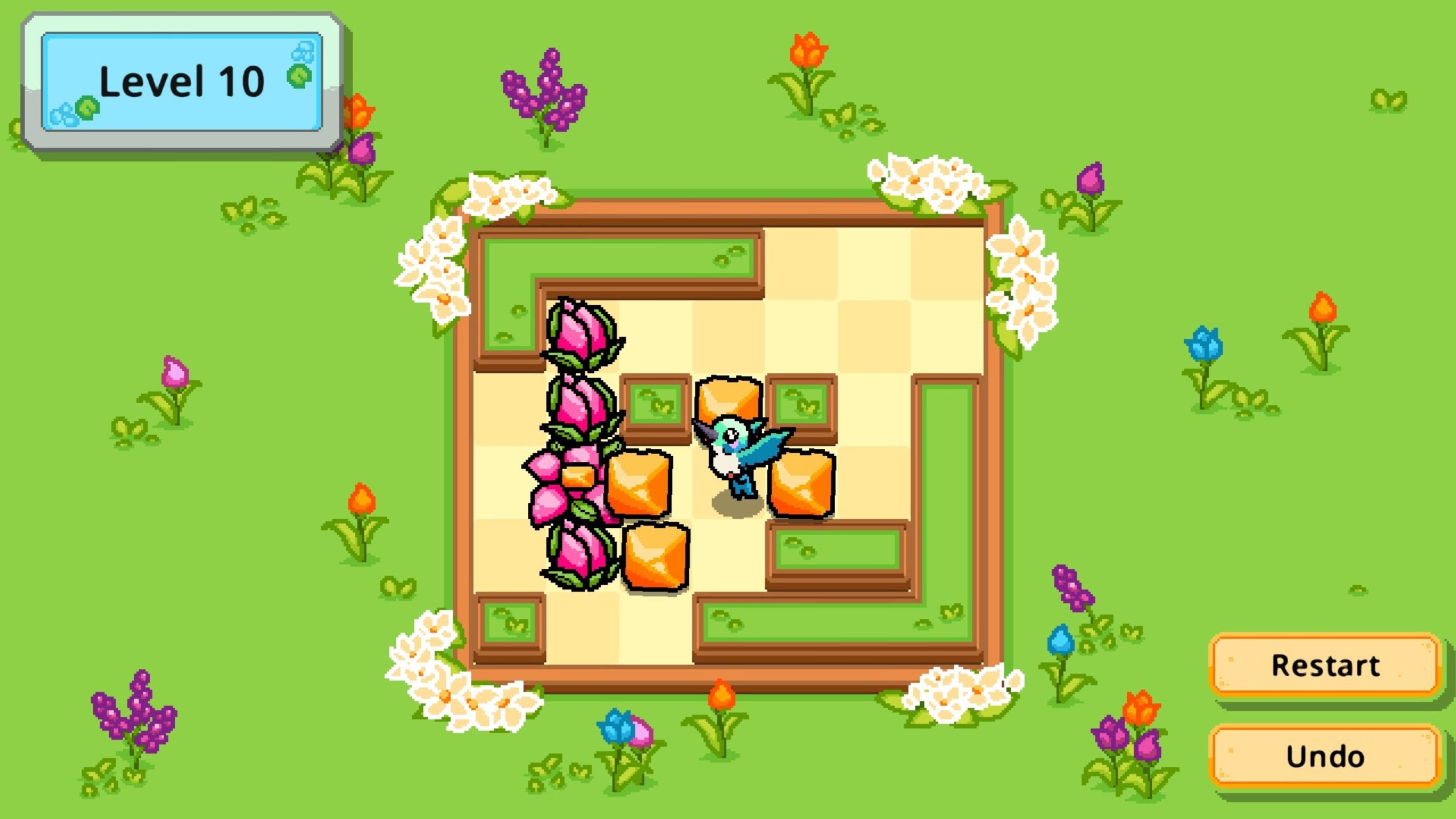
An Elegant Sokoban That’s Minimalist To A Fault
If I were to choose an animal to push a box around a grid, a hummingbird would not be high on the list. It’s got no upper body strength, no leverage. It’s a poor choice for manual labour. 2 out of 10. See me.
Oh alright, we haven’t played too many games that feature a hummingbird, so that’s original. Plus, everyone loves a hummingbird. The traditional crates can be replaced with nectar, and the goals swapped out for flowers. With a wave of the magic wand, we have a sokoban.
I imagine Afil Games go through a similar process when choosing their next sokoban games. They take a template – 30 puzzles, grids that you can fit on a screen, one to four ‘crates’ and one to four ‘goals’ – and determine how it will be presented. We have two Afil Games to review right now, and in gameplay terms, they bear uncanny resemblance to each other. But the difference is what they look like. This one has a hummingbird, and the other has a rock’n’roll mouse.
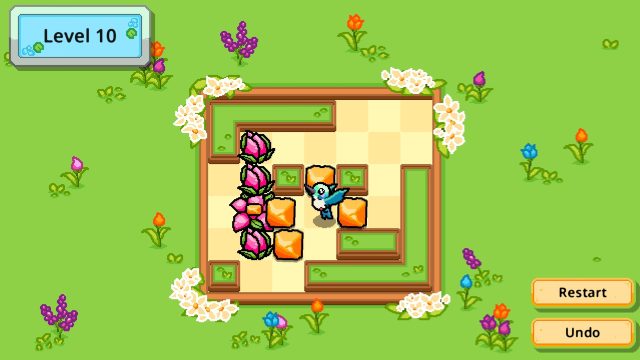 Ready to push some nectar around?
Going Soko Loco Down In Acapulco
That template-use is not necessarily a complaint. Afil Games know what they are doing. Sokoban, crate-pushing games have their fanbase (otherwise, why would we get them at a rate of about one every other week?) and the price is low. For less than £5, you get thirty puzzles, many of which are synapse-twistingly difficult, and they amount to an hour’s worth of play. Starting two very similar games in quick succession, all for less than a tenner, isn’t necessarily the end of the world.
For the uninitiated, a sokoban is a simple thing. You have a top-down grid and some boxes (or nectar, in this case). The boxes can only be pushed up, down, left and right, and you need to be behind the box to push it – which means giving yourself room to do so. There are goals to reach, and those goals are agnostic: it doesn’t matter which crate goes on which one, as long as the end of the puzzle has crates on each.
Hummingbirds With Real Teeth
It sounds easy, but the layout of each puzzle makes it intentionally difficult. It’s all too easy to push some nectar into a corner where it can never leave, or a wall where it can only be pushed in two directions. Two crates next to each other are dangerous, particularly if they’re also next to walls. And you need to ensure that your hummingbird doesn’t get trapped in a room it can’t leave. Yes, we know a hummingbird has wings, but abandon your reasoning for a moment.
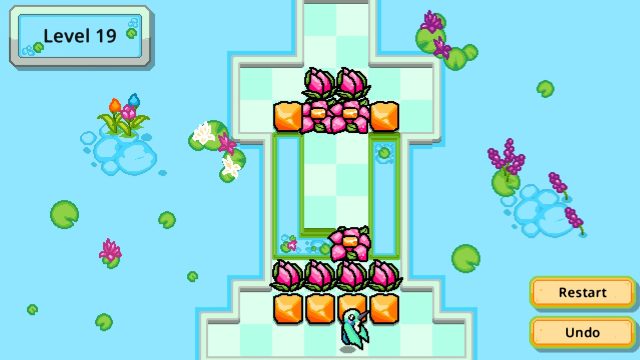 A no frills sokoban
There are no frills to Hummingbird Garden. The Afil sokobans sometimes dabble with an additional mechanic, but that’s not the case here. There’s no switch, move counter or teleportation portal in sight: it’s just your hummingbird and up to four nectar blobs to push around.
Perhaps the most noteworthy element of Hummingbird Garden is its degree of challenge. This is very much a wet-your-finger, stick-it-in-the-air situation, but my estimate is that this is the hardest of the Afil Games sokobans that I have played. I think I am on my fifth of their games now, and this had me stuck more than the others. At level 12 of 30, I was pulling clumps of hair out. On more than one occasion, I genuinely questioned whether there was a solution (when, of course, there was). Considering this is probably the most serenely themed of the sokoban games I have played, it’s a surprise.
The difficulty isn’t unearned, though. The puzzles here are – as we’ve come to expect from Afil Games – of a very high quality. They’ve often introduced a very specific problem to solve – a figure-eight loop, for example, or a wall of nectar that feels impossible to get on the other side of – and that makes the puzzles memorable, or as memorable as a sokoban puzzle can be. I’d love to know how these layouts are generated: is there someone in a backroom somewhere with some pencils and grid paper? Or is there enough basic maths involved that it can be partially automated? I’d love to know.
When You’ve Done One Sokoban…
The craft is top notch, but the feelings of staleness can’t be disregarded. There is nothing here, nothing at all, and that means that Hummingbird Garden blends into the other sokobans on Afil’s roster. When you can’t list a single thing – outside of a hummingbird – that differentiates it, that’s likely to generate feelings of fatigue. Of course, it’s only a problem for serial players of these games, but it can filter through to a first-time player too. Hummingbird Garden feels vanilla to play.
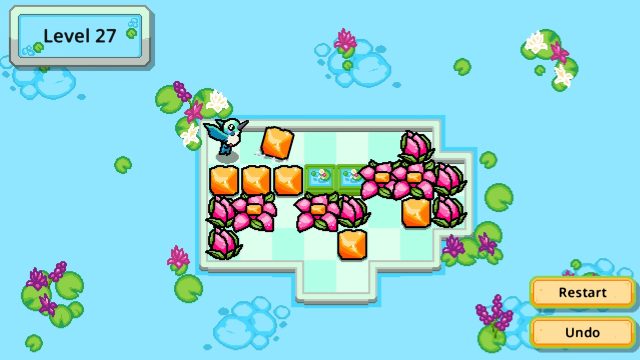 A fine ‘first Sokoban’
It’s hard to criticise Hummingbird Garden as an isolated game. The presentation, at least for a budget game, is elegant, and the puzzles have turned the dial towards super-challenging. It’s only when you fly up and look at all of the different sokoban games on Xbox that we get more critical. There’s nothing in Hummingbird Garden that makes it stand out from the crowd, and the mechanics are reasonably reductive.
If you’re in the market for a first sokoban, or don’t feel like you’ve hit a point of fatigue with sokoban games, then Hummingbird Garden is a fantastic choice. For anyone else, I’m less confident.
Important Links
Make Flowers Bloom In Hummingbird Garden On Xbox, PlayStation And PC – https://www.thexboxhub.com/make-flowers-bloom-in-hummingbird-garden-on-xbox-playstation-and-pc/
Buy from the Xbox Store, Optimised for Series X|S – https://www.xbox.com/en-gb/games/store/hummingbird-garden-xbox-series/9N3D9F46T1Q4
Or take home an Xbox One version – https://www.xbox.com/en-gb/games/store/hummingbird-garden-xbox-one/9P1FQLBMMXXQ/0010
Comments are closed.