
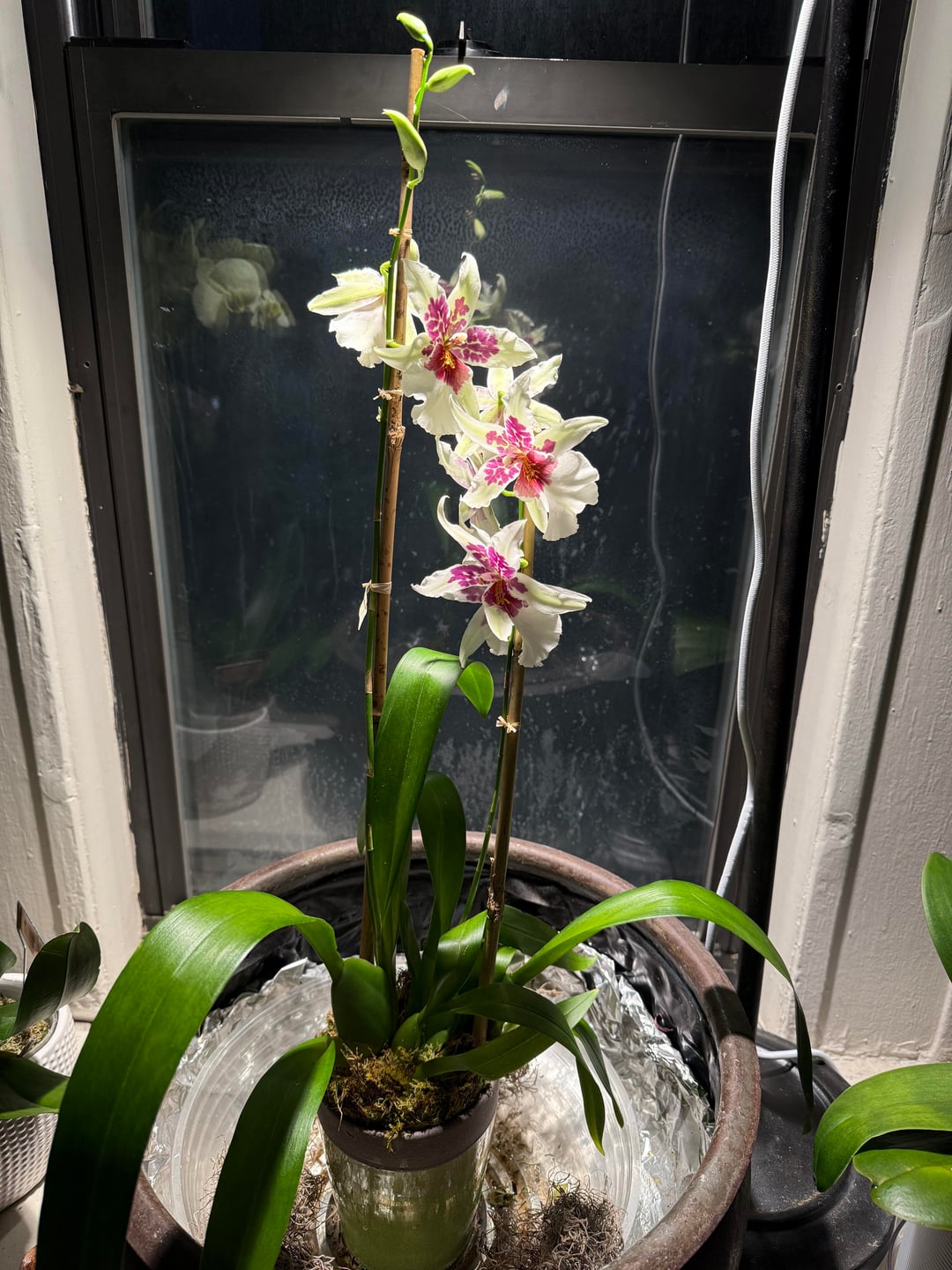
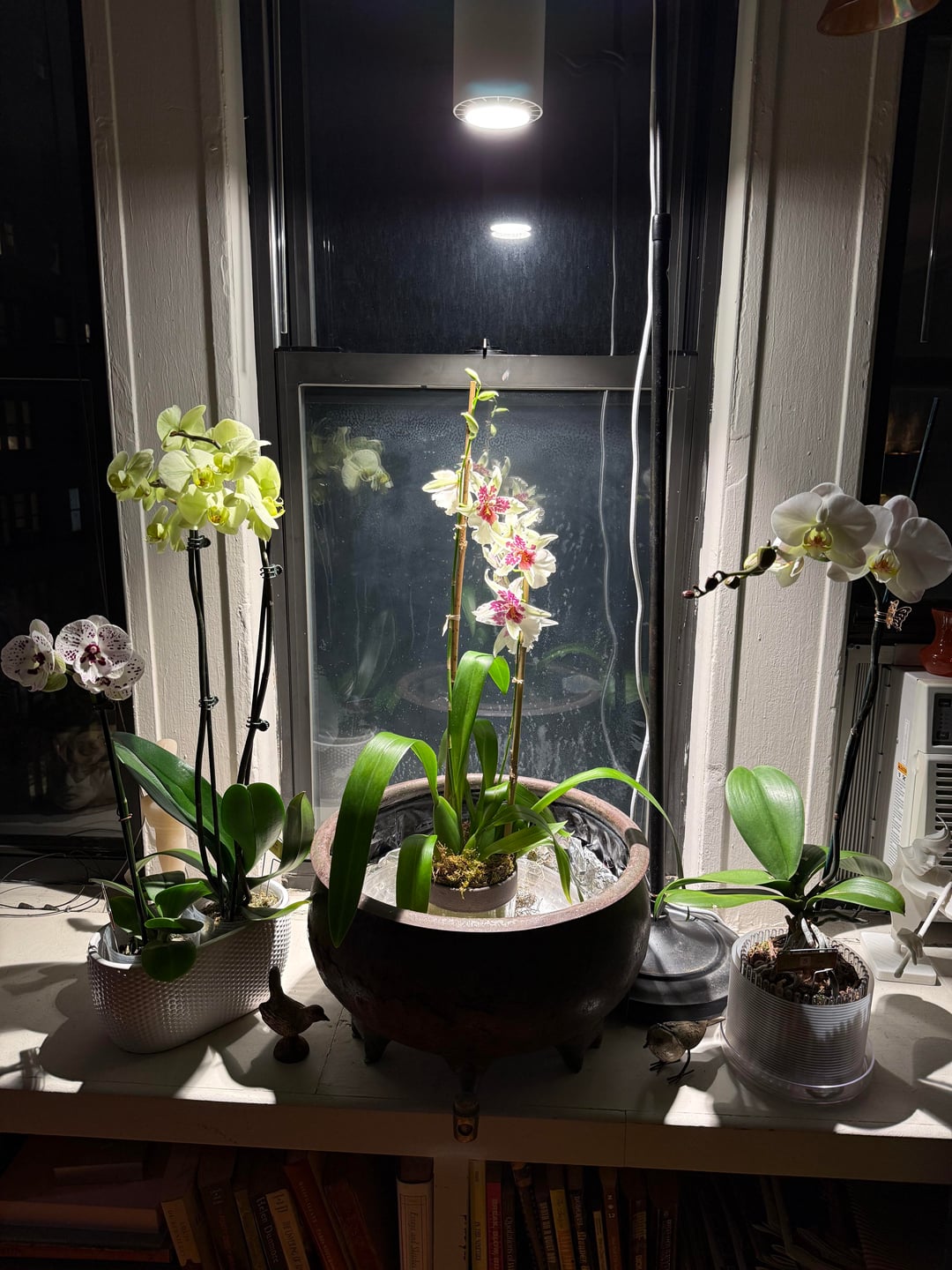
A dear friend who knows I love orchids gave me this Cymbidium for my birthday. My setup is perfect for phals, and I’m having great luck with them. But, according to Grok, I don’t have much of a chance of being as successful with this one. But it’s very beautiful, and I want to give it my best shot. I know it needs more light than the phals. As it happens, I just got a Soltech Aspect light for the living room to augment an east facing window that only gets light for a couple of hours in the morning before buildings block the sun. The stand for it is not arriving until next month, so I rigged something up for now. I could make it lower, but not higher.
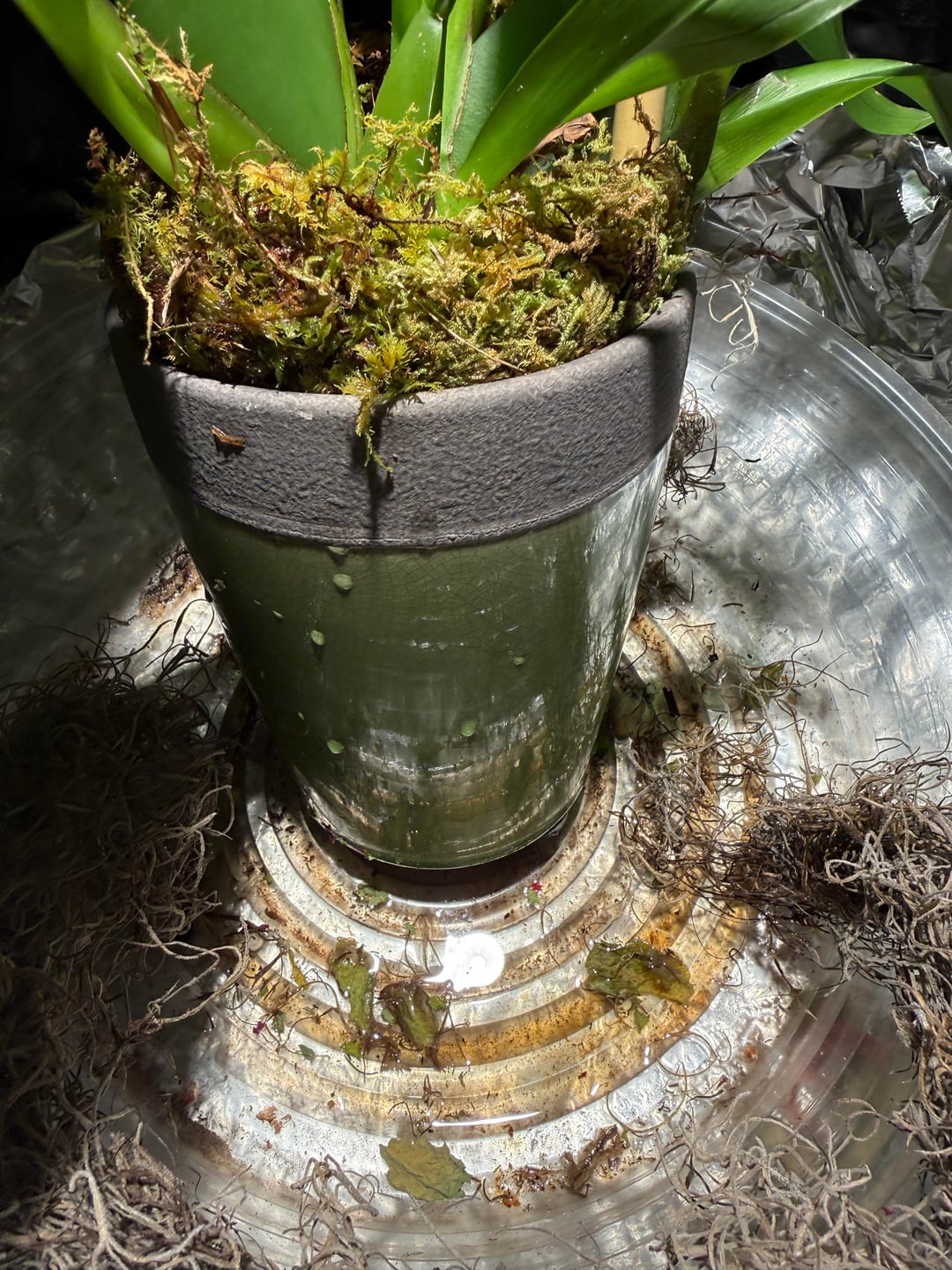
Grok also says not to repot Cymbidiums until after bloom, but I’m worried about this one. There’s some kind of plastic overlay that seals the bottom- It doesn’t slip off, I’ve tried. But maybe I could slit it with a box cutter and get it off that way. Would that give it enough drainage so it won’t rot? Or should I let it be? All suggestions gratefully received!
by FiddleBB
5 Comments
That’s an oncidium not a cymbidium (I used to get this confused as well!) and their care is similar to phals but they like to be more damp. It’s risky to repot when there isn’t new growth, so maybe just for now remove that moss on top that’s covering the bottom of the pseudobulbs, see what it’s potted in and water carefully when it’s mostly but not fully dry
That looks like an oncidium alliance, not a cymbidium. If the inside pot has a drainage hole, I would poke a corresponding hole through the plastic. If not, I would water sparingly till it has bloomed and then repot. I would also remove some of the moss on top so that it doesn’t rot as easily.
First advice is stop going to Grok for advice on orchids, that’s not a cymbidium. It’s something in the oncidium family. AI is really terrible at finding specific information about specialized topics like this.
Most stuff in the oncidium family are best repotted when you see new roots developing from a new growth. Most are okay at room temperature and like to be watered before they’re completely dry. One of the easier orchids; I’d consider them beginner orchids.
As others have said, that’s an Oncidium alliance intergeneric. I believe that is a Schunkeara Big Shot “Hilo Sparkle”.
These are great plants, and a little more challenging to grow than Phals, but not terribly different. They like to have more even moisture , and prefer a finer grained medium, but still need wet and dry cycles, like any epiphyte. The key on these is to observe the pseudobulbs, the big, green swollen bases among the leaves. As soon as these show any slight shrinkage or wrinkling, give a good, thorough soak. Make sure all the water can drain away. If that pot has no drainage, either drill some holes, or water the plant completely, let sit a few minutes, and then tip out the water, restraining the medium with your hand. I’ve grown orchids in containers with no drainage and used this method. It’s a bit of a pain, but works. The roots will do well if they have open, airy media that is not flooded which can be periodically wetted, and it really doesn’t matter whether the water goes in the top and out the bottom, or in the top and right back out the top. But, it is a lot easier if you’ve got drainage holes.
Unlike the monopodial growth of Phalaenopsis, where all leaves come from a single point and flower stalks grow off this, Oncidium alliance plants have what is called sympodial growth, where the stem buds off new section, each with leaves and flowers, and then produces a new stem segment off the old stem. The pseudobulbs are modified stems that act as storage organs, so the usual growth on these is a pseudobulb with basal leaves and some apical leaves, with a flower stalk coming out from between the basal leaves, then once that is done, one or more new pseudobulbs sprout from the base. The old pseudobulb will not bloom again or produce more leaves, and steps back into a support role, storing nutrients and water to support new growth. Each new pseudobulb will establish roots, and once mature, will bloom, then sprout more from the edges, and continue on like so. Periodically, they can be divided and the withered, aged, failing pseudobulbs removed.
It’s a very different growth habit from Phalaenopsis, but light and temperature requirements are similar, just with a little more frequent watering.
Stop asking language models technical questions. It is not a general knowledge machine. It is advanced mad libs. There are plenty of websites with good orchid care recommendations. Start in the wiki for this subreddit.