
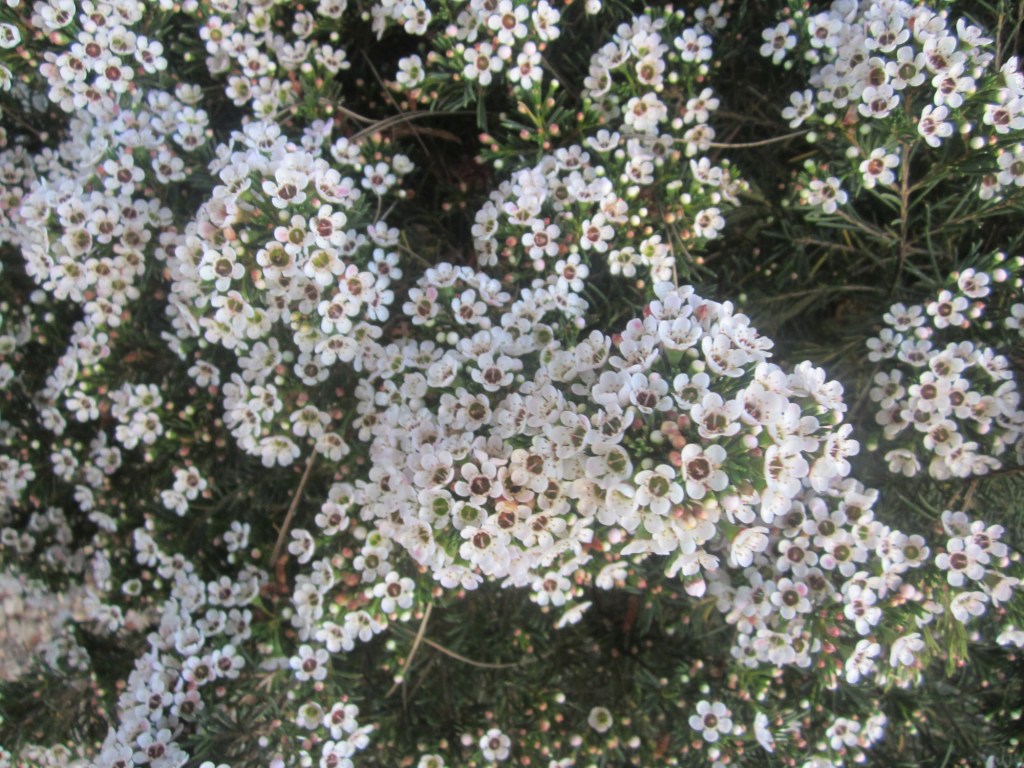
Foliage of some of the most common garden ornamentals will last up to a year or more in dry arrangements. It’s a wonderful bonus that comes along with planting these species.
Euonymus and Pittosporum are old reliables when it comes to broadleaf evergreen shrubs. Euonymous has dozens of cultivars, growing from two to 12 feet tall, all with leathery leaves, and many with green and gold or green and white variegations.
Pittosporum tobira is available in both solid green and variegated (grayish-green and cream-colored foliage) versions. Pittosporum is excellent for both full sun and shady locations, although if you want it to flower at maximum capacity, it must be grown in the sun. Commonly known as mock orange, if you refrain from pruning and just let it grow, it will be covered with sweet-smelling, dull yellow blooms whose fragrance rivals that of orange blossoms.
Butcher’s broom (Ruscus aculeata) provides fascinating faux foliage for dry bouquets. Not possessed of true leaves, flattened leaflike cladophylls decorate its stems. From the center of these cladophylls, flowers emerge and eventually develop into marble-sized red fruit. Butcher’s broom is among the most shade-tolerant plants and is exceptionally drought-tolerant. It also proliferates in any kind of soil, spreading through rhizomes. Its name derives from bundles of its tough stems, which were used in Europe by butchers to remove meat and fat from wooden chopping blocks. We now know that cells in this plant contain antibacterial compounds, which may have helped keep meat fresh after it was butchered on wood, broomed, and scrubbed with Ruscus stems.
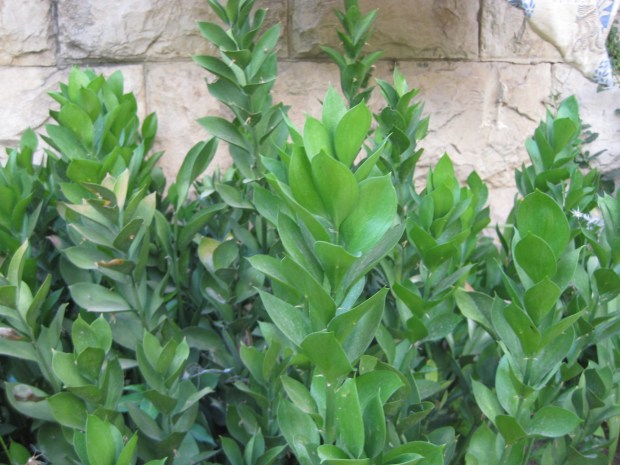 Butcher’s broom (Ruscus aculeatus) is shade-loving and useful in dry bouquets and vase arrangements. (Photo by Joshua Siskin)
Cast-iron plant (Aspidistra elatior) is another rhizomatous species that prefers shade. Its curvaceous leaves reach up to two feet in length and are glossy, dark green, and long-lasting when cut. Cast-iron plant, while remarkably cold and drought-tolerant, is highly suitable as an indoor plant as well. A cultivar with white foliar stripes is also available. Although rarely encountered, Aspidistra flowers grow at the base of the plant and are pollinated by fungus gnats, those nuisance insects that inhabit potting soil past its expiration date. If you see fungus gnats hovering around your potted plant, you will want to change its soil — unless it’s an Aspidistra. Otherwise, you can trap these pesky intruders in a shallow bowl of vinegar.
Now we come to Asparagus, a genus whose every species has distinctive foliage that will last for many months in a vase. Let’s start with the edible species, Asparagus officinalis. After you harvest its spears for their richness in Vitamin A, you will witness a spate of feathery growth emerge from the ground; cut it for decorative table arrangements. Myers’ asparagus (Asparagus densiflorus var. Myersii) is sometimes called foxtail fern due to its soft, surrogate leaves known as cladodes, each of which resembles a bushy, vulpine rear appendage. Asparagus retrofractus has large foamy sprays of foliage.
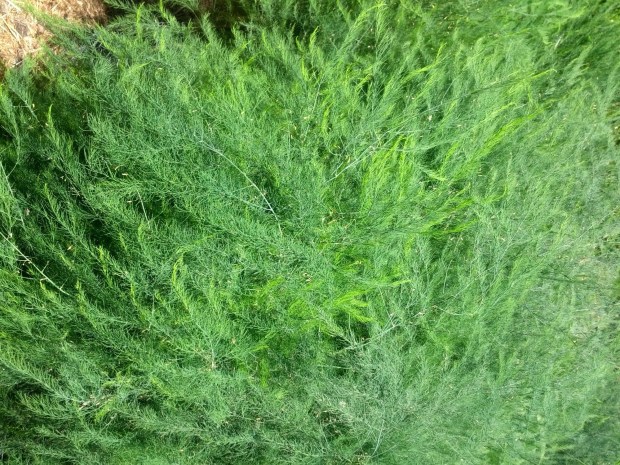 After asparagus spears are harvested, utilize subsequent foliar growth for ornamental purposes. (Photo by Joshua Siskin)
All asparagus species are virtually indestructible owing to their rhizomes, and two of them, although popular in dry arrangements, can become weedy in the garden. Fern asparagus (Asparagus setaceus) is a vining plant with the softest, laciest leaves that you will ever see. However, like most other ornamental asparagus, it has tiny thorns that require caution when handling. There are two areas in my garden where fern asparagus has been growing for more than four decades, having first spouted from seeds that had been deposited, no doubt, by birds. The other potentially weedy species is Sprenger’s asparagus (Asparagus aethiopicus). The billowy growth is difficult to resist, but it’s best to confine this species to a container or hanging basket. It is extremely aggressive in the garden, smothering and strangling any plants nearby, and its fruit is toxic to cats and dogs.
Stems bearing round, silvery-blue eucalyptus leaves are classic additions to dried arrangements. Such leaves are taken from four species of eucalyptus: spinning gum (Eucalyptus perriniana), silver dollar gum (Eucalyptus polyanthemos), silver mountain gum (Eucalyptus pulverulenta), and silver dollar tree (Eucalyptus cinerea). If you procure one of the first three species just listed, you must keep it in a juvenile state — which means constantly cutting it back and keeping it only a few feet tall — for continual production of the desired leaves. Once they reach maturity and begin to flower, their leaves assume a sickle shape and lose their decorative appeal. For continual production of round leaves even when the tree reaches maturity, plant Eucalyptus cinerea.
I recently wrote about loquats and received the following reminiscences from Mr. Paul Parque in response: “My parents built their home in the 1930s in the city of Bell Gardens. They planted four loquat trees along with a variety of other fruit trees and a raspberry bush. My mother had to sell the house that she built with my dad in 2004 to move to an assisted living place, but till the day she moved out, I would go over to the house that I was born in and pick those loquats until I got sick! I liked them both when they were just yellow and sour and when they turned sweet orange. I used to squeeze them so those big brown seeds would pop out onto the ground. My family used to sit around a 12-inch black and white television in the early 1950s and me and my two brothers would each have a bowl of that fruit. I am now 81 years old and live in Canyon Lake (near Lake Elsinore). There is a house nearby that has a loquat tree right by the curb of the street. When my wife and I take a walk, and I see the fruit starting to turn colors, I pick a few and remember my childhood.”
If you have reminiscences of a tree, a flower, or a plant of any kind from your past, you are invited to send them to joshua@perfectplants.com. Your questions and comments, as well as gardening conundrums and successes, are always welcome.
Comments are closed.