
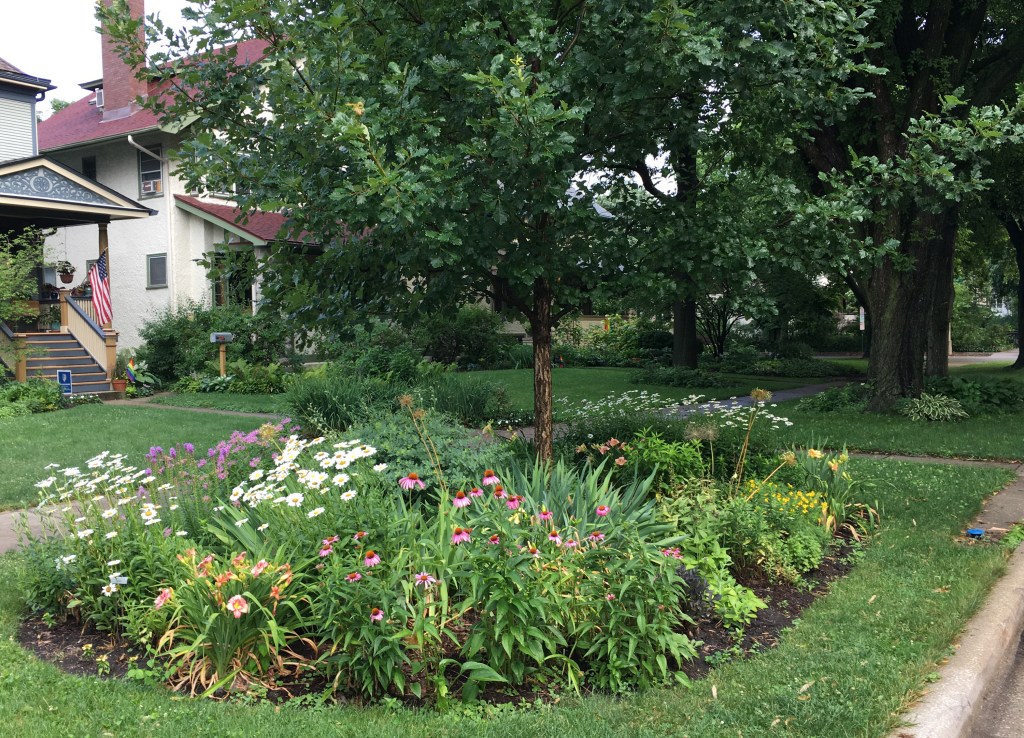
To many people, especially in cities, the parkway — the space between the sidewalk and the street — looks like an obvious place to plant something. But gardening in the parkway is a bit more complicated than digging up your own yard.
“For one thing, it’s not your property,” said Sharon Yiesla, plant knowledge specialist in the Plant Clinic at The Morton Arboretum in Lisle. The parkway is also an especially tough environment for many plants. And in most cases, something is already growing there: If there’s a tree within 20 or 30 feet, it needs the parkway space for its roots.
Here are some things to think about before you plan a parkway garden.
The city or village owns it.
Although the parkway may feel like an extension of your front yard, it’s public property. Anything you plant there can be dug up at any time without notice. Some municipalities require an official permit to plant in a parkway. The same is true in subdivisions without sidewalks, where a strip of each front yard nearest the street is a municipally-owned utility easement.
It’s full of underground utility lines.
The parkway’s main purpose is to accommodate the water and sewer connections to your house. It also contains pipes for natural gas and often phone and internet lines. Any of these utilities can be damaged with a shovel if you dig in the wrong place, with potentially devastating consequences.
Before you make any gardening plans, call to have the utility lines located and flagged so you can avoid them. In the city or suburbs, simply call 811. Allow several days for technicians to come and locate the lines.
Plants will have a tough life.
The soil of a parkway is usually compacted by foot traffic, making it too dense for water and air to percolate down to plant roots. Cars pass constantly, spewing exhaust particles onto the leaves and the soil. In winter, when snowy streets are treated with road salt, the plants will be splashed with salty spray that can dry out their roots. Dogs and cats leave other deposits. “It’s not a good place to grow food plants,” Yiesla said.
A parkway is surrounded by concrete, which is likely to leach lime into the soil and make it alkaline. Only some plants can tolerate alkaline soil.
If the space is sunny, it’s likely to be hot and dry. If there are trees, they will shade other plants in the parkway, and their leaves will intercept much of the rain that falls. Only plants suited for dry shade will be able to survive there. Since a parkway has so little soil area to absorb rainfall, you will likely need to water any plants there extra often.
Street trees need the space.
The trees along your street give your community beauty, shade, and many other benefits and are worth protecting and preserving. The small parkway rectangle is sometimes all the space their roots have, and those roots are easily damaged. Most of a tree’s roots are within a foot of the soil surface, and if they’re crowded into a parkway, they may be even shallower. “Any time you dig a hole to plant something, you will be cutting tree roots,” Yiesla said. “Make your street’s trees a higher priority than other plants.”
Use small plants.
Digging big holes to plant large perennials or shrubs will cut lots of tree roots. In a parkway, use small, young plants so you only have to dig small holes. Many plants, such as ground covers, will spread and eventually fill in.
Choose long-lived species.
To avoid repeatedly digging, select plants that are suited to the conditions and are rugged and long-lasting so you won’t need to replace them. Use only perennials, long-lived bulbs or small shrubs. Do not plant annual flowers, which would require digging and cutting tree roots every year.
Do not make a planter around a tree.
Using pavers or stones to build up a soil-filled planter around a tree’s trunk is seriously damaging to the tree. “You’ll be smothering it by piling soil so deep that its roots can’t get oxygen,” Yiesla said. “The soil will trap moisture against the bark and invite rot and disease.”
Consider containers.
You can get around many of the issues with parkway gardening by using large containers rather than planting in the ground. “By using potting mix, you avoid the soil problems,” she said. You won’t damage tree roots or threaten utility lines by digging. Dogs aren’t likely to make deposits inside a tall pot. Containers will need frequent watering, so set each pot up on bricks or pot feet to allow surplus water to drain away from your plants’ roots.
For tree and plant advice, see the online resources of The Morton Arboretum at mortonarb.org/plant-care, or submit your questions online at mortonarb.org/plant-clinic or by email to plantclinic@mortonarb.org. Beth Botts is a staff writer at the Arboretum.
Comments are closed.