
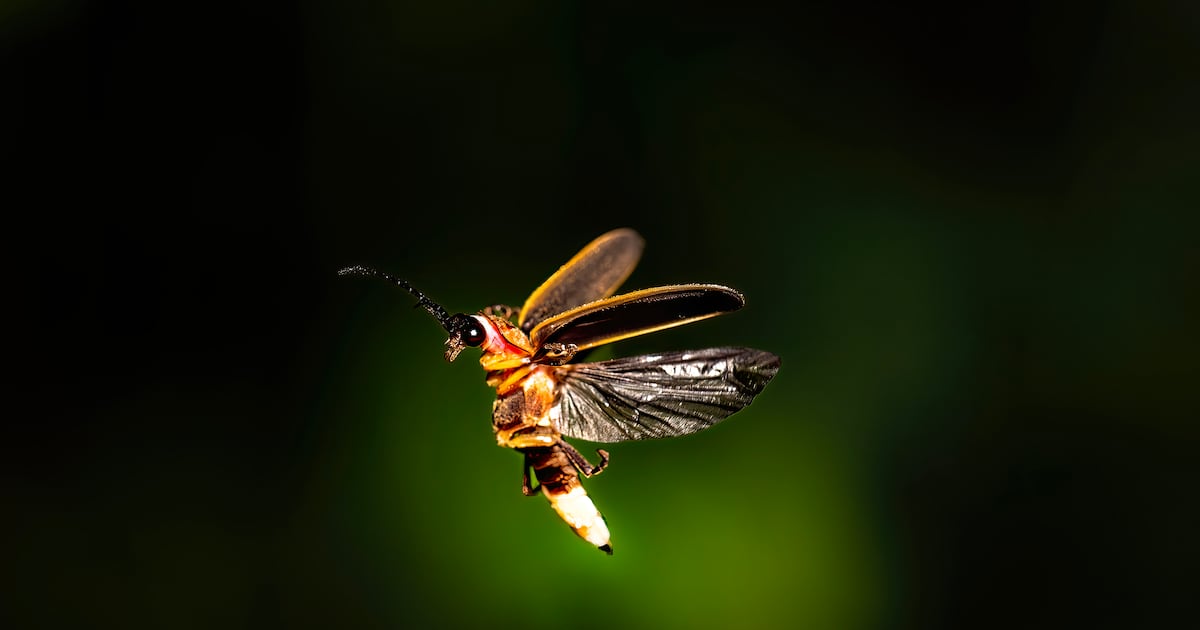
Most gardeners, presented with a quarter-acre pocket of arable land with which to do exactly as they wish, would almost certainly fill it with plants. Not Adam Hunt. Having recently acquired one small corner of a field next to his cottage in Somerset in the south of England, this award-winning garden designer is instead using it to create a habitat for glow worms.
These bioluminescent beetles are also known as fireflies, and their nocturnal mating habits are distinguished by the adult female glow worms’ near-magical ability to give off a strange, otherworldly green glow at night to attract a mate. They are native to all of Europe except Ireland (such a shame), but they’re in steep decline in the UK, their populations increasingly fragmented as a result of habitat loss, climate change, light pollution and the widespread use of pesticides.
By his own admission, Hunt’s plan has presented him with what some would consider a horticultural paradox. The glow worm larvae’s primary food source is slugs and snails, both of which it needs to eat in vast quantities if it’s to reach adulthood. So, to encourage the former, Hunt must first encourage large populations of the latter, the mere thought of which would send shudders down the spines of many seasoned gardeners.
But again, not Hunt. As a lifelong naturalist, qualified entomologist and half of the British landscape design team known as Urquhart & Hunt, he’s always been fascinated by what he describes as the “nonhuman beings” that are such a key part of the natural world and fundamental to its health.
“We’re traditionally taught to think of a garden in terms of its plants, but this ignores all the other things that contribute to our enjoyment of it. That might the sound of birdsong, for example, or the sight of butterflies visiting a patch of wildflowers.”
Our enjoyment aside, this kind of biodiversity, Hunt points out, is a sign of healthy habitats. But especially insect life. “Ask any rewilder and they’ll tell you that it’s all about the insects,” he says, referring to the “rewilding” movement where the aim is to nurture a sort of self-sustaining ecological balance where nature takes the lead.
Hunt’s deep-rooted respect for nature is also the driving force behind the thriving landscape design studio that he established with British designer Lulu Urquhart in 2007. Together they’re responsible for the memorable show garden, A Rewilding Britain Landscape, which won gold and best in show at the RHS Chelsea Flower Show in 2022. Supremely naturalistic, at its heart was a reconstructed beaver “hide” and beaver dam, highlighting the potential role that the recent reintroduction of this mammal to Britain can play as a low-cost eco-engineering solution to the problem of flash flooding.
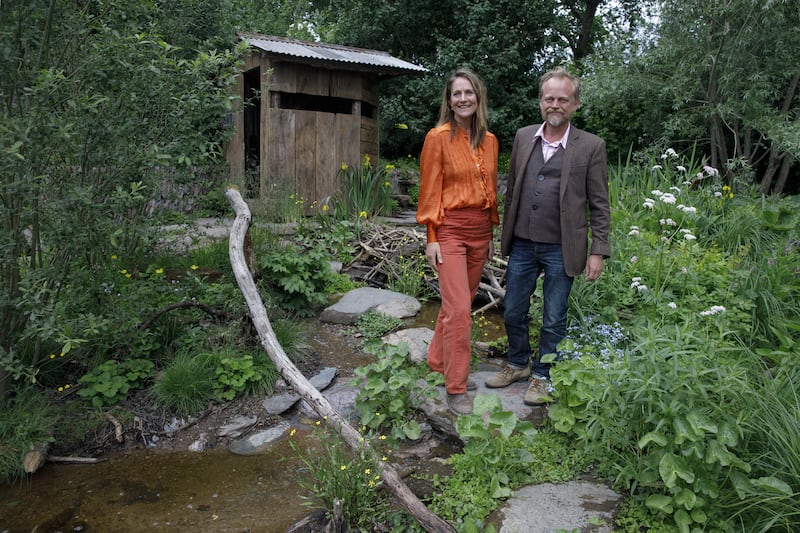 Best-in-show garden designers Lulu Urquhart and Adam Hunt posing in their garden Rewilding Great Britain Landscape at the RHS Chelsea Flower Show. Photograph: Luke Macgregor/PA
Hunt stresses that this isn’t purely theoretical. As a keen kitchen gardener with a deep interest in the development of what he describes as “a strong food production policy”, he’s talked to British farmers with beaver dams on or close to their land who have confirmed these industrious mammal’s role as landscape engineers mitigating the effects of extreme flooding.
While the beaver wasn’t ever native to Ireland, does Hunt believe there’s a convincing argument to be made for its introduction to this country? He’s far too discreet to say, but a growing number of environmentalists support it as a supremely practical, low-cost alternative to hard engineering solutions.
That same nature-first approach to garden design is winning Urquhart & Hunt an increasingly appreciative clientele, leading to large design projects in the UK, Italy and France as well as here in Ireland. These include a 70-acre Georgian garden and parkland restoration in the Cotswolds; a 10-acre public garden, Giordina Pistola in Puglia in southern Italy, designed as a series of drought-resilient terraces; and a collaboration with the esteemed Dutch garden designer Piet Oudolf on the gardens of the Hauser & Wirth Art Gallery in Somerset.
Underscoring his Irish connection is the fact that Hunt’s long-term partner is the Cork-based garden designer Valerie Keating Bond. Together they share a deep reverence for the natural world and an understanding of its fragility, and frequently collaborate professionally. One of Hunt’s favourite projects is the gardens of Marymount Hospice in Cork, on which the couple worked together alongside landscaper Colm Cronin, reinventing its old, silted-up ponds and creating a wildflower meadow as well as a garden of remembrance and garden of reflection.
For Irish gardeners wondering about ways to usefully scale down this nature-led design ethos so that it’s easily applicable to the average-sized, private garden, Hunt offers plenty of practical suggestions.
“Firstly, try to ensure that your garden boundaries are permeable to birds and mammals. This means hedges, rather than walls. Letting faded plants stand over winter rather than tidying and cutting them back will also provide valuable wildlife habitats. So will leaving some wild or “messy” corners where nature can establish a foothold. And of course, avoiding the use of insecticides and other environmentally harmful garden chemicals.”
As one of the speakers at The Interconnection of All Things, the Garden & Landscape Designers Association’s annual seminar, which takes place next week in Dublin, Hunt and his business partner Lulu Urquhart will be talking about their vision of the garden as “a living dialogue between the natural and the cultivated world”. For Hunt, that connection is everything. “Look at it like this. Viewed from a different perspective, a city’s parks, wild spaces and gardens can be read as a series of interconnected habitats – grassland, woodland, hedgerows and ponds – rather than just individual outdoor spaces. All play an important role in supporting nature, which in turn sustains us.”
This week in the garden
If you’re the proud owner of a stash of plants that for one reason or another you’ve never got around to planting in the ground, then this is a great time of year to sort through them, making sure to clean away any weedy top growth and cut back any dead or damaged stems before assigning them a permanent spot in the garden. But where ground conditions are still very waterlogged, hold off until they improve.
This is a great time of year to sow sweet pea to give strong young plants in flower by early summer. For best results, sow under cover in a cool, bright, frost-free spot, use fresh seed (ideally pre-chitted), a very good quality seed compost and deep root trainers, making sure to protect both freshly sown seed and emerging seedlings from slug and snail damage as well as rodents.
Dates for your diary
Snowdrop Month at Altamont Gardens, Co Carlow Continuing for the rest of February (9.30am-4.30pm, tours at 2pm). Other Irish snowdrop gardens open to the public include huntingtoncastle.com, huntingbrookgardens.com; burtownhouse.ie, hesterfordegarden.com, rhsi.ie (for Bellefield), shankillcastle.com, woodvillewalledgarden.com and @primrosehillgarden_ireland
Comments are closed.