
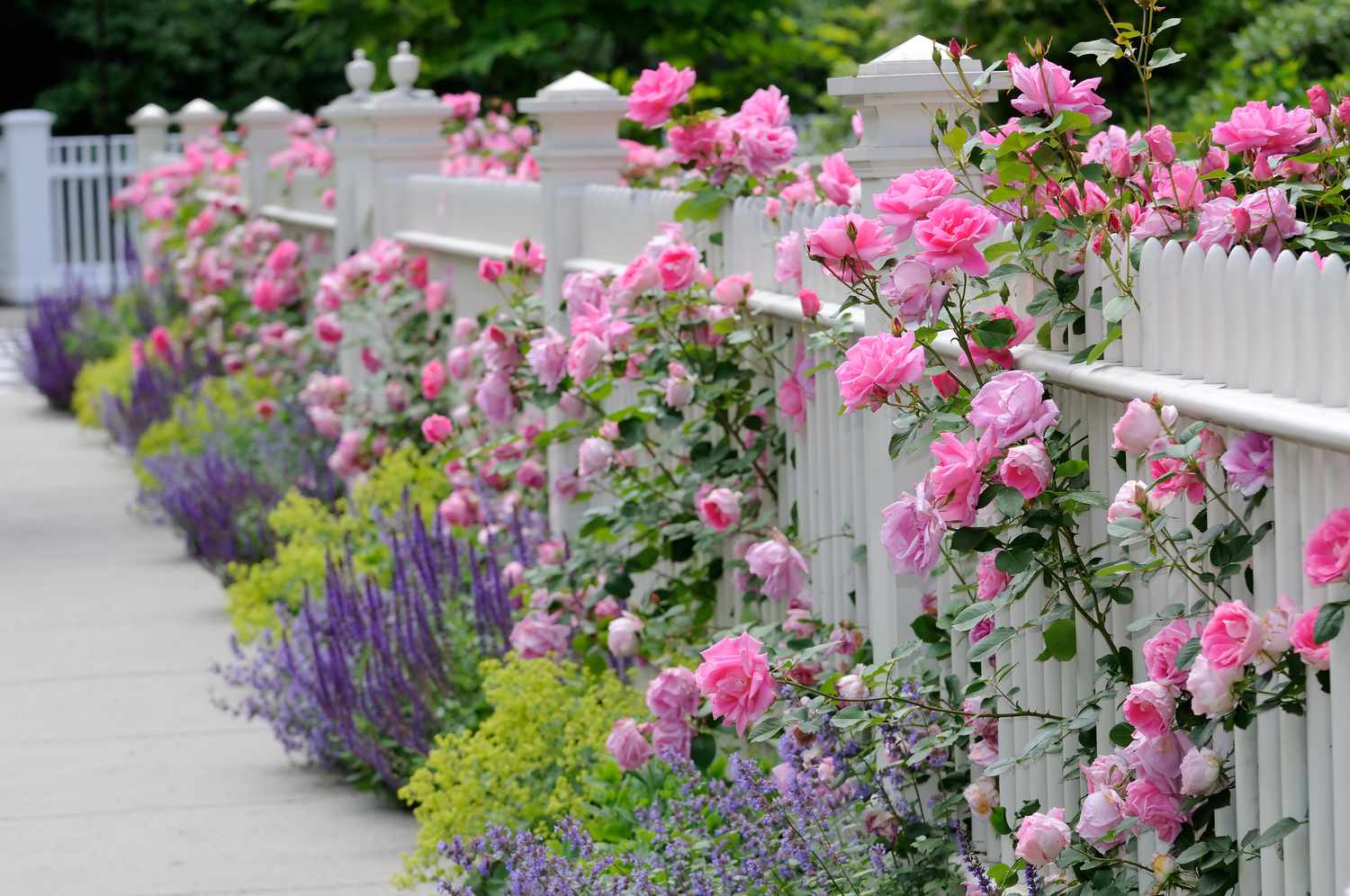
There are a myriad of architectural features that can enhance your garden, from elegant trellises to ornate archways. Then, there are more practical ones, like fences. Whether you’re trying to contain crawling vines or add an extra layer of personal privacy, these barriers are a smart, versatile addition to any yard.
Fences don’t have to sacrifice style, either. There are plenty of options beyond the white picket variety that can beautifully display your foliage—or act as an architectural extension of your abode. Here, we gathered a handful of expert-approved fence ideas to inspire a new garden layout.
Kevin Lenhart, design director of Yardzen
Christian Douglas, landscape designer and author of The Food Forward Garden: A Complete Guide to Designing + Growing Edible Landscapes
Marci Bonner, landscape architect and associate at Richardson & Associates
Wood and Wire Fence
Credit:
Dan Gordon Landscape Architects
Pairing a wood frame with a wire structure is both cost-effective and functional, especially for vegetable gardens. “They can be surprisingly decorative and skew a little modern,” says Christian Douglas, landscape designer and author of The Food Forward Garden. “Painting the wooden posts [or] framing a darker color can elevate it.”
Metal mesh or galvanized steel are great budget-friendly materials and pair well with wood. “A wood post cap makes any fence look more high-end,” says Marci Bonner, landscape architect at Richardson & Associates. Especially compared to the plastic caps available at many home improvement stores.
Wrought-Iron Fence
Credit:
balticboy / Getty Images
Wrought-iron fences are an opportunity to bring ornate, vintage flair into your garden. “They can be painted in matte or glossy finishes to complement the rest of your garden’s décor,” says Douglas. “The intricate designs bring a touch of old-world beauty.”
To really capture the Victorian-era style, wrap the fence in blooms reminiscent of the era. “They’re particularly effective when paired with climbing plants—like roses or clematis—which create a beautiful, soft contrast against the hard metal,” Douglas adds.
Modern Horizontal Fence
Credit:
Matthew Cunningham Landscape Design
On the flip side, modern, horizontal plank fencing can serve as a stark contrast to the surrounding greenery. This style can even be mixed with vertical boards for a more contemporary feel, says Kevin Lenhart, design director of Yardzen—as long as the two fence types feel like a cohesive set.
Layered Picket Fence
Credit:
slovegrove / Getty Images
You can help a fence blend in with your garden by layering vegetation in front of it. “Give the eye something else to look at and the fence will recede into the background, like the curtain at the back of a stage,” says Lenhart.
A tried-and-true vertical wood fence works well for this purpose, Lenhart notes, as it’s both affordable and versatile.
Stained Wood Fence
Credit:
Sasha Gulish Photography
Reapplying paint and a stain to a wood fence can help add years to its life, Lenhart notes. “Take cues from the home or its trim color to create visual balance,” says Douglas. “For a rustic, country feel, go for a picket or split-rail fence.”
As for the type of wood? “Cedar and redwood have more rot resistance, making them excellent choices for outdoor settings,” says Douglas. Bonner notes that pressure-treated pine is a more affordable option, and also works well.
Trellis Fence
Credit:
Cavan Images / Getty Images
Looking for privacy without having to block natural light? Trellises can act as tall fences while also adding greenery to your space. “These are excellent for climbing plants like roses, jasmine, or grapes and can create a beautiful green wall,” says Douglas. “[They’re] great when space is tight.”
Light-Flow Fence
Credit:
Yardzen
You can also opt for a more classic construction with a large gap, which will help maximize natural light. The result is a yard that looks more welcoming from the outside, and feels larger from the inside, according to Lenhart.
Hog wire and wooden fences with gaps up to four inches wide can both accommodate this style. “[They] all project an inviting aesthetic, while still being able to keep kids and pets safely corralled within the yard,” adds Lenhart.
Woven Willow Fence
Credit:
Christian Douglas
Fences don’t need to be completely separate from your greenery—plants can help create enchanting, living barriers that feel at one with your outdoor space. One of Douglas’ favorite choices in this category is a woven willow fence.
“They create wonderful texture and are relatively easy to install,” he says. “A wild rose scrambling across them is perfect for that whimsical cottage look.”
Willow can be trained to grow around a fence structure, or it can form its own natural barrier. “They do require regular upkeep to ensure the plants stay healthy and beautiful,” Douglas notes.
Reclaimed Grape Stakes
Credit:
aloha_17 / Getty Images
Reclaimed grape stakes (or other garden stakes) are simple, sustainable, and add a quaint charm. “It’s a wonderful, informal choice that provides a natural architectural element,” Douglas says. “[It’s] great for children and pet control too.”
Dark-Stained Privacy Fence
Credit:
Yardzen
To create a private sanctuary, Bonner prefers a solid, dark-stained, vertical board fence. “In some cases, a solid, six-foot fence with a two-foot lattice on top can give you an extra lift—without it feeling too overpowering,” Douglas says. “It creates a nice texture change, and adds a decorative detail.”
Deer Fence
Credit:
Sasha Gulish Photography
There’s no harm in choosing a purely practical fence—especially if your home is nestled in the woods. “For those living in more wild areas where the local fauna roam free, deer fencing can be the only solution to protect your much-loved plants,” Douglas says.
A wire mesh and metal or wood posts are the best materials to use in this case. “Ideally, these are placed a little deeper into the landscape and out of sight, providing protection without taking up too much visual space,” Douglas adds.
Scalloped Fence
Credit:
Wuka / Getty Images
Want to give your wood fence a chic touch? “Adding a gentle curve or scallop to the top creates a softer, more inviting look,” Douglas says. “This type of design can elevate a standard garden fence and add a whimsical touch—especially when paired with lush plantings at the base.”
Steel Fence
Credit:
Jordan Lye / Getty Images
For contemporary gardens, corten steel fences are a durable choice, inviting in a bold, brutalist aesthetic. “Over time, this material develops a unique rust patina, which adds both texture and warmth to the garden,” Douglas says. “It provides a striking, defined contrast to the greenery in front.”
Laser cut steel panels, on the other hand, grant an opportunity for customizable designs. “Colored, powder-coated, or natural metal options mean you have lots of space to be creative,” Douglas says.
Espalier Fence
Credit:
Sasha Gulish Photography
For a seamless transition into your garden that allows you to grow sweet treats, opt for espalier fencing, which uses the trunks and branches of trees as a natural barrier.
“Metal or wooden posts with horizontal wires can define a boundary, while providing a frame from which to grow fruits,” Douglas says. “I like to use apples, pears, or table grape vines for the green, edible layer.”
Accessorized Fence
Credit:
Alex Levine / Getty Images
Unassuming household items can become a great accessory for a garden fence. “Adding an antique mirror at head height among wandering vines can add an element of surprise and décor,” says Douglas. “[It] tells a story, turning your fence into a piece of art. This is particularly effective in small courtyard spaces.”
String lighting is a pretty accessory to run across your fence, too. “It adds a soft glow and makes the space feel magical after the sun sets,” Douglas adds.
Comments are closed.