
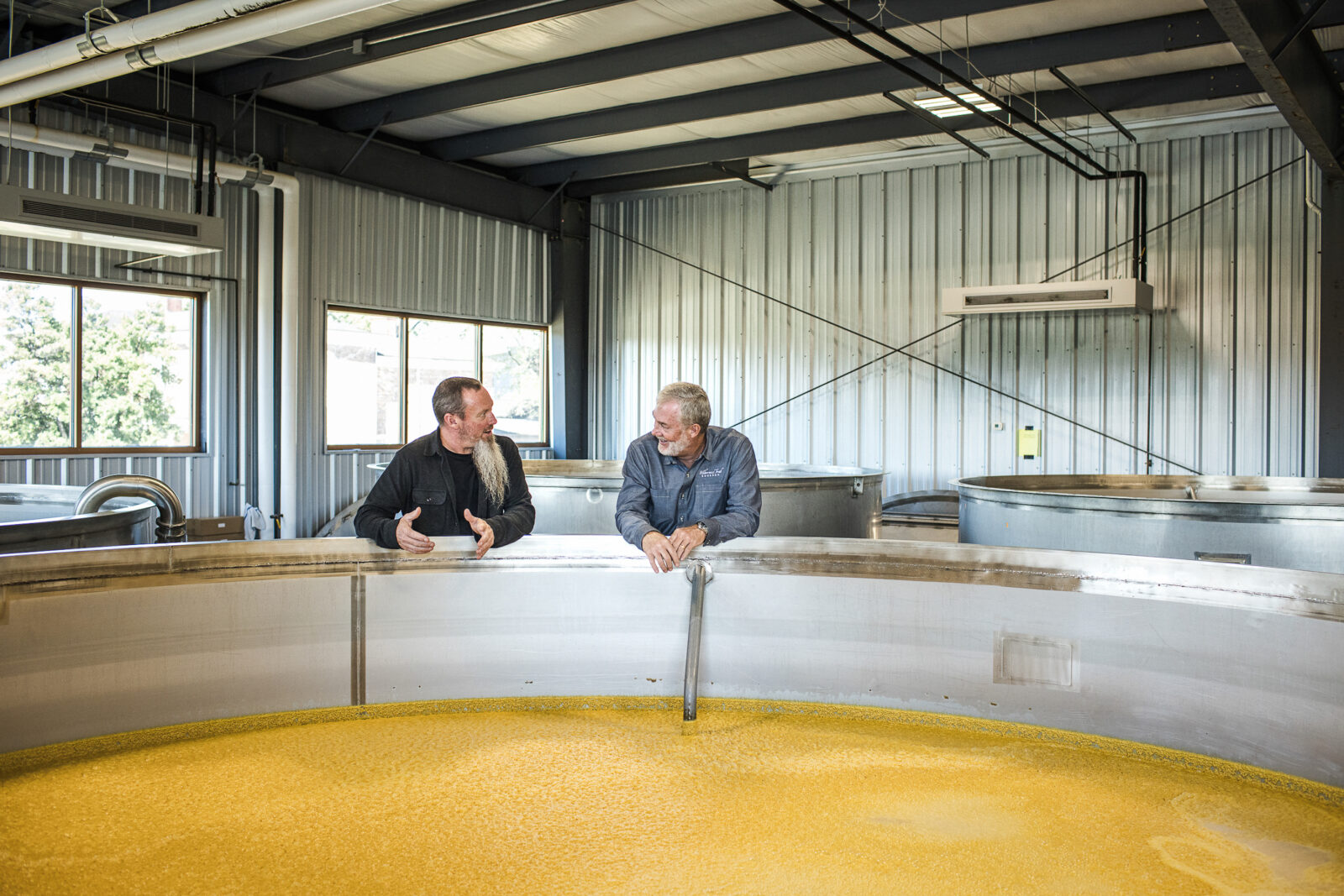
Bourbon gains much of its complexity—and all of its color—while resting in barrels. There, wood, chemistry, and time converge to shape aroma, flavor, and depth. But before a drop touches new, charred oak, before distillation, and even before fermentation, the trajectory of that whiskey is impacted by a deceptively simple choice: sweet mash or sour mash?
First, a few key definitions: Mash is the thick, porridge-like mixture created by steeping milled grains in hot water—in bourbon, that’s mostly corn, along with rye or wheat (sometimes both) and malted barley. The heated water loosens the starches locked inside the grains, which natural enzymes from the malted barley convert into simple sugars. Most commonly, distillers reserve a portion of the liquid left behind after a previous distillation—called backset or stillage—and add it early in the next batch. This technique is known as the sour-mash method. When a distiller uses only fresh water and grain, the mixture is known as a sweet mash.
In both cases, the mash is cooled, yeast is added, and the microscopic organisms get to work, consuming the sugars and producing alcohol and carbon dioxide. The resulting distiller’s beer, as it’s called, goes into the still.
“To understand sweet mash, you’ve really got to understand why distillers do sour mash,” says Pat Heist, cofounder of Wilderness Trail in Danville, Kentucky, one of a scant few American distillers that make only sweet-mash whiskey. “Number one is, once you get to be a certain size, getting rid of that stillage is a huge issue. If you can incorporate 20 or 30 percent of it back into your facility, that is a great reason in and of itself to utilize a sour-mash process.”

Photo: courtesy of Wilderness Trail
Heist (above) and Shane Baker founded Wilderness Trail in 2012 and began distillation the following year.
Mixing already-heated backset into a new batch saves on costs, as it requires less energy and raw materials. Beyond that, the acidic mixture also helps lower pH, promoting a more hospitable environment for yeast while inhibiting unwanted bacteria and improving consistency from batch to batch.
So, with those benefits, why would anyone bother with sweet mash? When Wilderness Trail first fired up its still in 2013, its size came into play. Heist says he and business partner Shane Baker worked dawn-to-dusk most days to fill only about three barrels a week. “By the time you came in the next day, any stillage you’ve collected is sitting cold in a tote,” Heist says. Starting with all-new ingredients outweighed the time and effort it would take to strain, pump, and heat everything up in a new batch of mash.
But there was another reason they gravitated toward sweet mash. Proponents argue the process preserves a cleaner expression of grain and fermentation, bringing out more distinct, fruit-forward flavors, while sour-mash devotees point to its layered depth and reliability from one batch to another. Heist and Baker had previously started a fermentation consulting company, Ferm Solutions, through which they’ve helped dozens of distilleries design their systems or troubleshoot issues. “We wanted to do something that differentiated us,” Heist says. “If you do a sweet mash correctly, you still get a good pH reduction, and with us being science guys, we knew as long as we were able to keep things clean, we should be able to kill it on consistency.”
Bryan Smith, distiller and cofounder of Hard Truth Distilling Co. in Nashville, Indiana, initially thought of sweet mash as a “marketing hook that you could tell a story around,” he says. That is until he spent a day with Heist and Baker when he was planning his own distillery, and they drilled into a few of Wilderness Trail’s barrels for a taste. “It broke my brain,” Smith says. “The brightness and softness and complexity that was expressed through that rye whiskey was unlike anything I’d tasted before.”
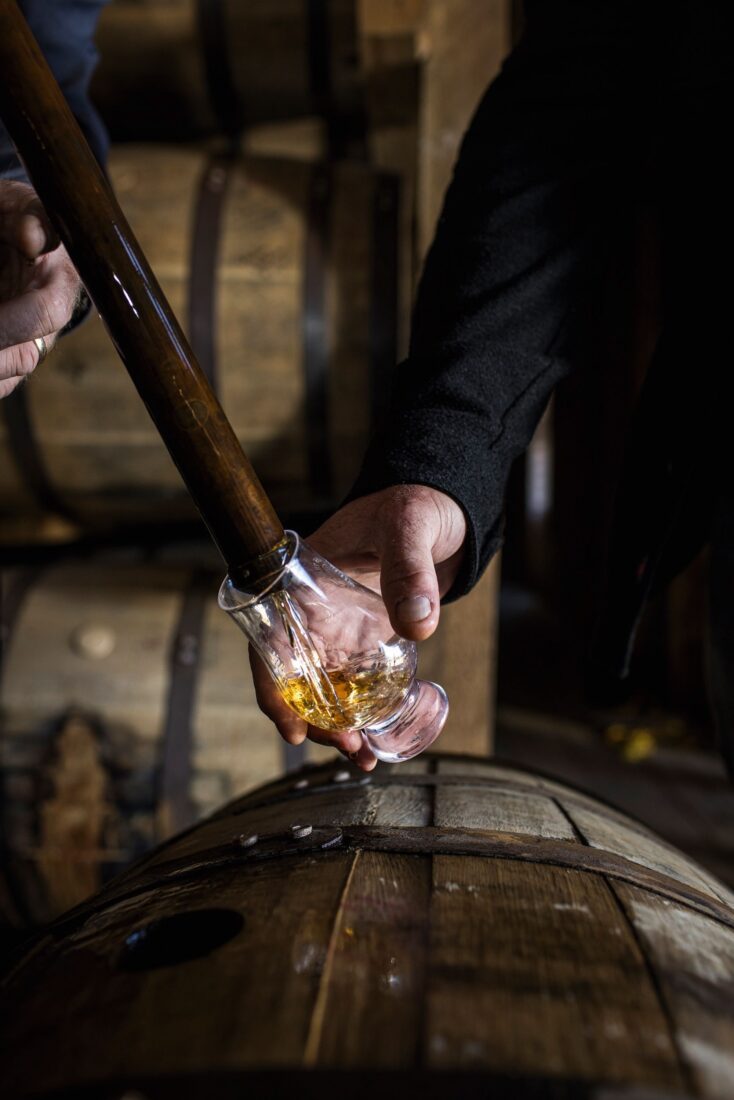
Photo: courtesy of Wilderness Trail
Sampling bourbon from a Wilderness Trail barrel.
Smith built Hard Truth’s distillery to run only sweet mash, too, using all stainless-steel components with few nooks and crannies where bacteria can hide and that can easily be steam-cleaned. “We make a few different bourbon mash bills and a few different rye mash bills, but they all have a lot of orchard fruit,” he says. The rye, especially, has a “nice, jammy, peach stone-fruit characteristic with a kind of pastry, custard flavor that comes from the barrel.”
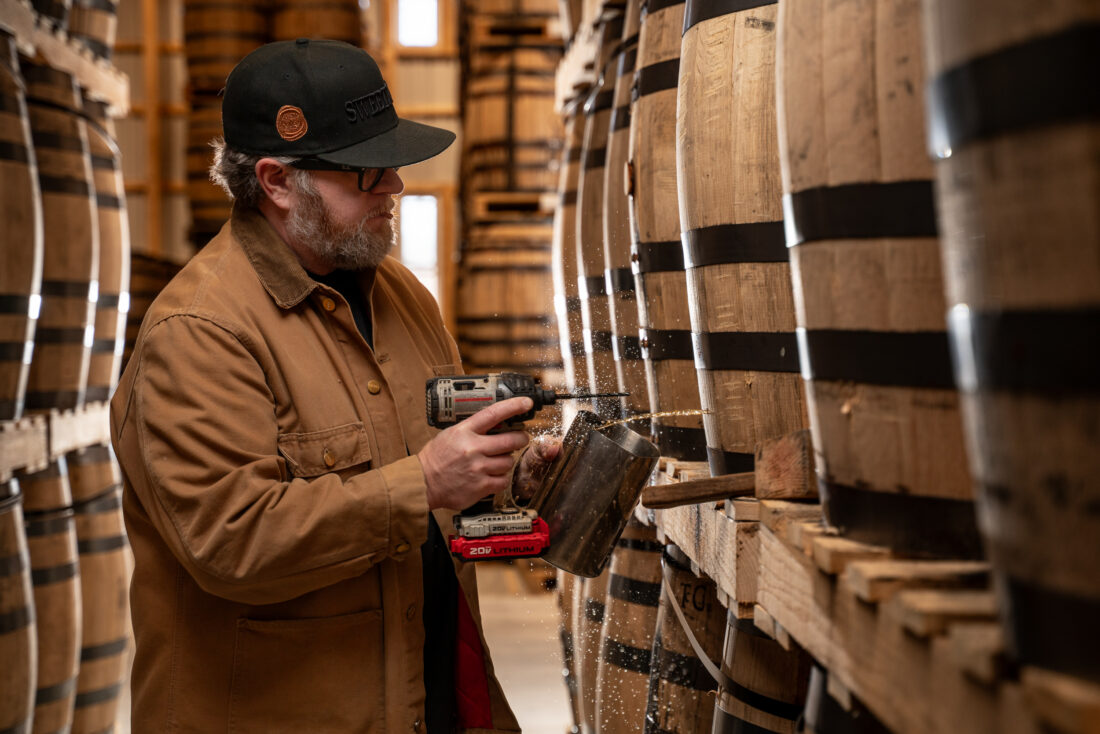
Photo: courtesy of Hard Truth Distilling Co.
Bryan Smith drills into a barrel at Hard Truth Distilling Co.
Brett Connors, head blender with Castle & Key, started out making sweet mash at the Frankfort, Kentucky, distillery, only to switch to primarily sour mash several years later. “As someone who’s done both, I love sweet mashing and I think you can get some really cool, unique flavors that way. It’s definitely dynamic,” Connors says. “As someone who also blends for a living and works as a contract distiller, I also love sour mash because it’s just a little bit more consistent.”
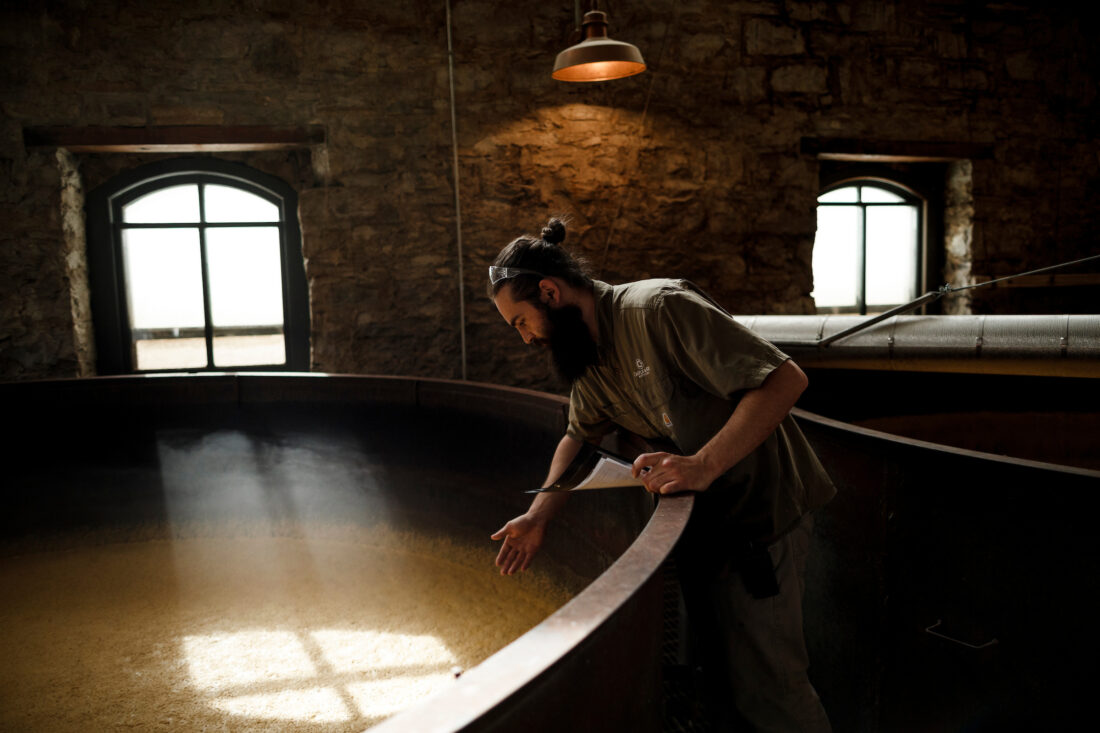
Photo: courtesy of castle & key
Brett Connors at Castle & Key.
In the end, it comes down to process and preference. “They’re both great options for making whiskey,” he says. “Which produces the flavors you want to bring out?”
For Kentucky Peerless Distilling, sweet mash was the way to go. Although Corky Taylor’s great-grandfather originally acquired the brand in 1889, Taylor didn’t feel constrained by history or tradition when he and his son, Carson, revived it in 2015. With no recorded mash bill and just a few old bottles for reference, they decided to start fresh with a new formulation and new distillery in downtown Louisville.

Photo: courtesy of Kentucky Peerless Distilling
Kentucky Peerless Distilling’s head taster, John Wadell.
“The big decision was, do we want to replicate a recipe or replicate the quality that the whiskey had at the time?” says head taster John Wadell. They landed on a sweet mash method paired with a low barrel-entry proof and bottled at cask strength, which they felt would best showcase the distinct flavors created through the process. “You’re really highlighting your grain and your fermentation,” Wadell says. “Another way to look at it is, with sour mash versus sweet mash, rather than tasting the past, you’re tasting the moment.”
Tom Wilmes is a journalist based in central Kentucky, specializing in bourbon and other spirits. A contributor for Garden & Gun, he has also written for Whisky Advocate, The Local Palate, Southbound, and various other publications. Follow @kentuckydrinks on Instagram.
Comments are closed.