
Report Overview
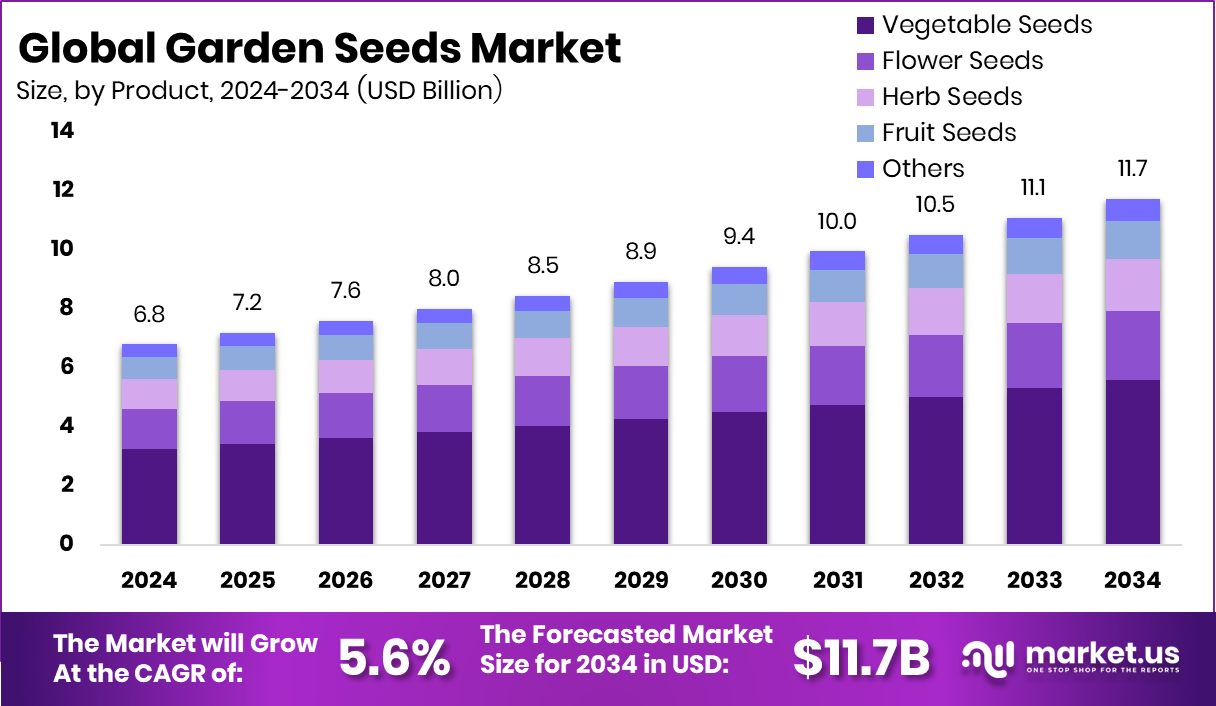
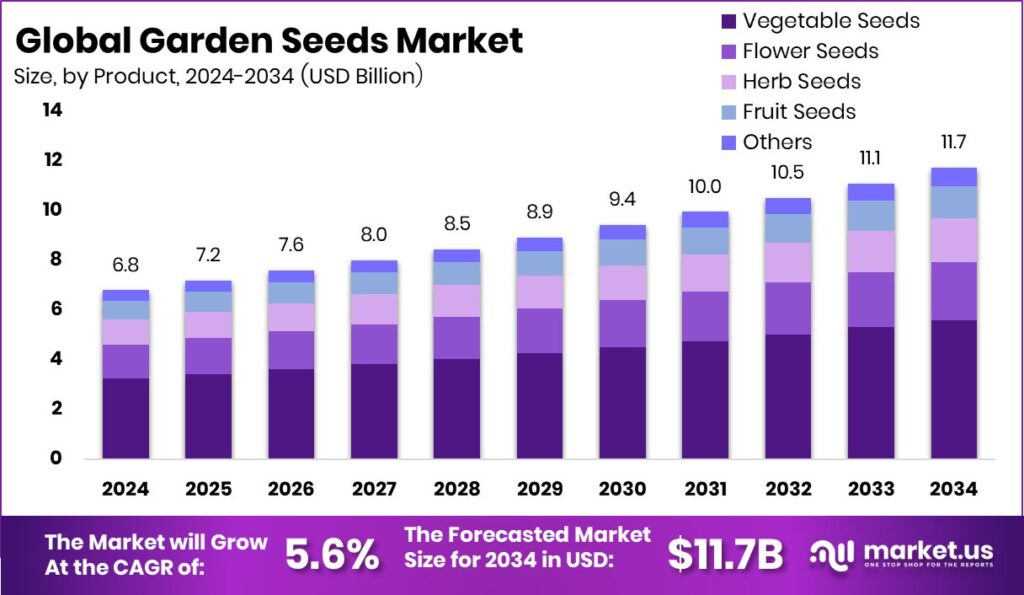
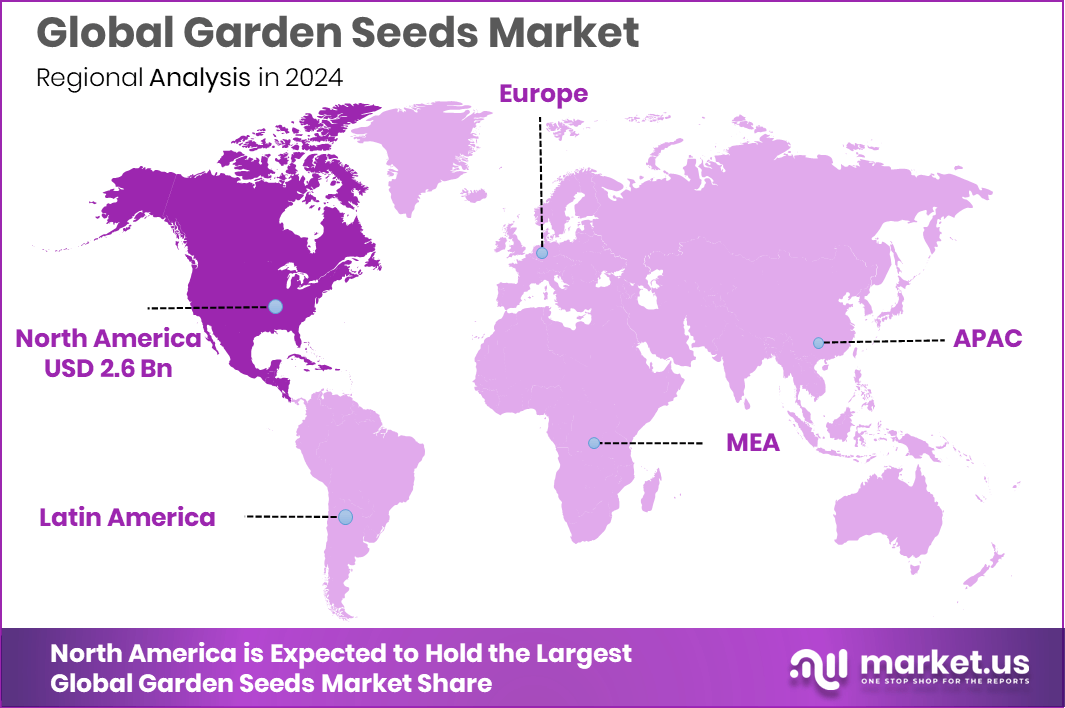
The Global Garden Seeds Market is expected to be worth around USD 11.7 billion by 2034, up from USD 6.8 billion in 2024, and is projected to grow at a CAGR of 5.6% from 2025 to 2034. North America accounted 39.5% share, generating USD 2.6 Bn in revenue.
Garden seeds refer to planting materials used to grow vegetables, flowers, herbs, fruits, and other plants in home gardens, terraces, lawns, and small farms. These seeds are developed to suit different climates, soil types, and user preferences. The Garden Seeds Market includes the production, breeding, packaging, and distribution of seeds across product categories such as vegetable seeds, flower seeds, herb seeds, fruit seeds, and others. It also covers hybrid seeds, open-pollinated varieties, genetically modified seeds, and organic seeds. Sales take place through online marketplaces, brand-owned webshops, garden centers, specialty seed stores, DIY chains, and grocery retailers, serving both household and commercial users.
Market growth is being supported by rising investment activity and policy backing across agriculture and seed innovation. Abu Dhabi investor’s 35% stake in Limagrain Vegetable Seeds highlights confidence in the vegetable seed segment. Tinubu’s approval of an N50 billion seed fund further signals the government’s focus on strengthening seed systems. Funding rounds such as Cano-ela’s €1.6 million and ingarden’s €1.2 million show strong capital flow toward seed-based nutrition and controlled growing solutions.
Demand is increasing as households adopt kitchen gardening, terrace farming, and decorative landscaping. Seed-focused funding, such as Malaysia’s Being Juice securing $1 million and Pasarnow raising $3.3m to upgrade fresh food supply chains, indicates broader ecosystem expansion that indirectly strengthens seed demand.
Opportunities lie in technology-driven cultivation and automation. Remora Robotics securing $16m and Naïo Tech raising €3m reflect growing interest in agri-automation, which can enhance seed productivity and support commercial-scale gardening expansion.
Key Takeaways
The Global Garden Seeds Market is expected to be worth around USD 11.7 billion by 2034, up from USD 6.8 billion in 2024, and is projected to grow at a CAGR of 5.6% from 2025 to 2034.
Vegetable seeds dominate the Garden Seeds Market with 47.8% share globally.
Hybrid seeds lead the Garden Seeds Market, accounting for 52.4% share.
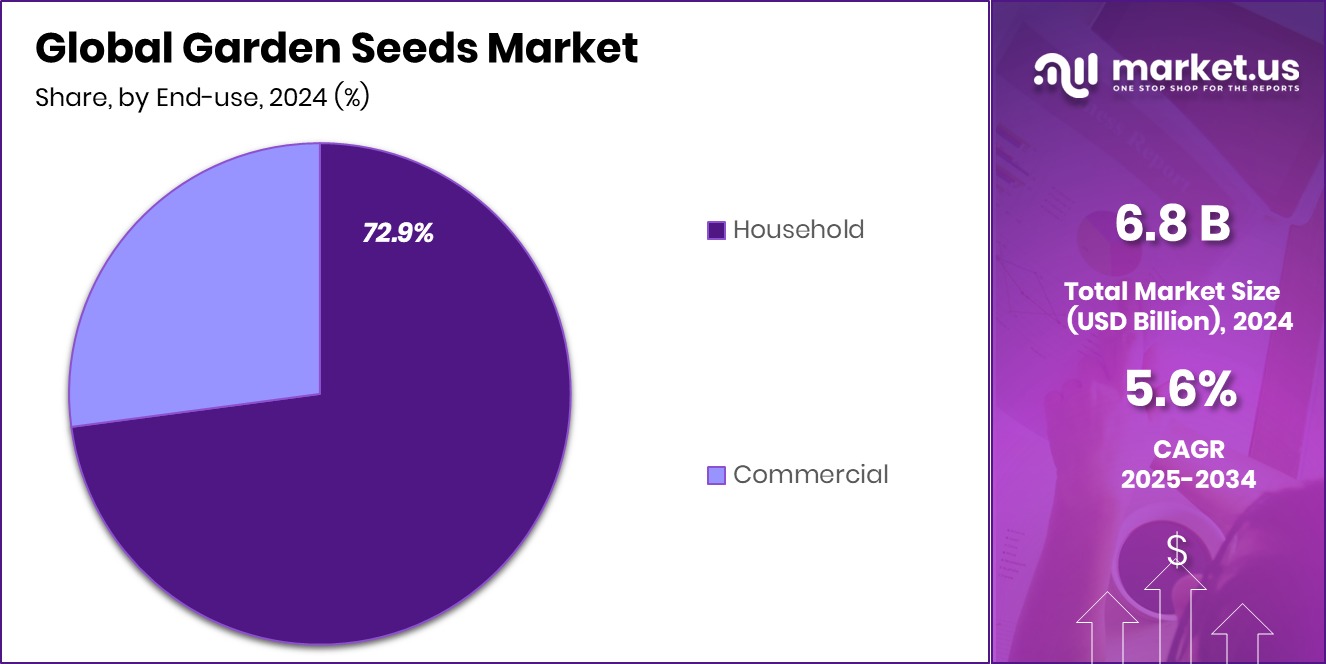
Household end-use drives the Garden Seeds Market with a 72.9% consumption share.
Online marketplaces capture 37.3% sales within the Garden Seeds Market globally.
In North America, the garden seeds market reached USD 2.6 Bn, holding 39.5%.
By Product Analysis
Vegetable Seeds dominated Garden Seeds Market with 47.8% share globally.
In 2024, the Vegetable Seeds segment dominated the Garden Seeds Market, accounting for 47.8% share of total revenue. This strong position reflects growing consumer interest in home-grown food, especially tomatoes, chilies, cucumbers, leafy greens, and other kitchen staples. Urban households are increasingly turning balconies, terraces, and small backyard spaces into productive vegetable gardens. The shift toward chemical-free food and awareness around food safety has further strengthened this segment.
Seasonal planting campaigns, improved seed varieties with higher germination rates, and compact vegetable hybrids suitable for small spaces have also supported demand. As food inflation continues to influence buying behavior, vegetable seeds remain the preferred choice among home gardeners, clearly leading the product category in 2024.
By Seed Type Analysis
Hybrid Seeds segment dominated the Garden Seeds Market with 52.4% share.
In 2024, Hybrid Seeds led the Garden Seeds Market by seed type, holding a 52.4% market share and clearly dominating traditional open-pollinated varieties. Gardeners are increasingly choosing hybrids due to their better yield, uniform growth, disease resistance, and faster maturity cycles. For small-scale home growers, predictable output and improved survival rates are key advantages.
Hybrid vegetable and flower seeds are widely promoted by brands through digital platforms and retail chains, further strengthening their market presence. Although hybrid seeds are typically priced higher, consumers view them as a value investment because of better performance. The segment’s leadership highlights a broader shift toward quality-focused gardening, where productivity and reliability outweigh price sensitivity in purchasing decisions.
By End-use Analysis
Household end-use dominated the Garden Seeds Market with 72.9% share.
In 2024, the Household segment dominated the Garden Seeds Market by end-use, capturing 72.9% share of total demand. Home gardening continues to gain momentum as consumers seek recreational outdoor activities and sustainable living practices. The rise of kitchen gardening, terrace farming, and decorative landscaping has expanded seed consumption among individual buyers.
Social media trends, gardening tutorials, and community gardening movements have also played a major role in encouraging participation. With increasing awareness around nutrition and mental well-being, households are treating gardening as both a hobby and a lifestyle choice. This strong consumer-driven demand ensures that household users remain the primary growth engine of the garden seeds industry.
By Sales Channel Analysis
Online Marketplaces dominated Garden Seeds Market with 37.3% share.
In 2024, Online Marketplaces emerged as the leading sales channel in the Garden Seeds Market, accounting for 37.3% share and dominating traditional retail formats. The convenience of browsing multiple seed varieties, comparing prices, reading reviews, and accessing doorstep delivery has significantly influenced buying patterns. E-commerce platforms frequently offer seasonal discounts, combo packs, and subscription-based seed kits, attracting repeat customers.
Digital marketing campaigns and influencer-led gardening content further drive online conversions. Additionally, small and regional seed brands are leveraging online channels to expand reach beyond local markets. As internet penetration and digital payments continue to rise, online marketplaces are expected to maintain their dominant position in seed distribution.
Key Market Segments
By Product
Vegetable Seeds
Flower Seeds
Herb Seeds
Fruit Seeds
Others
By Seed Type
Hybrid Seeds
Open-Pollinated Varieties (OPV)
Genetically Modified (GM) Seeds
Organic Seeds
By End-use
By Sales Channel
Online Marketplaces
Brand-Owned Webshops
Garden Centers and Nurseries
Specialty Seed Stores
DIY/Home-Improvement Chains
Grocery and Mass Retail
Driving Factors
Rising home gardening participation worldwide
Rising home gardening participation worldwide continues to support the steady expansion of the Garden Seeds Market. More households are turning balconies, rooftops, and backyard spaces into productive green zones, driving consistent demand for vegetable, herb, and flower seeds. At the same time, innovation-led funding is strengthening the broader agri and food ecosystem.
Food coating startup Sufresca securing a $500k seed round reflects growing attention toward reducing food waste and improving shelf life, indirectly supporting fresh produce value chains. Digital onboarding platform Product Fruits harvesting €1.6 million, also highlights how digital solutions are scaling agricultural and food-related businesses, creating smoother access to gardening tools and seed platforms for end users.
Restraining Factors
Restraining Factors: Fluctuating raw material cost pressures
Fluctuating raw material cost pressures remain a key challenge for the Garden Seeds Market, particularly in packaging, storage, and logistics. Seed producers often face volatility in input costs, which can affect pricing strategies and margins. Although Malaysia’s Being Juice secured $1 million in seed funding and Vivid Machines closed a $4.3m seed funding round, such capital flows are largely directed toward processing and technology improvements rather than directly stabilizing seed production costs. These funding activities indicate innovation momentum, yet they do not fully offset operational pressures faced by seed suppliers dealing with unpredictable transportation expenses and raw material price shifts.
Growth Opportunity
Expansion of online seed distribution
Expansion of online seed distribution is opening new growth avenues across urban and semi-urban regions. E-commerce platforms allow consumers to access a wide range of vegetables, flowers, and specialty seeds with doorstep delivery convenience. Czech Product Fruits raising €1.6M in a seed round demonstrates how digital-first platforms are scaling rapidly, reinforcing confidence in online business models.
Additionally, Kern Tec raising €12M to scale up alternative dairy products made from upcycled fruit pits highlights broader innovation in plant-based ecosystems. Such developments strengthen the agricultural value chain and indirectly create favorable conditions for diversified seed demand and specialized cultivation.
Latest Trends
Growing preference for organic seeds
Growing preference for organic seeds is shaping purchasing patterns, especially among health-conscious households seeking chemical-free produce. Consumers increasingly value traceability and sustainability in seed sourcing. Final Boss Sour securing $4m in seed funding to expand its product line signals strong investor appetite for food innovation linked to natural ingredients.
Similarly, Austrian foodtech Kern Tec is raising €12 million in Series A funding to convert food waste into sustainable ingredients, whichreflects the wider sustainability push. These developments align with a broader market shift toward environmentally responsible cultivation practices, supporting steady interest in organic and specialty garden seeds worldwide.
Regional Analysis
North America dominated the garden seeds market with a 39.5% share valued at USD 2.6 Bn.
In 2024, North America dominated the Garden Seeds Market, accounting for 39.5% share with a market value of USD 2.6 Bn. The region’s leadership reflects strong household participation in home gardening and well-established retail and online distribution networks.
Europe represents another significant regional market, supported by rising consumer preference for home-grown vegetables and ornamental plants. Asia Pacific is witnessing steady expansion, driven by increasing urban gardening trends and growing awareness around sustainable food practices. Meanwhile, the Middle East & Africa region is gradually developing, supported by improving access to gardening inputs and rising interest in small-scale household cultivation.
Latin America also contributes to the overall market, benefiting from favorable climatic conditions and growing urban residential gardening activities. While all regions show stable participation, North America clearly leads in both revenue and share, holding 39.5% of the global market and generating USD 2.2 Bn, reinforcing its position as the dominant regional contributor in 2024.
Key Regions and Countries
North America
Europe
Germany
France
The UK
Spain
Italy
Rest of Europe
Asia Pacific
China
Japan
South Korea
India
Australia
Rest of APAC
Latin America
Brazil
Mexico
Rest of Latin America
Middle East & Africa
GCC
South Africa
Rest of MEA
Key Players Analysis
In 2024, Corteva remains a strategically important player in the global Garden Seeds Market, supported by its strong seed genetics platform and deep agricultural expertise. The company continues to focus on improving seed traits such as disease resistance, climate adaptability, and yield performance. Its broad seed portfolio and established distribution presence give it a competitive edge in both developed and emerging markets. Corteva’s emphasis on research and advanced breeding technologies strengthens its positioning in vegetable and specialty seed segments, which are increasingly relevant to home and small-scale growers.
BASF SE plays a differentiated role in the garden seeds landscape through its integrated approach to seed development and crop solutions. The company leverages its scientific capabilities to enhance seed quality, uniformity, and resilience. BASF’s structured innovation pipeline and commitment to sustainable agriculture support the development of seeds that align with changing consumer preferences. Its global footprint and technical support network further reinforce its stability in the market.
Bayer Group continues to demonstrate strong influence in the garden seeds sector, backed by its established seed brands and research-driven breeding programs. The company focuses on delivering high-performance seed varieties tailored to diverse growing conditions. Bayer’s global operational scale and innovation focus help it maintain a solid competitive standing in 2024.
Top Key Players in the Market
Corteva
BASF SE
Bayer Group
Syngenta
Cargill, Incorporated
Jackson & Perkins
Fedco Seeds, Inc.
Fruition Seeds LLC
Johnny’s Selected Seeds
Bucktown Seed Company
Recent Developments
In October 2025, Corteva announced it would separate its seed business and crop protection business into two independent public companies. The seed unit will be named SpinCo, and the crop protection part will be New Corteva. This move aims to let each business focus on its own growth and innovation strategies.
In July 2024, BASF announced 19 new Xitavo soybean seed products for the 2025 growing season. These new products expand the company’s soybean seed portfolio to give growers more genetic variety. The seeds are developed to improve yield and performance under different field conditions. This step shows BASF’s focus on seed innovation and providing more options for farmers.
Report Scope
Comments are closed.