
Fukui Prefecture in the western part of the Hokuriku region of Japan is a destination that does not commonly make it onto a traveler’s bucket list. It is often bypassed for its more tourist-infested neighbors, Kyoto and Kanazawa. Yet, Fukui City and its surrounding towns take pride in their rich, traditional culture—knife, glass, paper, and lacquerware crafts, the famous Echizen crabs, the Fukui Prefectural Dinosaur Museum (reflective of extensive fossil discoveries), the 1576 Maruoka Castle, and the grand Eiheiji Temple from 1244, one of the largest Zen Buddhist temples in the country. The spectacular Tojinbo Cliffs, designated as a natural monument, stretch along the Sea of Japan in the northern part of Fukui and are considered one of the great wonders of the world.
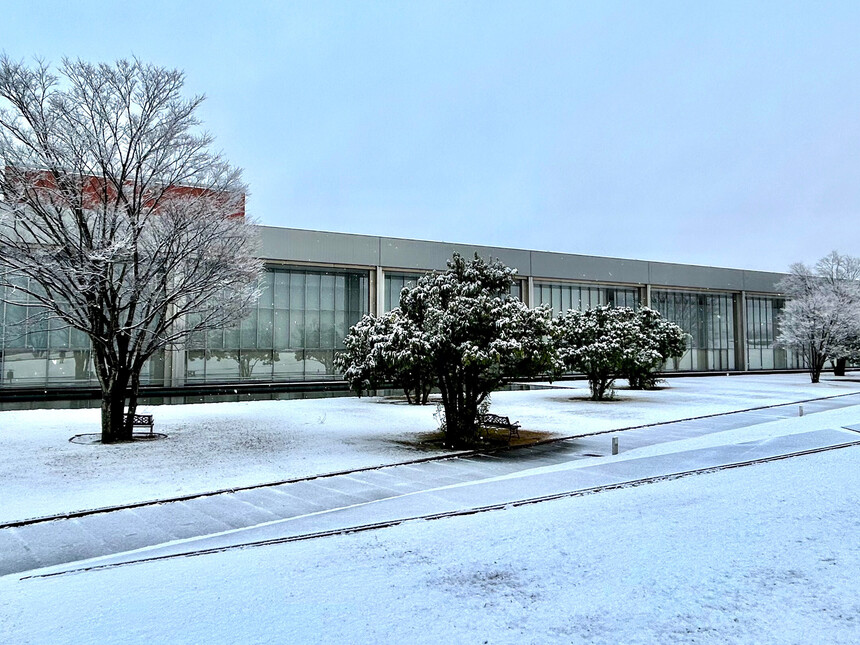
Fukui is also home to the spectacular modern architecture of the Fukui Prefectural Library and Archives.1 Visiting the sprawling property was definitely the highlight of my journey to this unspoken corner of Japan. Arriving by bus in the peak of winter, I was instantly greeted by the vast, snowy landscape dotted with skeleton-framed evergreen and conifer trees. The long, gray, and horizontal building in reinforced concrete, steel frames, and glass contrasts with the touch of the red terracotta-finished cube on one side, projecting a most appealing design.
The distinguished architect and Pritzker Prize recipient, Fumihiko Maki2 (1928-2024), conceived of his masterpiece as “a garden library and archives surrounded by greenery.” Built on extensive grounds covering approximately 70,000 square meters, the building embraces cutting-edge materials and the physical environment that takes advantage of the lush rice fields and the Asuwa River’s natural setting. Japanese principles sway harmoniously with modernism.
The architecture follows the Japanese spatial concept of “oku,” which refers to “inner space,” “depth,” or “inwardness.” It encourages a journey of delving into deeper and more intimate layers within a building or a landscape. The library is not merely a shelter for books; rather, it functions as a promenade of knowledge and culture, escorting visitors to an experience of a contemplative space bathed in the playful interplay of light, shadow, modernity, and nature. Maki has successfully merged the rice paddies and the river with the prairie architectural style, marked by low-pitched roofs intended to avoid any view obstruction. This essential consideration evidently constitutes a continuous line over the flat terrain and embodies profound respect for the local territory.
A water basin encircles the library on all sides alongside wooden veranda walkways, ushering in a feeling of the edifice floating on the water. “Engawa,” the wooden veranda running along the exterior, is a principal element of old Japanese houses. Reflections of the foliage and the building glow on the water’s ripples and create captivating silhouettes. The glass walls also mirror the idyllic scenery as though it seeps dramatically through the structure.
From the main entrance, the exterior view shines directly through the glass panels, igniting the notion of walking in nature from indoors. The library section comprises five floors and one basement floor. Towering metallic, cross-formed pillars rise to the skylit ceiling, niched in circular shapes, and perfectly stress geometric parameters. They are the most compelling design features of the building. Soft light passes through the alcoved ceiling and the glass walls, scattering throughout the entire interior space, and helping visitors attain higher reading visibility. The lofty ceiling of 7.35 meters provides adequate openness that makes private time calm and relaxing. Many seating areas line against the walls or face outdoors for visitors to savor the greenery’s panoramic views.
Within the main library sits an enclosed children’s room equipped with about 40,000 story, picture and educational books. The layout allows children and parents to lounge comfortably while reading. I was intrigued by the stencil-like paper cutout artwork on the glass partitions fencing in the children’s section. They resemble tree trunks and repeat rhythmically across the accordion-like wall construction. The motif purposely blends with the bordering nature.
Stepping outside to the expansive meadow carried a lighthearted feeling as I explored the pathways around the deciduous trees. A few small hills meander across the estate and offer an overall perspective of the seamless architecture. One can clearly observe the fluid connection among the different functional spaces through the use of continuous walkways instead of separate rigid boxes. Furthermore, the walls are carefully framed to invite the exterior light and scenery into the interior so that the library itself appears larger.
Maki had been well-reputed for his commitment to the application of Japanese and modern aesthetics. His ingenious fusion of traditional concepts and contemporary materials had earned him international recognition. Many of his massive structures imbue a personal and deep-seated ambiance. As a former student of Kenzo Tange, Maki was also a follower of the Metabolism movement, which regarded architecture and urban design as organic processes that adapt over time. To name a few of his renowned works—Floating Pavilion, Groningen, Netherlands (1996); 4 World Trade Center, New York (2013); Aga Khan Museum, Toronto (2014); and Shenzhen Sea World Culture and Arts Center, Shenzhen (2017)—are highly acclaimed.
Maki’s numerous awards include the Thomas Jefferson Medal in Architecture (1990), UIA (International Union of Architects) Gold Medal (1993), AIA (American Institute of Architects) Gold Medal (2011), and the Japan Art Academy Prize & Person of Cultural Merit (2012–2013). The architect passed away in 2024 at the age of 95, but his remarkable achievements are eternally revered as some of the world’s most formidable creations.
Notes
1 Fukui Prefectural Library and Archives.
2 Fumihiko Maki.
Comments are closed.