
Winter greetings from the Yakima County Noxious Weed Board!
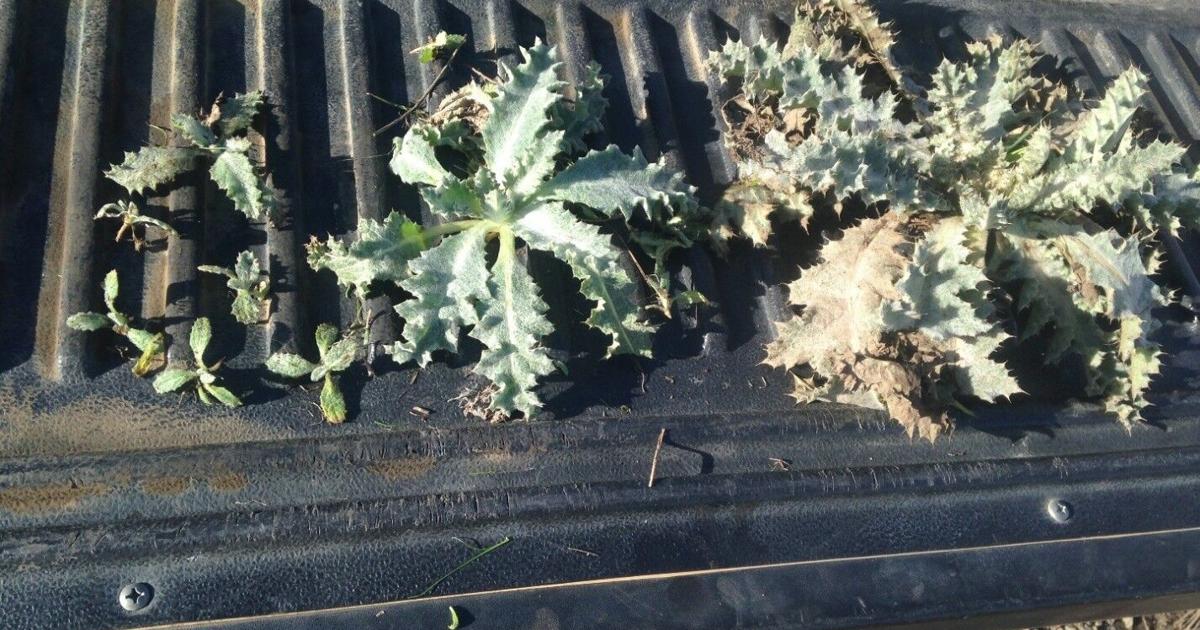
Winter is the time to start thinking about our plans for our gardens and fields in the coming year. Now is the time to look for, and if you can, cut out the wintering rosettes of scotch thistle.
The fall of 2025 through the winter of 2026 has been phenomenal period for the germination of noxious weed seeds. Every rainfall we get, new seed germination takes place. What’s more, mild temperatures have not allowed the usual winter kill. Please check areas monthly for new plants as the weather warms.
The weed board is seeing scotch thistle rosettes larger than dinner plates already. We urge landowners to take a walk through your property as soon as you can and take along a shovel or asparagus knife. Especially check areas where you have seen scotch thistle in past seasons. If the ground isn’t frozen, cut the stems an inch or two below the surface to prevent spring growth and seed production. Getting them early will prevent bolting and blooming.
Cutting the root two inches below ground will kill that root and plant. Cutting above ground is like topping a tree. Vigorous re-growth returns, this time with several stems instead of just one or two.
Scotch thistle can grow up to 13 feet tall and produce anywhere from one to hundreds of flowers, depending on the size of the plants. If conditions are dry, the plant will be shorter, with fewer flowers. If wet, it can be robust and full of flowers.

Scotch thistle early summer, bolted and ready to bloom.
Photo by Susan Bird
One flower can produce up to a thousand seeds that are viable for up to 20 years. Luckily, scotch thistle seeds are not easily windblown to new areas. Rather, seeds fall near the parent plants, forming dense colonies of thistle.
As the season warms and turns to spring and then summer, timing is important when it comes to scotch thistle eradication. It is critical that you cut the root or use an herbicide treatment before the plant’s flower heads turn a purple color. If the flowers already have color, it means the head has viable seeds. If it has a seed head that is still forming, the plant will push flowers even after it has been cut. Clip and collect the seed heads before they turn purple, even after you cut down the plant.
If flower heads are developed, they should be cut off and bagged. Dispose of the seed heads as garbage or burn them if allowed. Do not put them in compost or vegetative yard waste.
Sign up for our Daily Headlines newsletter — delivered to your inbox every morning at 7 a.m.
Thanks! You’re all set.
Watch your inbox for Daily Headlines.
Mowing mature or dry plants will move seeds and spread the problem. If you find last year’s skeleton plants with dry flower heads, there are most likely still some seeds in the head. Clip and collect them to prevent additional seed spread.
Please prevent the addition of a seed bank that will take another 20 years to control by removing scotch thistle plants prior to seed set. During active growing season after the threat of frost is gone, spraying the area with an herbicide is an option.
A good broadleaf herbicide with a liquid surfactant mixed according to label will help in control.
Scotch thistle is a class B designate on the state and county weed lists. Control is mandatory in Yakima County. Under state law, it is the landowners’ responsibility to control noxious weeds on their property. Checking early and often helps keep ahead of the noxious pests.
Control is defined as stopping all seed production and containing the noxious weeds to the current infested locations.
Our annual letter to landowners will be sent in February, with the notice of the public hearing in March. Look for the letter if you have property with a history of noxious weeds.
It is the responsibility of the Noxious Weed Board to assist you in gaining control of noxious weeds on your property. We loan out spray equipment and provide free inspection and identification services. If the infestation is substantial, we can offer an herbicide grant/cost-share to assist you with the expense of spraying the area. Grants are only given from March 1 through May 20. It is the landowner’s responsibility to control scotch thistle on their property even if no grant is available.
The Noxious Weed Board maintains a list of spray companies that landowners can hire that provide weed control services for noxious weeds. If you provide a spray service and would like to be added to the list, please contact the Noxious Weed Board office.
Call the Yakima County Noxious Weed Board, 509-574-2180, or email susan.bird@co.yakima.wa.us, jeff.knutson@co.yakima.wa.us or eric.bakker@co.yakima.wa.us, for assistance and for resources that will help.
Working together, we can prevent the establishment and spread of noxious weeds in Yakima County. It takes a team. Help us help you.
• Susan Bird is the program coordinator and outreach specialist for the Yakima County Noxious Weed Board.
• For any gardening questions, contact the Master Gardener Clinic at 509-574-1604 or email askamastergardener@yakimamg.org.
Comments are closed.