
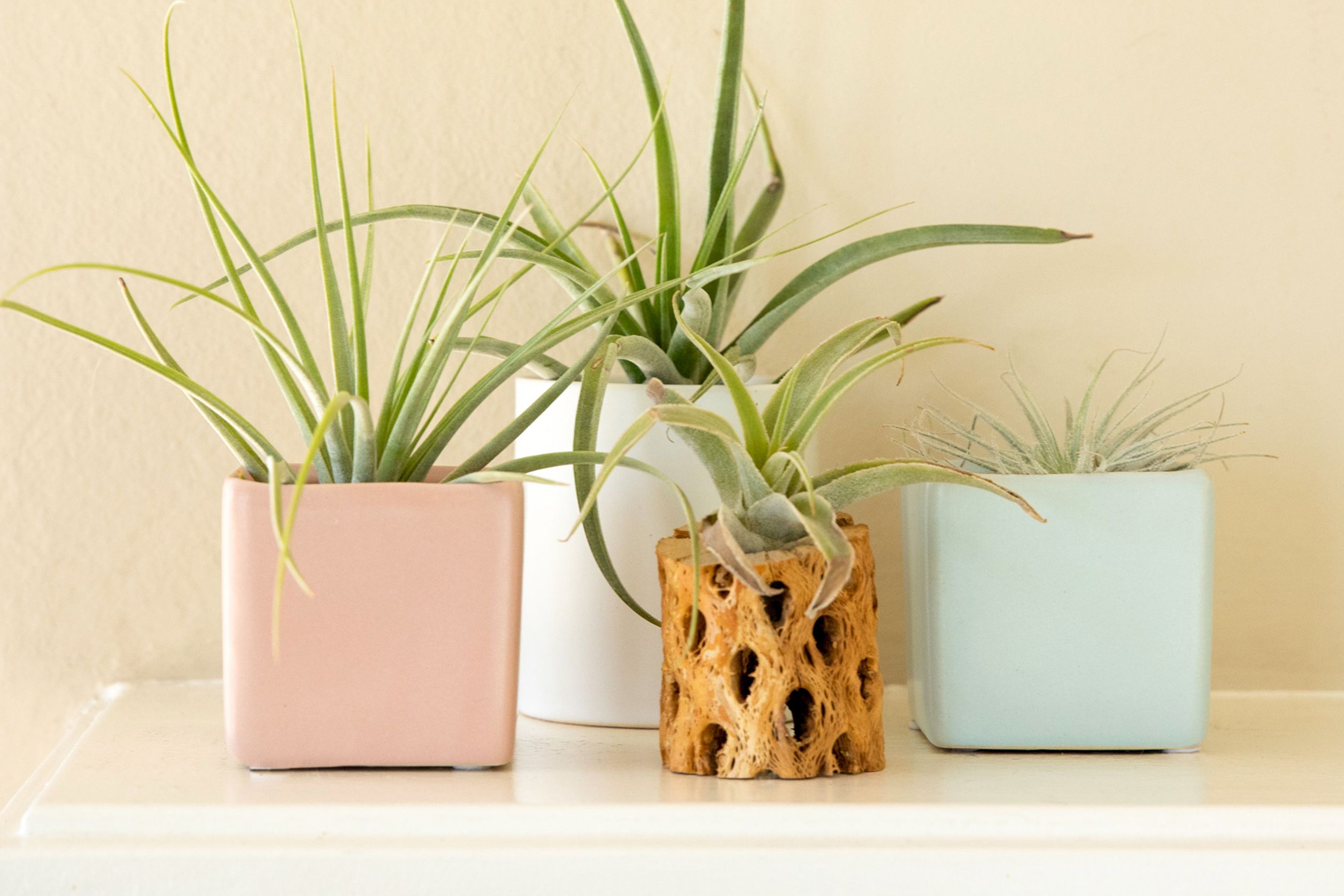
Air plants seem almost otherworldly in the way they grow, well, just in air. Yep, no soil at all is required in order to grow air plants. Plus, their leaves look a bit like alien tentacles or the appendages of an exotic sea creature. These fascinating little plants are different to care for than most other houseplants. Use this guide to grow air plants in your home and help them thrive.
Air Plant Overview
Genus Name
Tillandsia
Common Name
Air Plant
Plant Type
Houseplant, Perennial
Light
Part Sun, Sun
Height
2 to 84 inches
Width
1 to 48 inches
Flower Color
Blue, Orange, Pink, Purple, Red, White, Yellow
Foliage Color
Blue/Green, Purple/Burgundy
Special Features
Good for Containers, Low Maintenance
Problem Solvers
Drought Tolerant
Credit:
Krystal Slagle / BHG
About Air Plants
Air plants (Tillandsia spp.) are epiphytes, meaning they grow on other plants in nature, usually on tree branches. There are hundreds of species and varieties of air plants. They usually have narrow, strap-shaped or lance-like leaves that grow in a rosette pattern with new growth appearing from the center. Those with silver foliage tend to be the most drought-tolerant, while greener types dry out faster. You can also find colorful species, like Tillandsia maxima, that have coral leaves. Most species produce attractive tubular or funnel-shaped flowers, too. As houseplants, most Tillandsia species grow from 2 to 12 inches tall, but in their native tropical locations, they can reach 7 feet.
Credit: Jacob Fox
Air Plant Care
Growing air plants is easy once you’re aware of their needs. Although they don’t require potting, they do need consistent water, adequate light, and appropriate temperatures, similar to other houseplants. A healthy air plant will reward you with blooms.
Light
As a general rule, keep air plants out of direct sunlight. Remember, in the wild, many air plant species grow in the sheltered, shady canopy of trees. They do best if you can put them in bright but indirect sunlight. Some species, such as T. cyanea or T. lindenii, can handle dappled shade or less intense morning sunlight.
Water
Air plants are unique in that they don’t have typical root systems. Instead, they use short roots to cling to surfaces. In their natural settings throughout the southern U.S., Mexico, and Central and South America, air plants thrive on high humidity and abundant rainfall. Indoors, try to water your air plants about once a week, though some varieties can live up to two weeks without water.
Avoid letting air plants sit in standing water, which can cause rot.
Credit:
Krystal Slagle / BHG
To make sure they get proper hydration, either monitor your plants or establish a routine watering schedule. Here’s how to water them:
Submerge the air plants in a sink, bowl, or container filled with water for about 30 minutes.Shake them gently to remove excess water.Lay them upside down on a towel to drain thoroughly, as skipping this step can cause rot.When they’re dry, return them to their usual spots.
For extra freshness, mist air plants daily between soakings, especially in the drier winter months.
Temperature and Humidity
Air plants love warm weather, so it’s the other end of the thermometer you need to watch. Protect your plants from anything colder than 45°F; they die at those temperatures. If you live in USDA Zone 9 or warmer, you can grow an air plant outdoors all year if you keep it dry during the winter.
Air plants thrive in high humidity. If your home is particularly dry in winter, add a humidifier to the room holding the plants.
Fertilizer
Fertilizer is not necessary for air plants to survive, but an occasional application could help your air plants thrive. Use a liquid fertilizer formulated for air plants and follow the instructions precisely. Formulations include weekly and monthly application strengths. It is important not to overdo it when applying fertilizer, as too much can burn the leaves and kill the plant.
Pests and Problems
Air plants are pest-resistant but occasionally susceptible to mealybugs or scale insects. If this happens, isolate the plant from other air plants and remove the insects by hand using a damp cotton swab. If the weather allows, move the plant outside where birds might handle the pests for you.
Never use neem oil on air plants. The oil creates a barrier on the leaves that prevents the plant from absorbing water.
Most air plant problems stem from improper care. If your air plant feels mushy, has dark spots on the base, or is starting to fall apart, it may be suffering from rot due to sitting in water for hours (instead of the recommended 30 minutes) during the weekly soak. If the leaves and tips are beginning to turn brown and crispy, your plant may be dehydrated. If the plant looks bleached out or white, it could be getting too much sun. If it looks dull, is losing leaves, and doesn’t seem to be growing, it may need more sun exposure.
How to Propagate Air Plants
Air plants bloom only once in their lifetime, but after they do, they don’t die immediately. Instead, they continue producing pups (or offsets), often for several years, and then fade after those pups slowly mature and produce flowers of their own. The best way to propagate an air plant, therefore, is to removing pups from the mother plant. Here’s how:
Once a pup is at least a third the size of the parent, pinch it off at the point it is attached, which is typically at its base. (If the pup doesn’t detach easily with a gentle wiggle or twisting motion, don’t force it by pulling, which can damage the mother plant.)Place the fragile pup on a flat surface in bright, indirect light and be extra diligent about its care until it is established.Once the pub has begun thriving on its own, move it to a new spot as decoration, caring for it as you would an adult air plant.
Growing air plants from the minuscule seeds produced by the flower is challenging and takes four to five years to yield an adult plant—with only limited success—so propagation by seed isn’t recommended.
Displaying Air Plants
Air plants look great all on their own or in groups where you can display several varieties together. They can be placed in terrariums or attached to anything from magnets to driftwood for creating your own interesting displays using a bit of hot glue or translucent fishing line to secure them. Tillandsia species also make fine companions on a branch with orchids because they like the same conditions. You can also find glass or plastic globes made specifically for hanging them. For varieties that have colorful leaves, such as Tillandsia aeranthos ‘Amethyst’, also called the rosy air plant, try using a container that complements or contrasts with their hues.
Because they don’t grow in soil, air plants can be displayed in almost any way you can imagine. Try forming an air plant wreath, hanging mobile, or a beach-themed terrarium that plays off their resemblance to an octopus. Without much effort on your part, these houseplants can add fun, unique greenery to just about any space.
Credit: Peter Krumhardt
Types of Air Plants
Air plants take all kinds of sculptural forms. Here are some great varieties to grow at home.
‘Conehead’
Tillandsia ionantha ‘Conehead’ stands 2½ by 3½ inches tall and forms a small clumping rosette of thick leaves that turn reddish-pink as it matures. The flower is violet. It grows well in partial shade.
‘Rubra’
Tillandsia ionantha ‘Rubra’ is a small air plant that grows only 2 inches tall. It has fuzzy foliage that turns bright red to orange in direct sun. It is perfect for display in small terrariums or seashells.
Flower of the Air
Tillandsia aeranthos is an air plant species with a charming common name: flower of the air. This air plant is an excellent choice for beginners and grows 6-9 inches tall. It has dark green foliage and a pink and blue flower that often lasts for weeks.
King of Air Plants
The common name of Tillandsia xerographica says it all: In its natural environment, this air plant gets huge, up to a few feet wide. In a home environment, the slow-grower plant stays much smaller, but its rosette-shaped form is just as striking.
‘Maxima’
Hailing from Mexico, Tillandsia ionantha ‘Maxima’ starts out with silvery green leaves. Over time, they turn a brilliant coral hue, and the plant eventually produces several purple flowers.
Frequently Asked Questions
How long can an air plant live as a houseplant?
The average lifespan of an individual air plant is between two and five years, depending on the type, propagation method, and level of care—but a single plant can produce enough offshoots (or pups) to live indefinitely.
Do all air plants like to be soaked weekly?
Tillandsia tectorum air plants, such as ‘Snow’, differ from the typical air plant soaking routine. They perform best with 1 to 3 mistings per week—and no soak at all.
Can you water air plants with tap water?
Rainwater is the best type of water for air plants. Tap water is okay to use, but it’s best if it’s left in an open container overnight. That way, the chlorine will dissipate.
Are air plants toxic to pets?
No, air plants are not toxic to cats and dogs. That said, it’s worth keeping them out of reach of pets, especially playful cats who may find the light, soilless plants fun to bat around.
Comments are closed.