
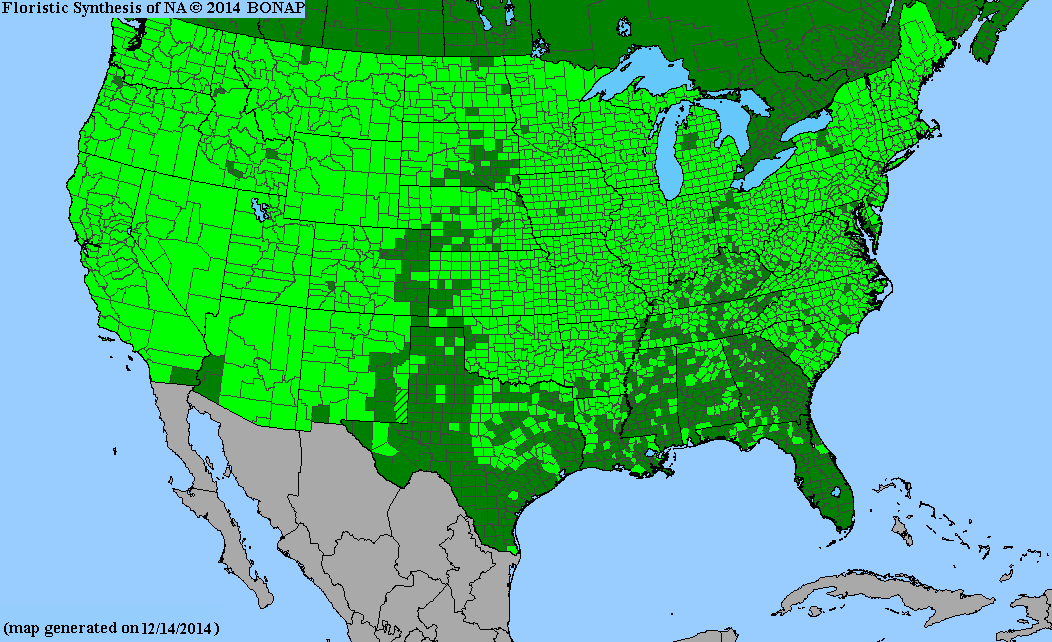
Is it native to North America? It seems like there's a lot of disagreement in the sources I usually consider.
- BONAP says it's widespread and not exotic across almost the entire contiguous US.
- NCSU Extension says it's "native to temperate regions of Europe, Asia and North America."
- Missouri Botanical Garden lists North America as part of its native range, but also says "Common yarrow from Europe and Asia was originally introduced to America in colonial times, and has since naturalized throughout the U. S. primarily along roadsides, fields, waste areas and lawns."
- Flora of the Southeastern United States says it's exotic: "Native of Eurasia. Only a few collections of the European races of the Achillea millefolium aggregate are known in eastern North America, from near old port cities"
It sounds like this plant wasn't in North America prior to European colonization — so why are sources listing it as native? Given how aggressively it spreads, wouldn't we be concerned about it being invasive?
And I'm not trying to be pedantic or a purist or anything! I'm less concerned with the technicalities of a plant's origin, and more concerned with growing plants that have the most potential to benefit local wildlife and the least risk of displacing other native species or creating a monoculture.
I got a few seed packets from a local master gardener event; I thought they were native and was doing some research to see how to best germinate and site them, but now I'm not sure if I should plant them at all. For other North American gardeners, is it a plant you're willing to grow?
by Cold_Shine5167
9 Comments
Would also love to know more about this
It’s probably cosmopolitan and has been around for a loooong time. Potentially long enough that there were distinct American and Eurasian populations that have been all mixed together since european colonization. I have it in my garden and it’s tough but I wouldn’t call it a bully. It can spread and fill out in the area around where you plant it but it doesn’t really take over ime. It’s a really good starter plant – fills the space, tolerates basically any conditions, nice foliage, flowers are visited by tons of stuff, kind of fades in to the background honestly.
It was. Yarrow is one of those rare plants that still has a circumpolar distribution. Red raspberries are another. There used to be a lot more before the ice age but once the glaciers cut off the main centers of plant diversity in Asia and North America most floral biotic interchanging between Eurasia and the americas stopped.
from Michigan flora: “Achillea millefolium, as treated here and in most other recent works, is a polyploid complex of native and introduced plants that hybridize and intergrade with one another. There is an apparent gradient from north to south in decreasing incidence of dark-bordered phyllaries (with various shades of intermediate and light brown also occurring). Plants with rays light to deep pink are rather frequently found. Some of the deepest magenta shade are doubtless cultivars of the Eurasian species and some may well be (as documented in Quebec) pentaploid hybrids. Native tetraploids tend to have a lighter rosy shade.”
https://michiganflora.net/record/207
so it always had a cosmopolitan distribution, and has gotten more mixed up, genetically.
I grow it in some corners
*Achillea millefolium* is a species that has Northern circumpolar distribution so it really is from both North America and Eurasia. However there are local subspecies and sub *sub* species:
Achillea millefolium subsp. millefolium:
A. m. subsp. m. var. millefolium – Europe, Asia
A. m. subsp. m. var. borealis – Arctic regions
A. m. subsp. m. var. rubra – Southern Appalachians
A. millefolium subsp. chitralensis – western Himalaya
A. millefolium subsp. sudetica – Alps, Carpathians
Achillea millefolium var. alpicola – Western United States, Alaska[11]
Achillea millefolium var. californica – California, Pacific Northwest[12][13][14]
Achillea millefolium var. occidentalis – North America[15]
Achillea millefolium var. pacifica – west coast of North America, Alaska[16]
Achillea millefolium var. puberula – endemic to California
And the one report says the European type hasn’t spreas far from port cities.
So its like…..don’t…don’t worry about it :,)
Same problem with dandelions
>This species includes botanical varieties that are North American natives. However, it also includes botanical varieties that are not native to North America, e.g. Achillea millefolium var. millefolium, Common Yarrow.
https://www.wildflower.org/plants/result.php?id_plant=acmi2
It sounds like there’s both – Native and non-native varieties.
Lots of sources are out dated. The most recent findings suggest that it’s exotic, kinda sorta.
There was a post in Facebook about this recently and Alan Weakly, the man in charge of Floraquest, said this.
““Achillea millefolium” IN THE BROAD SENSE is a circumboreal complex of multiple species that should be recognized. In eastern North America we have mainly native plants, especially northwards, that can be called Achillea gracilis (at least for now). At FSUS we consider the great bulk of plants encountered in the wild to be the native A. gracilis. A few decades ago, it was thought that yarrows in eastern North America were Eurasian weeds. We now know that they are genetically closely related to western North American plants, and are natives of North America. We don’t really know what we would see (yarrow-wise) if we got in a Time Machine and went back 500 years, or 15,000. I suspect we’d see native yarrow in colder parts of the Southeast (like NC Mountains), but maybe not in the Coastal Plain. But we give yarrow (as A. gracilis) the benefit of the doubt as native.
European Achillea millefolium IN A NARROW SENSE is has also been documented in the eastern US, as a rarity around old seaports, maybe no longer present”
https://m.facebook.com/groups/ncnpf/permalink/10164446427431763/?comment_id=10164447014251763
It’s a bit more complicated than a binary native/non-native. Achillea millefolium is actually a very genetically diverse group, as are many others in the Asteraceae family.
[One phylogenetic study](https://onlinelibrary.wiley.com/doi/abs/10.2307/25065957) suggests that
>*A. millefolium* agg., shaped by successive cycles of differentiation and hybridization + polyplodization, has expanded stepwise from Europe and SW Asia to E Asia, then to N America and finally world-wide with *A. millefolium*-6x as a weed.
So, most likely, it spread through Asia and the Bering land bridge (now strait) into North America sometime in the last 1-2 million years, and then got hit again by the European variants when the colonizers brought it with them.
Some sources now split Achillea millefolium into a Eurasian taxon (A. millefolium) and one or more American taxa (A. borealis being the main one). This is recent and not yet widely accepted, so it depends on which source you consult. Ultimately, some member of the A. millefolium complex is native to the Americas, yes.