
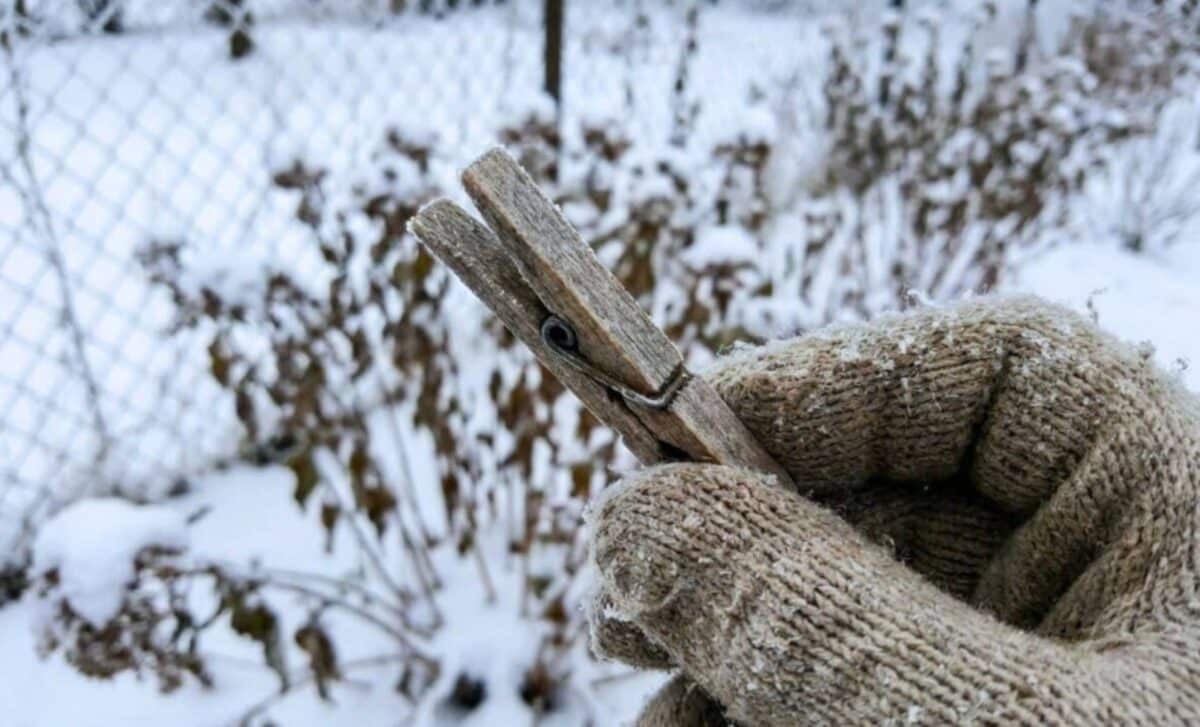
On clear, still nights, when the sky acts as a heat sink drawing warmth upward from the soil, the difference between crop survival and crop loss can come down to a few degrees of retained heat. For generations, gardeners in cold climates understood this intuitively, even if they lacked the terminology to describe radiative heat transfer. They covered their plants with whatever fabric was at hand and weighed down the edges with stones, bricks, or whatever heavy objects the shed could provide.
What they may not have anticipated is that the mechanical weak point in this system, the seal between cover and ground, would eventually attract the attention of researchers studying yield variability in Chinese cabbage. And they almost certainly did not foresee that a spring-loaded wooden clothespin, repurposed from the washing line, would become part of the conversation about adapting to increasingly erratic winter weather.
The practice has no official entry in most agricultural extension manuals. Yet by early 2025, documentation of gardeners using clothespins to secure frost protection fabric had spread through growing networks across North America and parts of Europe, driven by a simple proposition: a cover is only as effective as its seal, and a clothespin can hold that seal in places where bricks and stones cannot.
What a 91 Percent Yield Increase Reveals
The stakes of proper cover fastening become clear in data from controlled cultivation trials. Researchers at the University of Agriculture in Krakow studied early spring production of Chinese cabbage, a crop sensitive to temperature fluctuations during early development.
Their findings, detailed in a study published on ResearchGate, showed that plants grown under non-woven fleece row covers had a 36 percent increase in total yield and a 91 percent increase in marketable yield compared to open-field controls. The covers reduced cold-induced stress, accelerated early growth, and substantially lowered rates of internal bolting, a stress response that triggers premature flowering and reduces crop quality.
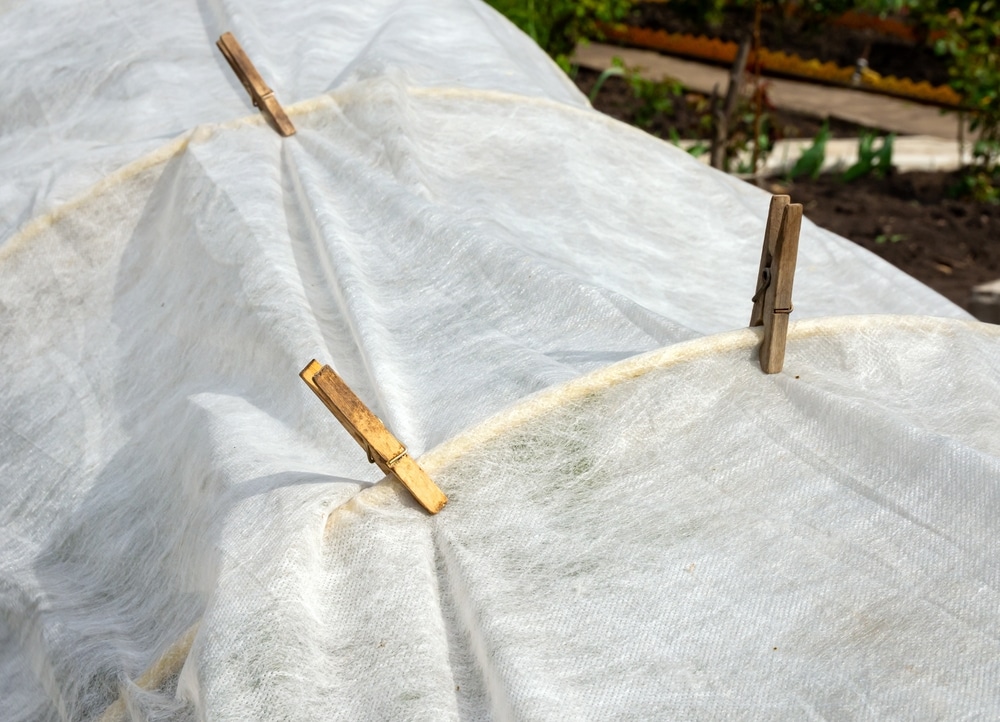 Clothespins used as fastening tools to improve insulation efficiency in small-scale row cover systems. Credit: Shutterstock
The mechanism behind these gains is well understood. Row covers trap residual soil heat and prevent radiative loss, the process by which ground and plant surfaces emit warmth into the night sky. New Mexico State University Extension guidelines note that lightweight covers typically retain two to four degrees Fahrenheit, while heavier fabrics can provide up to 10 degrees of protection. But these figures assume a complete seal. Where gaps exist at corners, along uneven ground, or where fabric lifts in wind, the insulating benefit diminishes.
Practical guidance from the University of New Hampshire Extension identifies this vulnerability explicitly. Floating row covers, lightweight fabrics designed to rest directly on plants, are especially prone to shifting in wind or sagging under condensation and frost. When covers shift, they compromise thermal retention and can transfer cold directly to plant tissue where fabric contacts foliage.
Why Gardeners Are Raiding the Clothesline
The clothespin addresses this mechanical weakness while introducing operational advantages that heavier weights cannot match. Gardeners can fasten fabric securely to hoops, bed edges, and support structures with a grip strong enough to resist wind but gentle enough to avoid damaging stems or polypropylene sheeting. They can unfasten sections for daytime venting to prevent overheating, then refasten before evening temperatures drop. The approach proves particularly useful for raised beds, container plantings, and high-density urban gardens where traditional anchoring methods prove impractical.
The technique has been documented in hoop house applications as well. A University of California system for low tunnels involves securing polyethylene sheeting to wooden stakes and support wire using clothespins, allowing covers to be opened and closed manually as conditions require. Similar adaptations have been reported by home gardeners using repurposed fencing materials as hoop supports, with clothespins securing row cover fabric to wire frames.
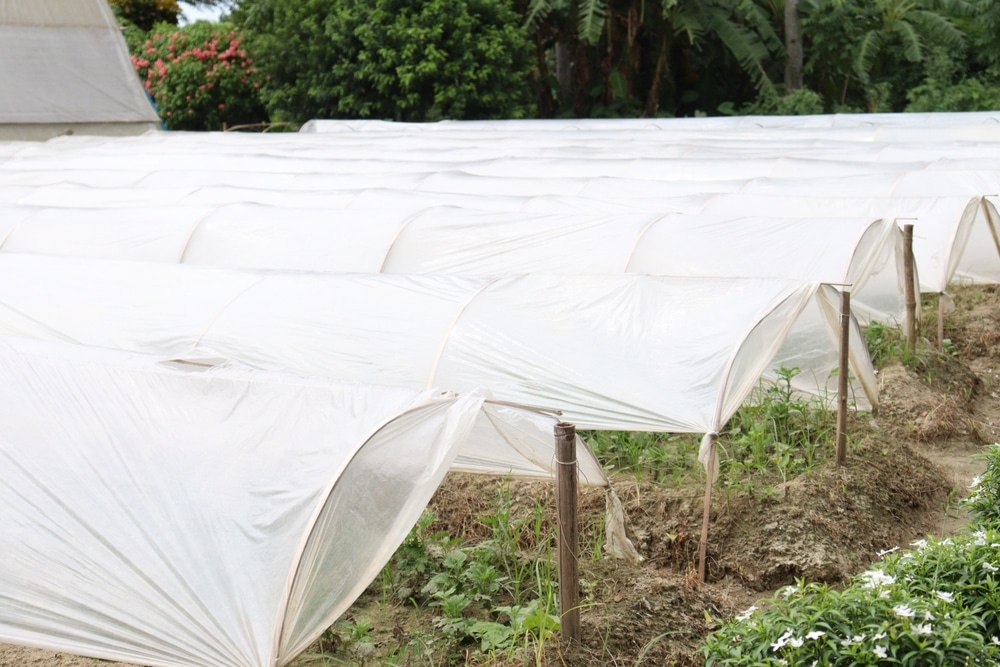 Low-cost fixation methods helping maintain ground-level seals during overnight frost exposure.Credit: Shutterstock
None of this alters the fundamental physics of frost protection. The insulating capacity of row covers remains limited by material weight and soil heat reserves. For less cold-hardy crops, even well-sealed covers may prove insufficient when temperatures drop into the mid-twenties Fahrenheit without supplemental heat or protected structures. The clothespin method buys time and extends capability, but it does not change the biological limits of frost-sensitive plants.
When Covers Must Come Off
Timing of cover removal carries consequences that no fastening method can circumvent. For insect-pollinated crops including tomatoes, peppers, and cucurbits, covers must be removed when female flowers bloom to allow pollination. Leaving covers in place too long can cause flowers to abort or fruit set to fail. In strawberry production, delayed cover removal can push flowering earlier into the season, increasing subsequent freeze risk, while restricted light and elevated temperatures may inhibit plant productivity.
The New South Wales Department of Primary Industries documented outcomes from commercial growers trialing floating row covers on mixed vegetable operations. After four to six weeks, lettuce grown under covers showed more advanced development and better quality than uncovered controls. Growers reported additional benefits including reduced insect contamination, decreased water loss, and protection from frost, wind, and light hail.
But the same favorable microclimate that accelerates crop growth can also intensify weed and pest pressures. Any insects that enter protected areas can multiply rapidly. Weeds may flourish where soil has not been treated or mulched, potentially requiring cover removal for hand weeding. These trade-offs are documented in extension literature and acknowledged by growers who adopt the method.
The Limits of Low-Tech Ingenuity
The growing interest in clothespin-secured covers reflects a larger shift in how gardeners approach season extension. Climate models suggest that irregular frost events may increase in both frequency and intensity across temperate zones, disrupting fixed planting schedules and traditional overwintering practices. In response, low-cost, adaptable strategies are gaining traction in community-based and peri-urban agriculture.
The technique spreads through gardening networks without formal endorsement from most extension services. It represents a bottom-up innovation addressing a gap between commercial-scale recommendations and the constraints of smaller spaces. Whether it remains a niche adaptation or becomes a standard recommendation in future growing guides depends on how reliably it performs as winter variability continues to escalate.
Researchers at Purdue note that for crops requiring protection below critical thresholds, 28 degrees for lettuce, 30 degrees for open strawberry flowers, row covers alone may eventually prove inadequate without integration with heated structures or fundamentally different production systems. The clothespin method addresses one variable in a complex equation. The physics of radiative heat loss is settled science.
Comments are closed.