
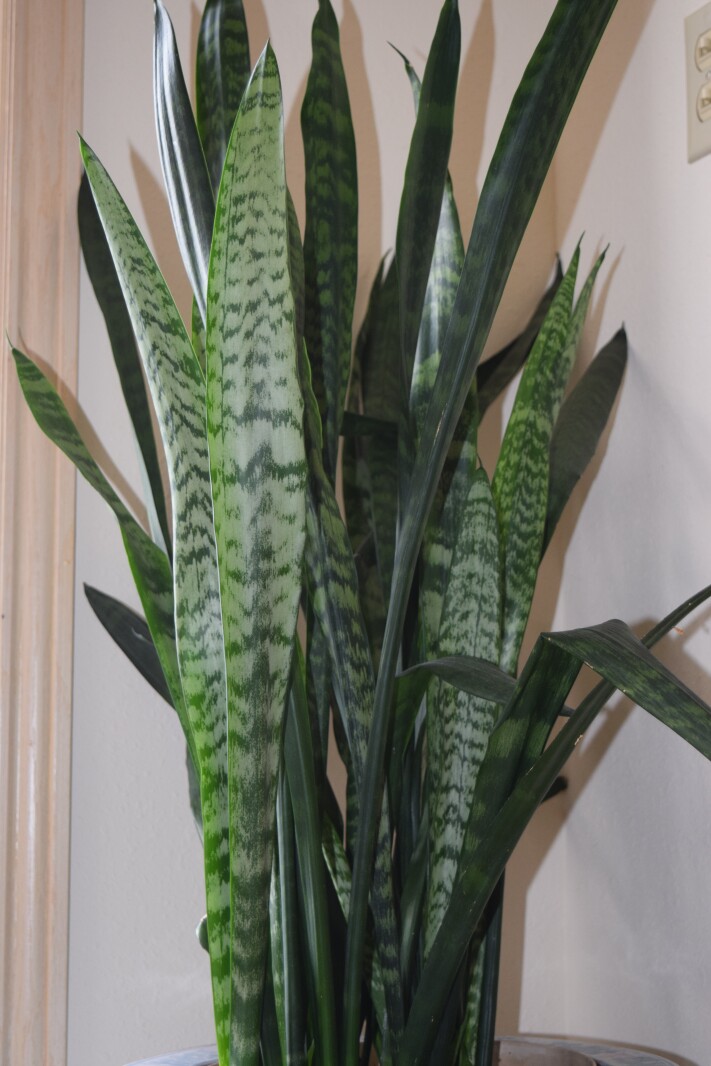
Dear Master Gardener: I have a snake plant that has gotten so tall that a few leaves have fallen over and one has broken off. What causes them to fall over? Can the leaves that have not broken off, but just fallen over recover?
Answer: Snake plant (Sansevieria), also called mother-in-law’s tongue, endures when others fail. It’s quite tolerant of neglect — dim daylight, haphazard watering, dry air — it survives! The only way to kill this plant is drowning it with too much water. Sansevieria is a succulent, so the soil needs to be kept on the dry side. The leaves will fall over from overwatering, causing mushy, rotting bases and can also fall over from underwatering, which causes weak, shriveled leaves. Sometimes tall leaves from a mature plant can fall over from their own weight, especially when the soil is very dry. Rather than watering your plant on a schedule, water it when the soil feels dry down to the first knuckle of your finger. I water mine approximately every two weeks during the fall and winter and water it a little more in spring when new growth appears. Fertilize it at half-strength no more than once a month during the spring and summer. They like low humidity, which is perfect for our dry, winter homes. A pot-bound, mature plant will send up tall spikes of dainty, white, fragrant blooms.
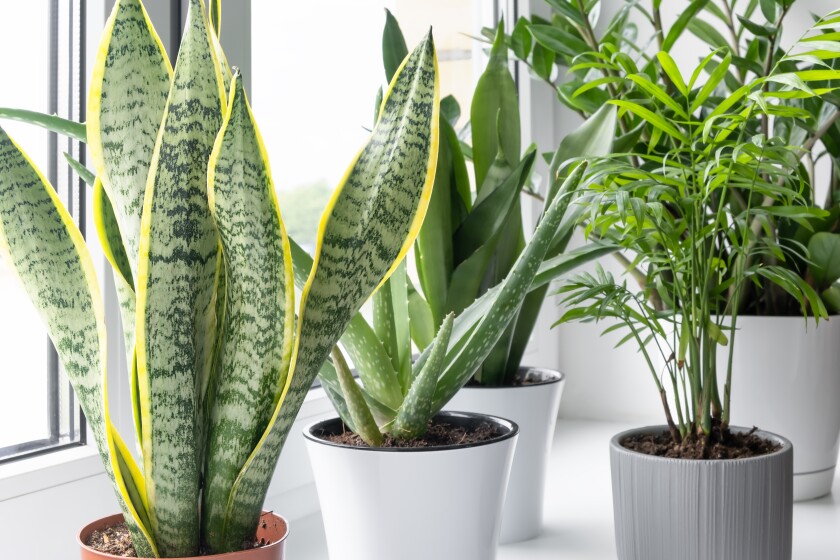
Plants such as the Sansevieria are easy to grow and tolerate low light conditions — perfect for growing indoors over the winter.
Contributed / Shutterstock
The leaves that have fallen over will not recover – they will stay flopped over. When a leaf is damaged, you can remove it by cutting it off at the soil level.
As an aside, a unique feature of a Sansevieria is its ability to convert carbon dioxide into oxygen at night. Although all plants convert carbon dioxide to oxygen, there is a group of plants (one of which is a Sansevieria) that have a kind of photosynthesis that releases the oxygen at night. This houseplant is nontoxic.
Dear Master Gardener: Is now a good time to start sowing seeds indoors? Do I need special grow lights, or can I use fluorescent shop lights?
Answer: There are some seeds that are slower to mature and need to be started earlier than others. The goal is to sow seeds so they are ready to plant after there is no threat of frost. According to the Minnesota DNR there is a 50% chance of falling below 32 degrees on May 13, 40% chance on May 16, 30%chance on May 19, 20% chance on May 23, and a 10% chance on May 27.
There are some seeds that can be started in February. Geraniums, pansies/violas, wax begonias, leeks and onions need 14-15 weeks of indoor growth. Browallia, dusty miller, fountain grass, impatiens, larkspur, lobelia, nemesia, stocks, torenia and celery need 12-13 weeks. It is best to refer to the directions on your seed packets to find out how long the germination is, whether the seeds need any other treatment before planting, and how deeply you should plant the seeds.
To start your seeds, use a growing medium that is light, porous, and sterile. Commercial seed-starting mixes are an excellent choice. If your potting mix is dry, you will want to moisten it before planting your seeds. Ideally, seeds should be planted in small, individual containers that have drainage holes, with a single seedling in each container. Onions and leeks, started from seed, are an exception, and can be started in a large flat. Covering your containers with domes or plastic wrap will help keep the soil moist and humid. You can use a spray bottle with warm water to mist the soil when it is needed. Because you want to keep your soil warm, a windowsill is a poor place for germinating seeds because it is too cold. For some seeds, the top of a refrigerator works well. You can also purchase electric heating mats, which are made for starting seeds. Keeping a continuous heat source from underneath can be very beneficial to seedlings. When the plants emerge from the soil and reach the plastic cover, you can remove it. After the seedlings get their first few leaves, feed them once a week with a water-soluble fertilizer at one-fourth strength.
You do not need to purchase special grow lights — fluorescent shop lights work very well. Hang the lights from chains to make it easier to raise them as the plants grow. Place the lights as close as 2 inches, but no more than4, to the tops of your plants for 14-16 hours each day. Because many plants need a dark period each night to develop properly, do not leave the lights on continuously.
Dear Master Gardener: Last night we turned on our outdoor lights and saw a dozen or so flying squirrels around our bird feeder. Is this unusual?
Answer: No, it is quite common, but because flying squirrels are nocturnal, most people never see them. There are two kinds of flying squirrels found in Minnesota, the southern and northern. The northern is somewhat larger and heavier than the southern. Here in central Minnesota the habitats overlap. Flying squirrels do not actually fly. Rather, they glide from post to post, sometimes traveling over 100 feet, though most glides are 20-30 feet. Folds of skin stretching from the squirrels’ ankles to wrists can be stretched taut and form planing surfaces.
The squirrels are about the size of a chipmunk; 9-11 inches long (including tail) and weigh 2 to 3 ounces. Their fur is dense, soft and silky, grey brown on the back, and white on the underside and tail. Their eyes are large and ringed with black, much like a raccoon. They nest in tree hollows and leaf nests and feed on fruits, grains, nuts, insects, and small birds. They are very fond of bird feeders. They do not hibernate and have mild dispositions.
You may get your garden questions answered by calling the new Master Gardener Help Line at 218-824-1068 and leaving a message. A Master Gardener will return your call. Or, email me at
umnmastergardener@gmail.com
and I will answer you in the column if space allows.
University of Minnesota Extension Master Gardeners are trained and certified volunteers for the University of Minnesota Extension. Information given in this column is based on university research.
Comments are closed.