
Bindweed
Credit: Marty Baldwin
Type: Broadleaf perennial
Size: Can climb to 6 feet or more
Where It Grows: Thrives in sunny landscape and garden areas
Appearance: You can recognize this garden weed by its arrowhead-shaped leaves on twisting vines. Bindweed is also known for its white to pale pink, morning glory-like flowers.
Control: Apply a layer of mulch in your garden in order to help prevent bindweed. Consistently pull or cut down growing bindweed plants that you notice. For effective removal, use a nonselective herbicide that targets roots in addition to above-ground growth.
Black Medic
Credit: Peter Krumhardt
Type: Broadleaf annual or short-lived perennial
Size: Typically grows 1-2 feet tall and 1 foot wide
Where It Grows: Prefers poor, dry soil in full sun
Appearance: This weed can easily be identified by its small, clover-like leaves and little yellow flowers. Its creeping stems form a thick, dense mat.
Control: Use mulch in your gardens in order to prevent black medic. Pull or dig out these weeds by hand, or apply an appropriate herbicide. You should also keep your soil well-watered and enriched with organic matter, such as compost, to discourage its growth.
Black Nightshade
Credit: Marty Baldwin
Type: Broadleaf annual
Size: Reaches about 2 feet tall and wide
Where It Grows: Found in rich soil areas, whether sunny or shaded
Appearance: This plant can either be bushy or climb. It features white or purple flowers and producing purple or red fruits.
Control: You can prevent black nightshade by mulching your garden. Remove the weed by hand or use an appropriate herbicide.
All parts of this plant are toxic (including the fruits) to humans and pets if swallowed.
Canada Thistle
Credit: Marty Baldwin
Type: Broadleaf perennial
Size: Can grow up to 6 feet tall and 3 feet wide
Where It Grows: Found primarily in sunny lawns, landscapes, and garden areas
Appearance: This weed is characterized by its spiny, gray-green leaves and purple flowers. Its root system is extensive, and can stretch several feet away from the main plant.
Control: In order to prevent Canada thistle, you should apply garden mulch. Use a broadleaf herbicide on lawns during the spring or fall season, or carefully dig the weed out by hand, using thick gloves to protect yourself from the sharp spines.
Chickweed
Credit: Peter Krumhardt
Type: Broadleaf annual
Size: Grows to about 6 inches tall and 12 inches wide
Where It Grows: Common in lawn, garden, and landscape areas with rich, moist soil, thriving in both sun and shade
Appearance: Chickweed forms lush green mats and are decorated with tiny, star-shaped flowers.
Control: In order to prevent chickweed in your garden, you should apply mulch in gardens or consider using a pre-emergent herbicide in early spring. Pull weeds by hand for effective management.
Crabgrass
Credit: Dean Schoeppner
Type: Grassy annual
Size: Can reach up to 18 inches tall and 20 inches wide
Where It Grows: Found in lawns, landscapes, and garden areas, thriving in both sun and shade
Appearance: This grassy weed grows roots wherever its stem touches the soil. Its seed heads spread out like four fingers.
Control: You can apply a pre-emergent weed preventer to stop crabgrass seeds from sprouting. For management, pull crabgrass by hand or use a nonselective herbicide in areas like sidewalk cracks where other plants are not present.
Types of Weed Killers
A pre-emergent herbicide works on weed seeds. It won’t have an effect once plants start to grow.
A post-emergent herbicide targets weeds that are already growing.
A broadleaf herbicide kills non-grass type plants.
A nonselective herbicide kills any plant it touches.
Creeping Charlie
Credit: Marty Baldwin
Type: Broadleaf perennial
Size: Typically grows 4 inches tall but can spread several feet wide
Where It Grows: Prefers shady lawns, landscapes, and garden areas
Appearance: This lawn weed features scalloped leaves, creeping stems, and clusters of purple flowers that bloom late in the spring season. This weed emits a mint-like aroma when mowed or crushed.
Control: Use mulch in the spring season to prevent creeping Charlie, which is also known as ground ivy. Manage it by pulling plants by hand or spraying with a post-emergent herbicide during spring or fall.
Cudweed
Credit:
Jayron / Getty Images
Type: Broadleaf annual or biennial
Size: Reaches 10 to 24 inches tall and wide
Where It Grows: Common in lawns with thin turf grass and rocky or sandy garden soil in full sun
Appearance: In the winter months, cudweed forms a low rosette that is sparsely branched, and in the spring, it grows upright with white, lavender, or yellow flowers. Its gray-green leaves are covered in woolly hairs.
Control: Encouraging dense turf grass can limit cudweed growth. You can remove individual weeds by hand or use a selective herbicide for control.
Dallisgrass
Credit:
arousa / Getty Images
Type: Perennial grassy weed
Size: Can vary from 14 inches to 5 feet tall and grows 18 inches wide or more
Where It Grows: Frequently appears in bare spots on lawns and favors sandy and clay soils in full sun or partial shade
Appearance: Dallisgrass is coarse-textured and forms an ever-enlarging circular clump. While this weed resembles crabgrass, it is much taller and has larger seed heads.
Control: You should maintain a healthy lawn and use pre- and post-emergent herbicides, or remove weeds by hand for effective management.
Dandelion
Credit: Marty Baldwin
Type: Broadleaf perennial
Size: Typically 12 inches tall, spreading 6-16 inches wide
Where It Grows: Commonly found in lawns and gardens, thriving in both sun and shade
Appearance: This familiar garden and lawn weed features a long taproot and deeply notched leaves. Its bright yellow flowers transform into puffballs, with seeds that disperse like parachutes in the wind. This allows them to spread into new spaces in lawns and garden beds.
Control: In order to prevent dandelions, make sure to use mulch in gardens. Pull the weeds by hand or treat your lawns with a broadleaf herbicide, ensuring you don’t harm the grass.
Dayflower
Credit: Marty Baldwin
Type: Annual grass relative
Size: Can grow up to 30 inches tall and wide
Where It Grows: Found in both sunny and shady landscape areas
Appearance: The dark green leaves of dayflowers sprout from a central stem. The plant showcases brilliant blue flowers throughout the summer months.
Control: You should apply garden mulch to prevent dayflower growth or use a pre-emergent herbicide in the spring. For existing weeds, pull by hand or spot-treat with a nonselective herbicide.
Dock
Credit: Peter Krumhardt
Type: Broadleaf perennial
Size: Can reach up to 4 feet tall and 2 feet wide
Where It Grows: Commonly found in landscape and garden areas, flourishing in sun or shade
Appearance: This weed is known for its large, wavy-edged leaves and prominent seed heads that are covered with brown seeds.
Control: You can use mulch to help prevent dock. In order to manage growth, you can pull and dig up the plants or treat them with an appropriate herbicide.
Fleabane
Credit: Peter Krumhardt
Type: Broadleaf annual
Size: Typically grows about 2 feet tall and 18 inches wide
Where It Grows: Thrives in landscape and garden areas, preferring sun to partial shade
Appearance: Fleabane features slender leaves that are attached to an upright, branching stem, producing small, daisy-like flowers that range from white to pale lavender in spring and early summer.
Control: You should use mulch to prevent fleabane growth. These plants are easy to remove by hand, or you can mow them down if they’ve spread across your lawn.
Henbit
Credit: Peter Krumhardt
Type: Broadleaf annual
Size: Can reach up to 12 inches tall and wide
Where It Grows: Found in lawns, landscapes, and garden areas, thriving in both sun and shade
Appearance: Henbit is a low, creeping plant that is distinguished by its scalloped-edge leaves and tiny purple flowers.
Control: Apply mulch in order to prevent henbit in gardens, or use a pre-emergent herbicide in the spring season. You can also pull the plants by hand or treat lawns with a broadleaf herbicide for effective management.
Knotweed
Credit: Marty Baldwin
Type: Broadleaf annual
Size: Typically grows up to 8 inches tall and spreads up to 2 feet wide
Where It Grows: Common in sunny or partly shaded lawn, landscape, and garden areas
Appearance: Knotweed acts as an invasive groundcover characterized by its blue-green leaves sparsely appearing on long stems.
Control: In order to prevent knotweed, you should use a deep layer of mulch or apply a pre-emergent herbicide in spring. Once the plant begins to grow, hand-pull or spot-treat it with a nonselective weed killer for effective control.
Lamb’s-Quarter
Credit: Marty Baldwin
Type: Broadleaf annual
Size: Can grow up to 4 feet tall and 18 inches wide
Where It Grows: Found in landscape and garden areas, flourishing in both sun and shade
Appearance: This weed features scalloped, triangular leaves with distinct gray undersides.
Control: In order to prevent lamb’s-quarter, you should use mulch in your garden. For management, pull the weed plants by hand or treat using a post-emergent weed killer.
Musk Thistle
Credit:
BHG/Kelli Jo Emanuel
Type: Broadleaf biennial
Size: Can reach up to 6 feet tall and 18 inches wide
Where It Grows: Prefers full sun in landscape and garden areas
Appearance: Musk thistle is noted for its prickly leaves growing off tall stems, with each stem topped by a hefty two-inch purple flower.
Control: You should apply mulch in your garden to prevent musk thistle. Manage its growth by using an herbicide or removing the weed manually by digging.
Nutsedge
Credit: Marty Baldwin
Type: Grass-like perennial
Size: Typically grows about 2 feet tall and 1 foot wide
Where It Grows: Found in lawns, landscapes, or garden areas in both sun and shade
Appearance: Nutsedge is characterized by its slender, grassy leaves and triangular stems, with small, nutlike tubers in its root system. These specific lawn weeds grow faster than your grass, making them quick and easy to spot.
Control: You should apply mulch in garden areas in the spring season to help prevent nutsedge. While they are relatively easy to pull up by hand, getting rid of an infestation requires repeated efforts. Use an herbicide specifically labeled for nutsedge, ensuring it’s suitable for the type of turf grass you have to prevent damage.
Oxalis
Credit: Marty Baldwin
Type: Broadleaf perennial
Size: Can grow up to 20 inches tall
Where It Grows: Thrives in sunny or shady landscapes, as well as lawns and garden areas
Appearance: Oxalis is identifiable by its light green leaves that somewhat resemble clovers, along with cup-shaped yellow flowers that bloom in the summer and fall months.
Control: In order to prevent oxalis, you should apply mulch in garden areas during spring. For control, pull the weeds by hand or use a broadleaf herbicide in spring or fall.
Pigweed
Credit: Marty Baldwin
Type: Broadleaf annual
Size: Typically reaches 6 feet tall and 2 feet wide
Where It Grows: Found in sunny landscapes or garden areas
Appearance: Pigweeds are tall plants that have a taproot. They can be identified by their clusters of hairy-looking green flowers. However, some varieties are cultivated as annuals.
Control: In order to prevent pigweed, you should mulch garden areas in spring or use a pre-emergent herbicide. Manage existing weeds by pulling them by hand or using a nonselective weed killer for spot treatment.
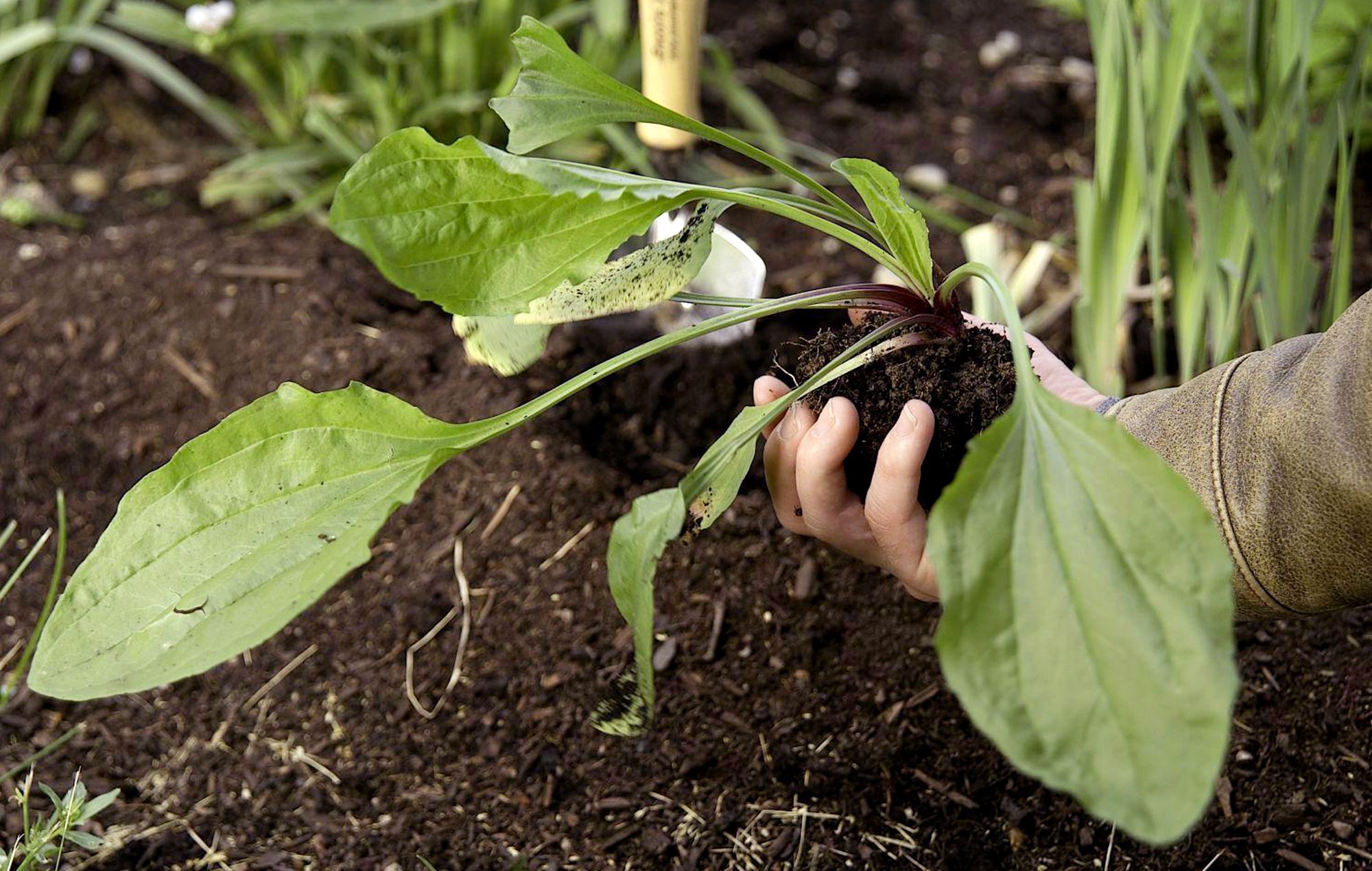
Plantain
Credit: Denny Schrock
Type: Broadleaf perennial
Size: Can grow up to 8 inches tall and 12 inches wide
Where It Grows: Common in moist lawn and garden areas, thriving in both sun and shade
Appearance: When identifying weeds growing in your garden, broad, flat, oval-shaped leaves arranged in a low rosette likely indicate a plantain is present.
Control: You can use mulch to prevent plantains from growing in the garden. For removal, pull by hand or, if they occur as lawn weeds, treat with a post-emergent herbicide.
Poison Ivy
Credit: Marty Baldwin
Type: Broadleaf perennial
Size: Can grow up to 15 feet tall and wide
Where It Grows: Found in both sunny and shady landscape or garden areas
Appearance: Poison ivy may grow as a vine, shrub, or groundcover. It has leaves divided into three leaflets and can produce clusters of green berries.
Control: To prevent poison ivy, you should apply a deep layer of mulch. If it begins growing in your yard, spot-treat the plant with an herbicide or wrap your hand in a plastic bag, pull up the plant roots and all, then carefully invert the bag to seal and discard it.
All parts of poison ivy contain oils that cause a severe allergic skin reaction in many people on contact. These oils are present even in dead leaves and can become airborne and inhaled if the plant is burned.
Pokeweed
Credit: Marty Baldwin
Type: Broadleaf perennial
Size: Up to 10 feet tall and 2 feet wide
Where It Grows: Sunny landscape or garden areas
Appearance: Identify this garden weed by its large, oval, light green leaves, clusters of white flowers, and dark purple berries.
Control: Prevent pokeweed seeds from germinating with a deep layer of mulch. Once the plant grows, hand-pull or spot-treat it with an herbicide.
Prostrate Spurge
Credit:
BHG / Kelli Jo Emanuel
Type: Broadleaf annual
Size: 3 inches tall, 18 inches wide
Where It Grows: Lawn, landscape, and garden areas with dry soil
Appearance: Green or purple-blushed leaves of prostrate spurge form dense mats anchored by a shallow taproot. Tiny but prolific flowers appear all along stems through summer.
Control: Mulch your garden to prevent prostrate spurge or use a pre-emergent herbicide in lawns. Pull weeds when young or spot-treat with an herbicide.
Purslane
Credit: Marty Baldwin
Type: Broadleaf annual
Size: Up to 6 inches tall and 2 feet wide
Where it grows: Dry, sunny landscape and garden areas
Appearance: Identify this weed groundcover by its fleshy, dark green leaves and small yellow flowers at the ends of the stems.
Control: Mulch your garden to prevent purslane or use a pre-emergent herbicide in the spring. Pull plants by hand or spot-treat with a nonselective herbicide.
Quackgrass
Credit: Peter Krumhardt
Type: Grassy perennial
Size: Up to 3 feet tall and several feet wide
Where It Grows: Landscape and garden areas in sun or shade
Appearance: This garden weed has wheatlike flower spikes, which appear above slender clumps of grassy foliage.
Control: Mulch your garden well to prevent quackgrass. Dig plants out by hand, being sure to remove every bit of root. Spot treat with a non-selective weed killer.
Quickweed
Credit: Marty Baldwin
Type: Broadleaf annual
Size: Up to 2 feet tall and wide
Where It Grows: Sunny landscape and garden areas
Appearance: Quickweed has jagged, hairy leaves and tiny white daisy-like flowers in summer.
Control: Use mulch or a pre-emergent herbicide in spring to prevent quickweed. If plants do grow, pull them by hand.
Ragweed
Credit:
Kelli Jo Emanuel / BHG
Type: Broadleaf annual
Size: Up to 4 feet tall and 2 feet wide
Where It Grows: Landscape and garden areas in sun or partial shade
Appearance: Ragweed has finely cut green leaves that are almost fern-like.
Control: Mulch your garden to prevent ragweed. Use a post-emergent herbicide or pull it out by hand.
Red Deadnettle
Credit:
Wirestock / Getty Images
Type: Broadleaf winter annual
Size: 4 to 12 inches tall, 12 inches wide
Where It Grows: Sunny areas
Appearance: The plant has square stems and light purple flowers with a tubular shape. New leaves have a purplish tinge.
Control: Use a post-emergent herbicide before the weed flowers or remove individual weeds by hand.
Smartweed
Credit: Marty Baldwin
Type: Broadleaf annual
Size: Up to 42 inches tall and 30 inches wide
Where It Grows: Sunny landscape and garden areas
Appearance: Identify smartweed by its lance-shape leaves often marked with purple chevrons. It’s an upright plant with pink or white flowers in summer and fall.
Control: Mulch garden beds in spring to help prevent seeds sprouting. Pull plants that do pop up by hand or spot treat with an herbicide.
Stinging Nettle
Credit: Denny Schrock
Type: Broadleaf perennial
Size: Up to 6 feet tall and 3 feet wide
Where It Grows: Garden areas with rich, moist soil
Appearance: This garden weed has sawtooth-edge leaves covered with tin stinging hairs. Greenish yellowish flower clusters appear in spring and summer and seeds ripen in fall.
Control: Mulch to prevent stinging nettle. Dig out weeds or treat with an herbicide.
The needle-like hairs on nettle leaves can irritate skin when touched, so always wear gloves when removing this plant or working around it.
Persian Speedwell
Credit:
Bob Stefko
Type: Broadleaf annual
Size: Up to 8 inches tall and 1 foot wide
Where It Grows: Rich, consistently moist soil in full to part sun, especially in freshly disturbed areas.
Appearance: This common garden and lawn weed forms low-growing mats of small green leaves with toothed edges in cooler months, and fades away in summer. Tiny blue or purple flowers with a white center appear in late winter into early summer.
Weed Control: Mulch garden beds to prevent speedwell seeds from sprouting. In lawns, encourage dense grass growth to shade out weeds. Use a pre-emergent herbicide in early spring or a post-emergent herbicide later in the season before the plants can set seeds.
Velvetleaf
Credit: Marty Baldwin
Type: Broadleaf annual
Size: Up to 6 feet tall and 3 feet wide
Where It Grows: Fertile, sunny landscape and garden areas
Appearance: Velvetleaf gets its name because of its large, velvety heart-shape leaves up to 10 inches across. The weed has yellow flowers in summer.
Weed Control: Mulch your garden to prevent velvetleaf or use a pre-emergent herbicide in spring. Pull existing plants by hand or use a post-emergent herbicide.
White Clover
Credit: Marty Baldwin
Type: Broadleaf perennial
Size: 8-10 inches tall, 12 inches wide
Where It Grows: Lawn, landscape, and garden areas in sun to partial shade
Appearance: White clover has distinctive three-lobed leaves and round white flower clusters. The plants quickly spread outward to form dense mats of foliage.
Control: Mulch your garden beds to prevent white clover in landscape areas. Use an iron-based herbicide to get rid of clover growing in lawns or dig out the weeds in garden beds.
Wild Violet
Credit: Marty Baldwin
Type: Broadleaf perennial
Size: 6 inches tall, 6 inches wide
Where It Grows: Shady lawn, landscape, or garden areas
Appearance: Wild violet forms a dense groundcover with its heart-shaped leaves. Small purple flowers appear in late spring.
Control: Mulch garden beds in spring to prevent wild violet. Pull weeds by hand or spray with a broadleaf herbicide in spring or fall.
Violet flowers are edible, but never eat the blossoms after applying herbicides.
Yellow Salsify
Credit:
Kelli Jo Emanuel / BHG
Type: Broadleaf biennial or short-lived perennial
Size: Up to 3 feet tall and 2 feet wide
Where It Grows: Sunny landscape and garden areas
Appearance: Spot yellow salsify by its gray-green leaves. Yellow flowers on the plant are followed by large puffballs of seeds.
Control: Mulch your garden to prevent yellow salsify. Pull plants by hand or spot treat with a post-emergent herbicide.
Yellow Sweet Clover
Credit: Peter Krumhardt
Type: Broadleaf annual
Size: 1-3 feet tall, 12-18 inches wide
Where It Grows: Landscape and garden areas
Appearance: Identify this garden weed by its slender, lanky branches, clover-like leaves, and fragrant yellow flowers.
Control: Mulch your garden to prevent yellow sweet clover. Pull plants by hand or spot-treat with an herbicide.
Comments are closed.