

It’s pruning time for shrub roses, hydrangeas, gardenias, and other summer-blooming shrubs.
And yes, even crape myrtles and vitex – for those who choose to do so.
Last week, someone beat me to a crape myrtle I harvest every year for material to maintain a woven-wattle herb border at the Ag Museum in Jackson. I expertly pollard the tree, pruning long, limber stems back to thick knobs.
I know some folks think this is unnatural. Sure, and so is shaping boxwoods into big green spheres, espaliering a magnolia flat against a wall, or plucking natural eyebrows.
We shape all kinds of shrubs and small trees: sheared, balled, pyramided, espaliered, bonsaied, sculpted, and topiaried into fantastic forms. Two common examples are the ancient Japanese art forms niwaki – or “floating clouds,” which some call “poodle plants” – and kobushishitate, or “fist pruning,” which creates balls on the ends of stems. Even arborists with the Royal Horticultural Society do it across England.
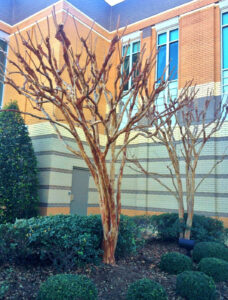
A carefully pruned crape myrtle shows off clean lines and well-thinned branches, demonstrating proper pruning techniques that maintain the tree’s natural shape while promoting healthy growth. Photo Courtesy of Felder Rushing
Wait – is pruning crape myrtles a horticultural sin?
The first time I heard the term “crape murder” – the widespread ruining of perfectly healthy crape myrtles – was from my old friend Steve Bender, senior garden editor for Southern Living magazine. The term originally described pruning plants down to thick, bare trunks without regard for their natural shape or thinning the “witch-broom” sprouts. It’s, frankly, butchery.
What started as an insider joke about bad pruning went mainstream. Garden writers, Master Gardeners, and others latched onto the catchy term, creating a climate where few dare touch a crape myrtle without criticism – even though crape myrtles are nearly impossible to kill. Shear one to the ground with a pickup truck, and it will sprout back quickly as a flowering shrub.
The truth is this: to prune – or not to prune – a crape myrtle or vitex is a matter of personal style, not a horticultural commandment. Sure, it may look odd to some, but it comes down to preference. And it’s not my place to criticize – or applaud – a practice that doesn’t matter much in the big picture, any more than I would comment on what someone does with a poodle dog.
That said, there is a proper way to prune crape myrtles without harming their natural shape. Start by cutting out sprouts growing straight up from the base or inner limbs. Then thin cluttered limbs and branches, being careful to avoid leaving stubs that can rot. If an entire tree needs size control, prune in layers, cutting trunks at different heights rather than straight across. Finally, return later to thin weak “witch-broom” sprouts, keeping only the strongest two or three. And remember – there’s no horticultural purgatory if you make a mistake.
Historic, useful, and decorative practices like pruning, shaping, and pollarding do not harm crape myrtles or vitex. If you don’t like the look, don’t do it. If you do, know you are in good company around the world.
For examples of well-pruned and historic pollarded crape myrtles, visit my blog.
Felder Rushing is a Mississippi author, columnist, and host of Gestalt Gardener on MPB Think Radio. Visit his blog at felderrushing.blog or email gardening questions to [email protected].
Posted in Columns
Quality, in-depth journalism is essential to a healthy community. The Dispatch brings you the most complete reporting and insightful commentary in the Golden Triangle, but we need your help to continue our efforts. In the past week, our reporters have posted 36 articles to cdispatch.com. Please consider subscribing to our website for only $2.30 per week to help support local journalism and our community.
Comments are closed.