
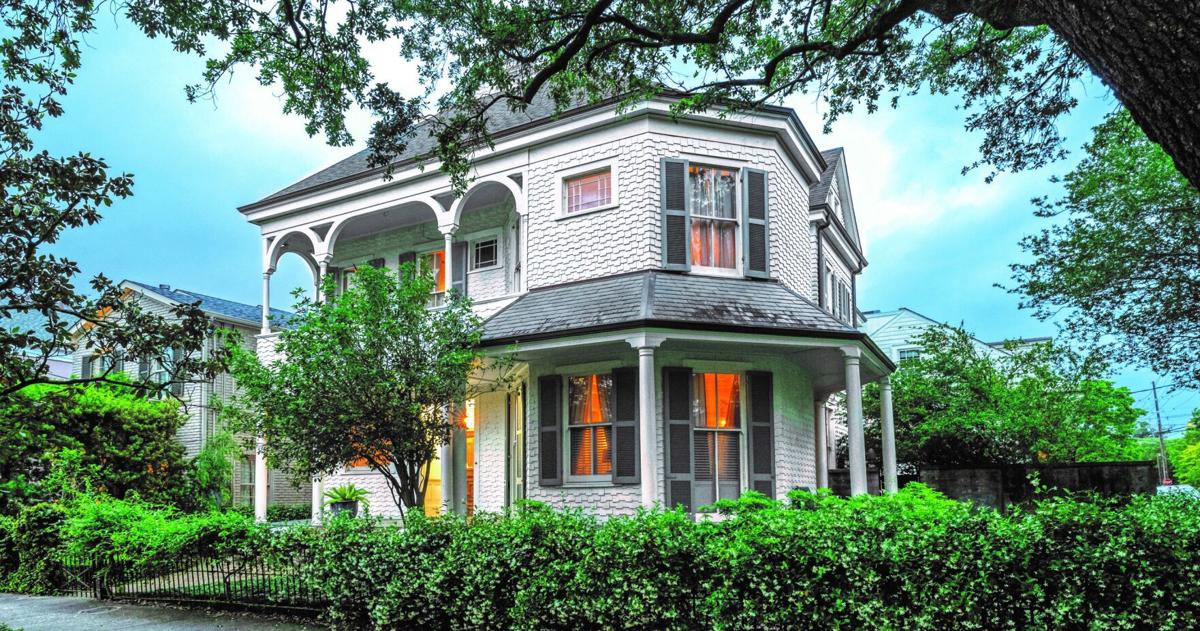
The Garden District Association has put together a new book that offers a comprehensive history of the iconic, landmark neighborhood. And what better time to consider “New Orleans Garden District: Profiles in Preservation” than when eyes are turned to the neighborhood while Carnival parades roll down St. Charles Avenue?
A seven-year labor of love by dedicated souls who cherish the city’s history, the book was produced by the association as part of its Profiles in Preservation Program, chaired by Andrea St. Paul Bland.

The Camors Waters House on Chestnut Street is notable for its perfect symmetry and proportions. The classic raised American cottage was built in the early 1850s.
PROVIDED PHOTO BY DAVID SPIELMAN
The project created individual house histories for each of the 100 participating homeowners detailing the history of each house from bare earth to the present.
Bronze plaques were created to share that history with neighborhood visitors.
In time, a self-guided tour will be mapped out so visitors can locate the houses with the plaques and learn their stories.
The Abraham Kahn House on Seventh Street, built circa 1900, ‘is neither Greek Revival, like one neighboring home, nor asymmetrically Queen Anne like the other.’
PROVIDED PHOTO BY DAVID SPIELMAN
Also featuring more than 300 pages of lush photographs, this tome goes well beyond the coffee table books of historic homes.
The history of each home begins with the story of its owners, bringing to life, among others, the stories of women who were able to own property free of their husbands thanks to our French- and Spanish-based law. There are also histories of property ownership by free people of color in antebellum New Orleans.
The circa 1860 Bosworth Hammond Fox house on Washington Avenue was once cited by the city as blighted and was named as one of Louisiana’s most endangered historic properties. It was restored in the early 2000s.
PROVIDED PHOTO BY DAVID SPIELMAN
Like most historic neighborhoods, the Garden District has periods of boom and bust. Several pages are devoted to archival photographs of buildings lost to redevelopment.
Most demolitions occurred between 1950 and the mid-1970s before the creation of historic districts or, at the very least, a demolition review process.
On the bright side, what remains is a fantastic architectural collection in a shaded garden setting. The neighborhood has bloomed in recent years with many new homeowners joining long-term residents in maintaining this special place.
Prior to 1870, the most popular architectural styles in the neighborhood were American cottage, Greek Revival, Italianate and a smattering of Gothic Revival. The final quarter of the 19th century witnessed the rise of Queen Anne, Eastlake and shingle-style homes. The neoclassical revival and colonial revival styles appeared as we rolled into the 20th century.
The Soria Creel House on Prytania Street is a late Italianate-style home built in 1875. Over its nearly 150-year history, only two families have owned it.
PROVIDED PHOTO BY DAVID SPIELMAN
Photographer David Spielman took thousands of images over the seven-year period but said there actually was a surprisingly small window for his work.
For exterior shots, he had to find periods when homes were not in holiday dress for Halloween, Christmas or Carnival, he explained, and before midsummer heat began to play havoc with gardens.
Interior photography also required working within the schedules of 100 homeowners.
The interior photos were taken without additional lighting. The results are softly lit images with highlights and shadows that offer a more natural appearance.
Other members of the Garden District Association committee behind the project include Shelley Landreau, program director and the association’s executive director; historians Sally Reeves and Hilary Irvin; and graphic designer Laura Moise.
A book signing is scheduled at 5 p.m. Feb. 27 at Garden District Book Shop at The Rink, 2727 Prytania St. Signers will include Spielman, Reeves and Irvin, and historian Howard Hunter. The book, published by 83 Press, is $95.
GARDEN DISTRICT CLIFF NOTES
1832: Marie Celeste Marigny Livaudais sells land to a group of Americans who plan a suburb that would become the Garden District.
1833: The subdivided land becomes the City of Lafayette, laid out by New Orleans architect, planner and surveyor Barthelemy Lafon. Each square block is divided into four lots to accommodate large homes set in lush gardens.
1852: The City of Lafayette is annexed into the City of New Orleans as its Fourth District.
1939: Residents form the Garden District Association to preserve the residential integrity and quality of life of the neighborhood.
1971: The Garden District is placed on the National Register of Historic Places in recognition of its great number of well-preserved 19th-century homes representing a range of architectural styles.
THE AMERICAN WAY: The American influence on this neighborhood is visible in many ways. The large plots with homes set back from the street were a distinct change from earlier neighborhoods, which were more densely developed in a more Old World manner.
Even the streets in the Garden District were named in that most American manner: with numbers.
DRAWING THE LINES: The Garden District is one of the most distinctive of the city’s 63 neighborhoods, as recognized by the Planning Commission. Its boundaries are most often recognized as St Charles Avenue to Magazine Street between Jackson and Louisiana avenues. It remains very much the garden suburb envisioned in 1832, but now set within an urban context.
Louis J. Aubert is a professional member of the American Society of Interior Designers and an avid preservationist. Some of his most visible New Orleans projects include making interior color selections for Gallier Hall, Trinity Episcopal Church and the Louisiana Supreme Court Royal Street Courthouse, and both interior and exterior selections for St. Stephen’s Basilica. Contact him at mrcolour@aol.com.
Comments are closed.