
Right now you would be forgiven for forgetting that we live in the driest part of the country, if it were not for the daily reminders on the news and on social media that others, especially in the west country, are struggling with so much more rain and lots of flooding.
Even here it has been pretty relentless, and for the first time ever, this week we could not do the outside seed sowing exercise on the Certificate in Practical Horticulture course because the ground was waterlogged.
Areas of the field where we teach the practical courses have become so muddy that they are impossible to walk on without slipping.
Certificate in Practical Horticulture seed sowing exercise (Image: Norfolk School of Gardening)
Was it really only last summer when we were saving washing-up water to give our plants a drink and considering how viable some of our planting would be in a drought-blighted future?
Of course, we may have another dry summer, and our problem is that, like so many people, we do not have a way to capture and store all this rainwater for longer-term use, so we will be once more at the mercy of the increasingly challenging weather.
The kind of water storage we would need is very expensive and it is impossible to know whether it would be a good investment right now, even if we had the necessary cash.
For the moment we will have to carry on, like all of you, and spend a lot of time talking about, dealing with and sometimes bemoaning, our erratic weather.
Happily, we had one dry day this week when Jenny ‘Niff’ Barnes returned for one of her sell-out Rose Scultpting workshops.
Holme Hale Hall garden from the greenhouse (Image: Norfolk School of Gardening)
If you haven’t yet discovered Niffing do take a look at our social media or find it online.
It is a wonderful way to create sculptural shapes out of your roses and turn them into focal points in your winter garden when they are normally all but invisible.
Jenny’s workshops are hugely popular and the next ones, in October, are already filling up, with people coming from as far away as California (USA, not Norfolk).
Get in touch if you would like one of the remaining spaces and learn how to Niff.
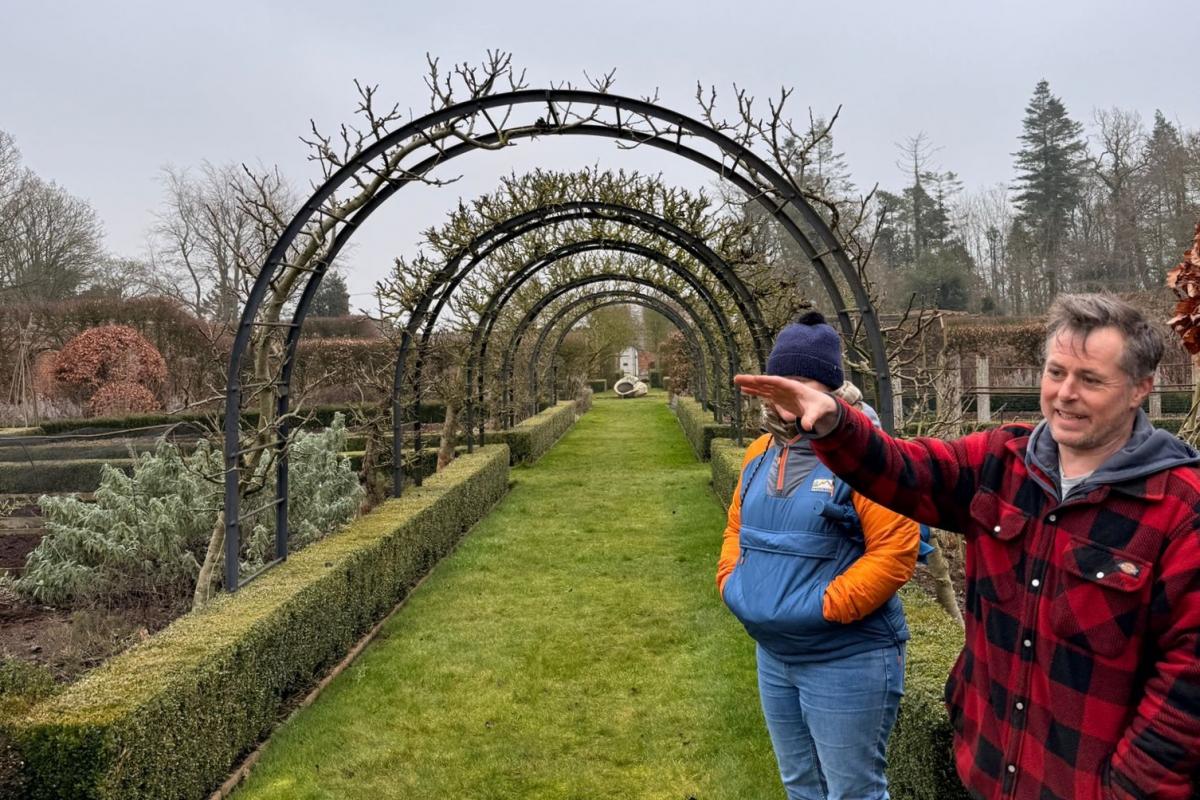
The Introduction to Garden Design students spent a study day at Holme Hale Hall, immersing themselves in the gardens which were designed by Arne Maynard and which look fantastic even in the depths of winter.
The bones of a well-designed garden are, in themselves, a thing of beauty.
Jenny ‘Niff’ Barnes explains rose sculpting (Image: Norfolk School of Gardening)
There are structures, bare shrubs, grasses and seedheads which stand through the winter months, but also the clipped shapes of topiarised yew, beech and box balls.
It is always a treat to spend time in these gardens.
There are some great courses coming up which still have spaces.
Let us know if you would like to join one of these:
· Pruning Shrubs & Roses – 4th March
· Willow & Hazel Plant Supports – 11th March
· Advanced Practical Gardening – 18th March
· Plants for Free (propagation workshop) – 25th March
Ribes laurifolium2 (Image: Norfolk School of Gardening)
Plant of the Week
Ribes laurifolium is a handsome, evergreen shrub native to western China, valued for its glossy, laurel-like leaves and early-season interest.
In late winter and early spring, it produces drooping racemes of small, creamy-white flowers, often lightly scented and attractive to early pollinators.
These may be followed by dark berries.
It forms a dense, upright shrub, reaching around 2–3 metres, making it useful for screening, at the back of a mixed border or trained up a wall.
Grow in sun or partial shade in moist but well-drained soil.
Contact us via www.norfolkschoolofgardening.co.uk or follow us on Instagram or Facebook.
Comments are closed.