
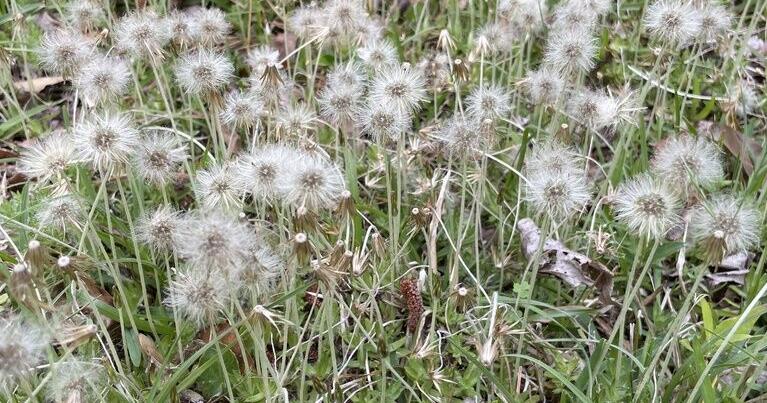
Extension agents across North Carolina sometimes share questions they have with other agents across the state. These questions usually end up being incredibly insightful, so when a plant identification request came across the line about a sample someone brought in, I knew we were in for a treat.
Gardeners can be the first line of defense against biological invasions. We spend more time looking at the ground than almost anyone else, noticing every new sprout and leaf. But sometimes, a new arrival is so subtle that it hides in plain sight for years before we realize the neighborhood has changed.
Enter Chevreul’s sharp lawn-weed, Chevreulia acuminata, a diminutive, silver-tinged weed in the sunflower family. Originally detected in Alabama in 2012, it is now quietly making itself at home in North Carolina lawns.
The Hitchhiker’s Guide to North Carolina
How does a plant native to South America (specifically Argentina, Bolivia, Brazil, Ecuador, Peru, and Venezuela) end up in a backyard inNorth Carolina? The answer lies in the incredible ways plants move.
Plants are the ultimate hitchhikers. They don’t need a passport; they just need a ride. Chevreulia acuminata likely arrived through one of three common pathways. Our interconnected world makes it easy for seeds and plant parts to hitch a ride on a global route. For example, seeds can hide in the root balls of ornamental plants or in shipments of bulk seed.
One strategy that is happening in plain sight is lawn care equipment. Landscaping equipment that isn’t cleaned between properties can carry stolons (creeping stems) or seeds from one lawn to the next; introducing a potential issue with each site change.
Finally, and most effectively, the wind can easily move plants around. This plant produces small, tufted seeds similar to a dandelion, allowing it to “balloon” across miles of landscape.
Identifying the New Arrival
Chevreul’s sharp lawn-weed is a low-growing perennial that often gets mistaken for common cudweed or Virginia buttonweed. Always remember: leaves are misleading and many plants can share a similar leaf structure without even being related.
There are a few identifying characteristics you can look for to help identify Chevreul’s sharp lawn-weed. The most striking feature is the underside of the leaves, which are covered in fine, white hairs, giving them a silvery or “woolly” appearance. This characteristic can be diluted when the plant is wet. This plant has a prostrate habit, growing in dense, flat mats that hug the ground, allowing it to survive even the lowest mower settings. The most obvious time to see it would be in the spring (if you haven’t mowed in a while) when it produces tiny, brownish-white flower heads that look like miniature, un-opened dandelions.
Why ‘New’ Matters: The Power of Observation
You might ask, “It’s just a small weed, why does it matter?” In the world of ecology, we talk about the Invasion Curve. When a plant first arrives, it is easy and cheap to eradicate. However, if we ignore it because of plant blindness—the tendency to see all green things as the same—the plant’s presence in the landscape and ecosystem can reach a tipping point. Once a plant like Chevreulia becomes established, it has the potential to outcompete native species and become a permanent, costly burden for farmers and homeowners alike.
By paying attention to “new” plants on your property, you aren’t just weeding; you are acting as a mindful steward of your local ecosystem.
How to Report a Stranger
If you see a plant that you don’t recognize, don’t just pull it and toss it. Help us record these occurrences across North Carolina.
Take a Photo: Take a clear picture of the leaves (top and bottom) and any flowers.
Use iNaturalist: This app is a powerful tool for researchers to see real-time “heat maps” of where plants are appearing.
Contact Us: Feel free to bring a sample (in a sealed plastic bag) to your local NC Cooperative Extension Office. We can send photos to the NC State Herbarium for official identification.
Early Detection is the Best Cure
As we move into the 2026 growing season, I challenge you to look a little closer at your lawn. If you see a silver-leaved mat creeping between your grass blades, don’t let it become a permanent resident. Let’s work together to keep our North Carolina landscapes healthy and free of uninvited hitchhikers.
Resources
Amanda Bratcher is the horticulture agent with NC Cooperative Extension- Lee County Center. You can reach out to the office at 919-775-5624 for more information or questions regarding this article, but also any other questions about your garden, farm, land or plants! We’re here to help! You can check out our website at https://lee.ces.ncsu.edu/events/ for more information and to register for upcoming programs.
Comments are closed.