
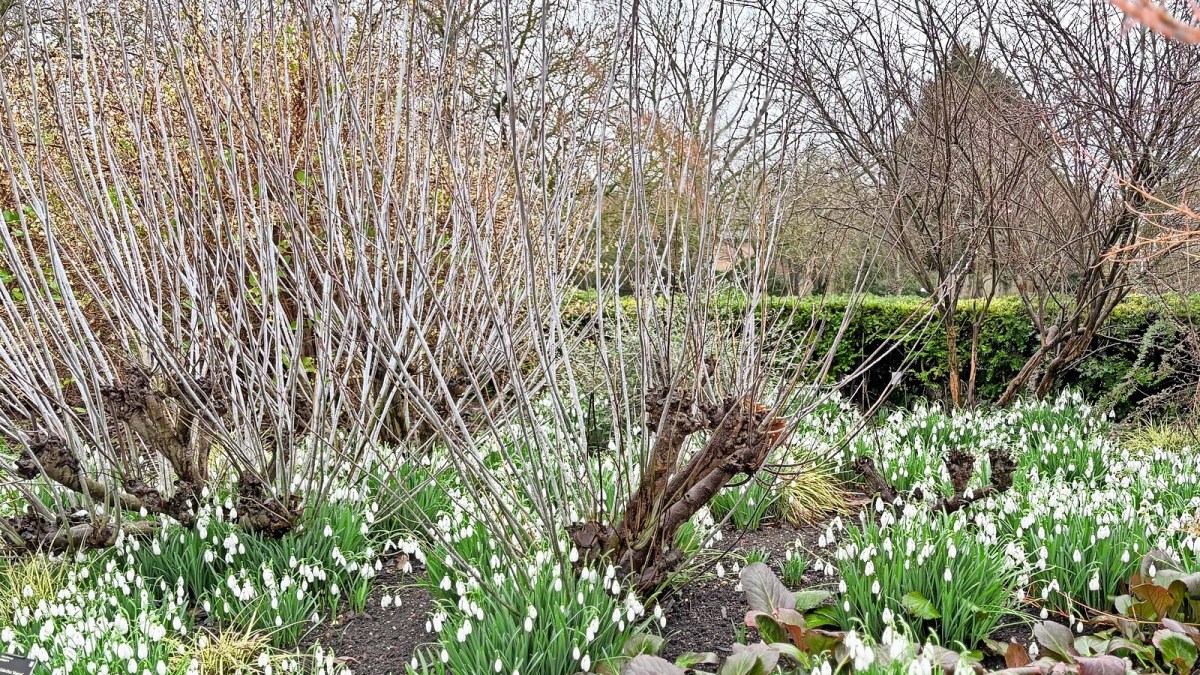
It’s a funny time of year, still winter but with a hint of spring often in the air. The Swedes have a word for this fifth mini-season — varvinter , which translates literally as “spring-winter”. The best word in English I can think of for this seasonal cusp is “wintergreen”, which popped into my head this week during a visit to Cambridge University Botanic Garden.
It was cold and rainy but, from the moment we arrived, we were cheered on by the copious clumps of snowdrops, a flower that surely epitomises the concept of wintergreen. This botanic garden is special for all sorts of reasons, not least its rigorous mix of science and horticulture, which makes it a living laboratory. The 180-year-old garden, right in the middle of town, was laid out by Charles Darwin’s mentor John Stevens Henslow in the “gardenesque” style, which is all about focusing on the plants as specimens.
• I have been suffering from ‘gardener’s block’. Here’s why
Cambridge was way ahead of the curve with its winter garden, planted in 1979. Many newer winter gardens seem to have been designed for Instagrammable impact, with soldierly rows of brightly coloured cornus stems set against clusters of white birch and green grasses. It’s stunning, but there is a limited plant palette.
The winter garden at Cambridge is much more about the plants themselves and there are 185 kinds listed. There are some outstanding plant combinations that could work in smaller gardens too. It inspired me to make a detailed note of some of the plants that caught my eye, as now is the ideal time to plan for the next wintergreen season.
White-stemmed brambles
The beauty of the white-stemmed Rubus brambles is the way the canes, which are naturally arching, reach up and then bend back down, creating the effect of a lacy and almost spidery lattice dome. The tallest here is Rubus biflorus, which grows to 3m to 3.5m, followed by R. ‘Goldenvale’, up to 2m (the name comes from the colour of the fern-like leaves). Finally, and here staying closer to the ground, is Rubus thibetanus ‘Silver fern’, also known as ghost bramble.
The carpet underplanting often features pale green and/or white plants, such as the rather witchy Corsican or holly-leaved hellebore (H. argutifolius) as well as multiple snowdrops. A contrast underplanting is Bergenia ‘Bressingham Ruby’ with its rich burgundy leaves paired with Helleborus dumetorum subsp atrorubens, which has magenta flowers and dark purple stems. You only need a small group of interlaced brambles to make it work.
And now for something completely different: another wintry stem gem is R phoenicolasius, or the Japanese wineberry, with hairy dark purple canes that look almost prehistoric.
• Read more from Ann Treneman
Wiggy-wig bush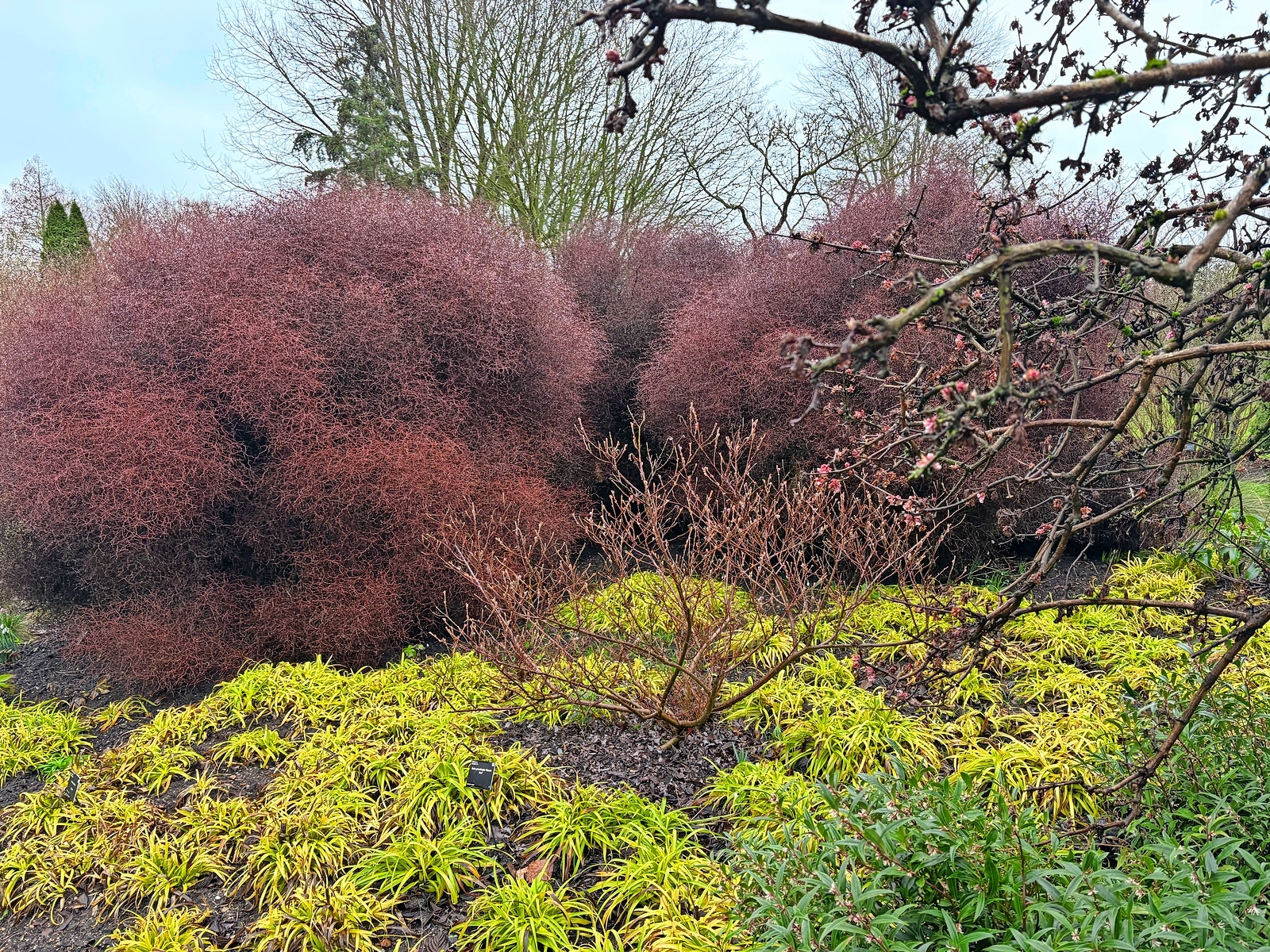
A wiggy-wig bush at Cambridge
ANN TRENEMAN
The wiggy-wig bush, or Muehlenbeckia astonii, looks like a hazy purple cloud as you walk towards it but, close up, you can see it is made up of a dense and tangled web of wiry zig-zag branches. At about two metres high (and wide) the resilient New Zealand native makes an impact here, especially when accompanied by a carpet of the bright yellow-green rush Luzula sylvarica ‘Aurea’. The combination is completed by a small Salix gracilistyla ‘Mount Aso’ with its pink catkins. On the other side of the wiggy-wig, the bush is set off by copious clumps of snowdrops. It’s a showstopper either way.
Blue-stem willows
One of the subtlest and most beautiful combinations centres on a blue-stem willow (Salix irrorata) that has been pollarded back to shrub level. Its stems are actually reddish purple but have a white bloom that makes them look bluish. Its catkins are a pussycat grey. It is set off by underplanting of snowdrops and Bergenia x smithii ‘Sunningdale’.
Another striking tree is the Chinese red birch, Betula utilis subsp albosinensis, with bark that peels away in papery strips to reveal a smooth and multicoloured trunk. It clearly has proved a little too fascinating as it sports a sign that says “Please do not peel the tree bark”.
• Our expert’s four essential garden resolutions for 2026
Irises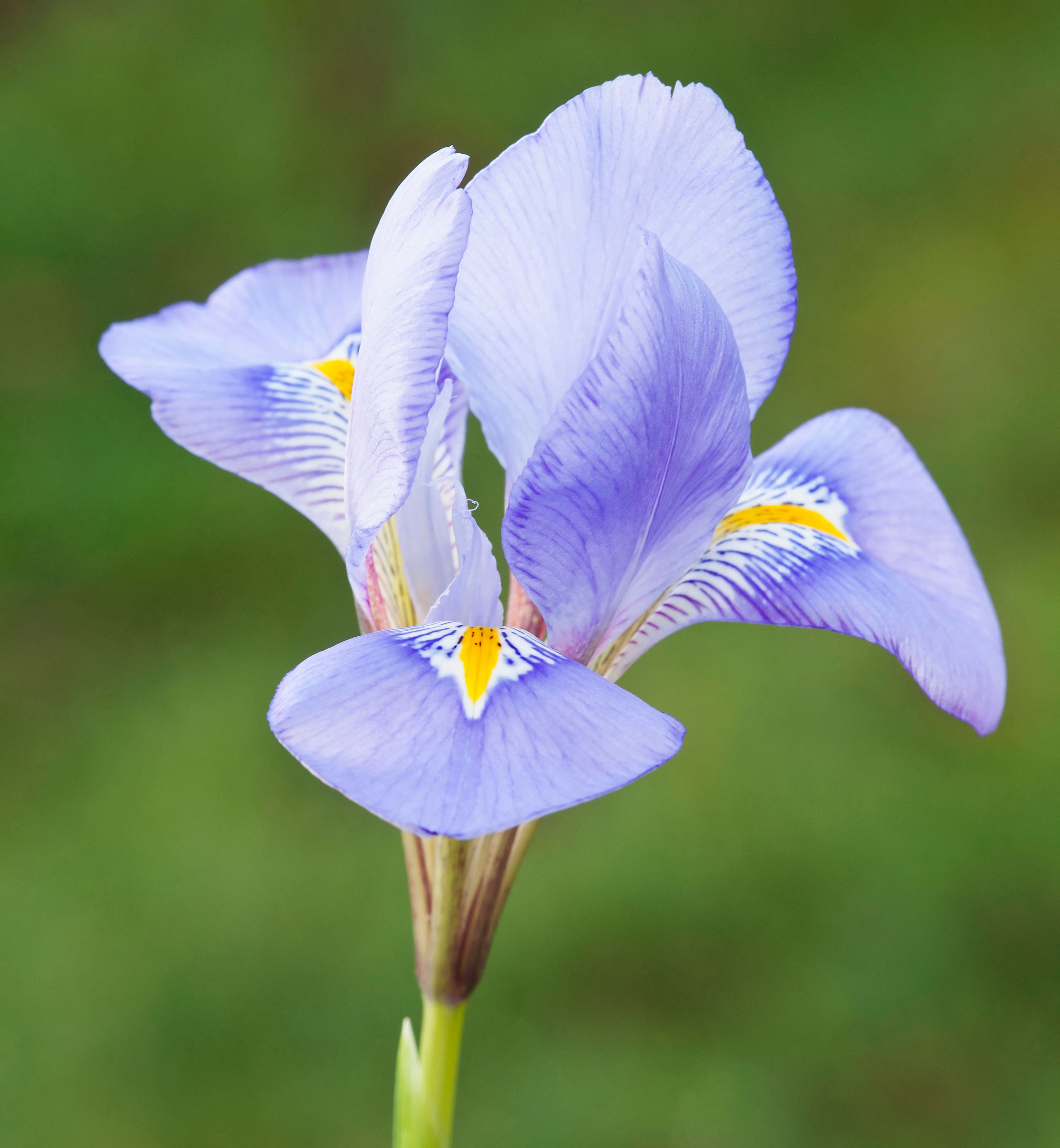
Two irises of note include winter flowering purple Algerian iris (Iris unguicularis) and the yellow dwarf Iris reticulata ‘Katherine’s Gold’. There are 48 types of snowdrop in the entire botanic garden but the standout star is Magnet, which is planted in abundance throughout. Sally Petitt, the head of horticulture, says it was chosen because it is big (for a snowdrop), exceptionally robust and moves with even the slightest breeze.

Iris reticulata ‘Katherine’s Gold’
SHUTTERSTOCK
Gardener’s question
Invading roe deer ravaged my garden last summer, stripping rose bushes, Japanese anemones, most annuals. They left the euphorbias, hellebores and hydrangeas. What flowering plants are disliked by deer?
Hazel Garas
Deer do indeed dislike hellebores and euphorbias as well as peonies, skimmia, jasmine, buddleia, daphne, quince, honeysuckle, foxglove, eryngium, catmint, forget-me-nots. Bulbs include daffodils and snowdrops. There’s a more complete list on the RHS website too.
Send your questions to gardenquestions@thetimes.co.uk
Comments are closed.