
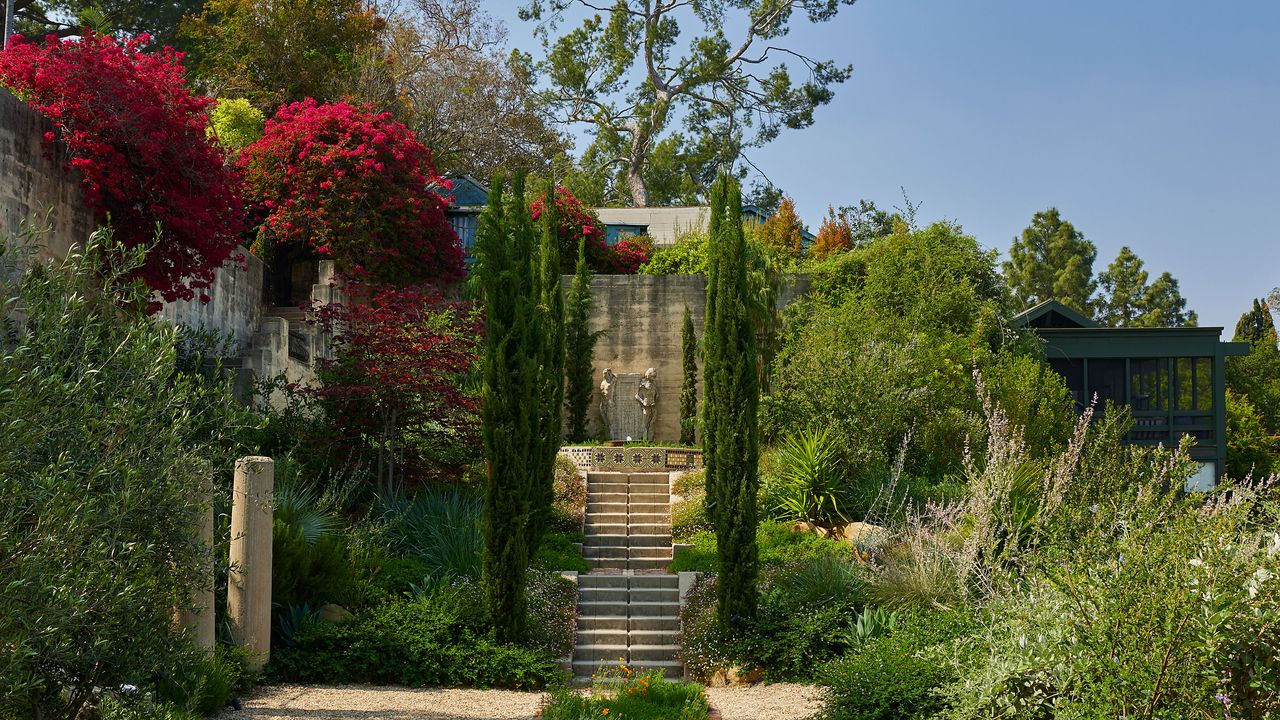
In jam-packed Los Angeles, it’s rare to find a plot of land that doesn’t have some history. But one half-acre parcel overlooking the Silver Lake Reservoir is particularly redolent of the past. It once belonged to Julian Eltinge, a vaudeville performer who usually played women—so convincingly that audiences were often shocked when he revealed himself to be a man. Starring in musical comedies like The Fascinating Widow, The Crinoline Girl, and Cousin Lucy (all title roles written for him), Eltinge went on to become one of the highest paid movie stars of the 1920s. One prominent critic cleverly dubbed him “ambisexstrous.” Whatever his sexuality, his story has been folded into the LGBTQ history of the Silver Lake neighborhood, where the early gay rights group the Mattachine Society was founded in 1950 and where queers protested against police brutality at the Black Cat Tavern in 1967, two years before Stonewall.
In 1918 Eltinge built a castle-like, Spanish Revival house atop a steep hill. Below it, he installed a formal “Andalusian garden.” Water flowed from an octagonal fountain into a long, rectangular pool that ended near a pergola of classical columns.

Homeowners Scott Boxenbaum and Ruth Pierich in the garden. A steeply sloping bed is planted with Pride of Madeira, Cleveland Sage, Yarrow, Dwarf Citrus Trees, Wild Rye, and Sycamore. The path is lined with Del Rio gravel.

The owners’ two English labs, Toffee and Rolo, at the Moorish fountain.

A historic shot of the view down from the fountain.

The property’s original castle-like, Spanish Revival house sat on a hilltop overlooking the Silver Lake Reservoir and its “Andalusian Garden” spread down the sloping parcel.
Eltinge’s career faltered during the Depression and he died in 1941. The property was eventually sold to Charles Knill, who cherished its history and collected Eltinge memorabilia. In 2015, Scott Boxenbaum, a real estate investor, interior architect, and former stand-up comedian, was hunting for a water-view lot in the neighborhood and approached Knill about the land below his house. Knill, according to Boxenbaum, insisted, as a condition of sale, that Boxenbaum restore the formal garden and that Knill be given access to it. Unfortunately, parts of it had fallen down the hill over the decades, Boxenbaum says. It took more than two years for the men to come to an agreement.
While still negotiating, Boxenbaum consulted Takashi Yanai, a Tokyo-born, California-raised, and Harvard-educated partner in Ehrlich Yanai Rhee Chaney Architects, who, more than a decade earlier had designed a house for Boxenbaum’s parents in Beverly Hills. Boxenbaum admired Yanai’s architecture, but he envisioned something very different from his parents’ assemblage of crisp white and gray cubes. Indeed, he wanted his house to be black, in part so it would blend in with the scenery. He also wanted some of what he calls “the combination of gravitas and tranquility” he associates with Japanese architecture. And perhaps most of all he wanted his dogs to be able to run around inside and out. “It’s basically a very large doghouse,” jokes Ruth Pierich, Boxenbaum’s spouse.
Comments are closed.