
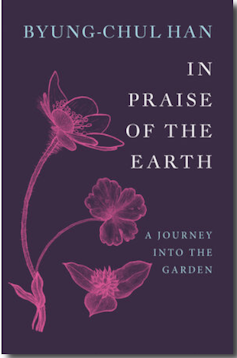
Cicero, the Roman Stoic, once wrote to his friend Varro, pending a visit to his home: “If you have a garden in your library, we shall have all we want.” This same desire for good books and natural beauty is at the heart of Byung-Chul Han’s In Praise of the Earth, in which he reflects on gardening as a form of philosophical meditation.
Review: In Praise of the Earth: A Journey into the Garden – Byung-Chul Han (Polity)
Born in South Korea and based in Germany, Han has risen to prominence as a philosopher in the last ten years with a series of short, readable but penetrating works critiquing the values that govern contemporary capitalist society.
Han considers contemporary concerns like burnout, the loss of attention and information overload, drawing on thinkers such as Hegel, Marx and Nietzsche to diagnose the effects of digital capitalism.
As well as these canonical European thinkers, he considers the ideas of Eastern philosophers and poets like Lao Tzu and Bashō. Indeed he has written books on Zen Buddhism and the Chinese idea of shanzhai or “decreation”, which disrupts the usual hierarchy between real and fake.
Han is a rare thinker who can make complex ideas engaging without losing any of their intellectual acuity. He writes slim volumes, easily carried in a coat pocket, which brim with explosive diagnoses of contemporary ills while proposing new ways of living.

Byung-Chul Han pictured in 2015.
Wikimedia Commons
In The Burnout Society, for instance, Han critiques the effects of what he calls “the achievement society”, in which efficiency and a relentless drive toward self-optimisation result in feelings of despair, loneliness and exhaustion. Against the tide of self-help manuals focusing on positivity and success, he suggests “rest and contemplation are acts of resistance against a world that demands constant productivity. In pausing we reclaim our humanity.”
In Praise of the Earth suggests the humble practice of gardening can offer one example of this kind of resistance. While he reflects on the deeper implications of gardening and thinking, Han’s book is also practical and personal. It is both a philosophical treatise on gardening and a diary of his experiences tending to his Bi-Won, Korean for “secret garden” in Berlin, over a period of three years.
Han describes gardening as a form of “silent meditation, a lingering in stillness”. Cultivating plants, he suggests, can transform our relationship to time. “Since I have begun working in my garden,” he writes, “I experience time differently. It passes much slower. It expands. The time until next spring feels like an eternity.”
This new sense of time is not only attuned to the changing seasons but to the growth of the plants and flowers he nurtures. “Every plant has its proper time,” he notes. “In the garden many such times overlap. The autumn crocus and the spring crocus have an altogether different sense of time.”
This awareness of overlapping time schemes prompts Han to reflect on what he describes as “the time of the other”, which invites an ethical response of care and concern. This time of the other is not related to acquisition or domination but instead thrives through a mutual act of cultivation.
For Han the time of the garden is fundamentally different to the time of digital capitalism, which is characterised by speed, distraction, and exploitation. “Digitalisation intensifies the noise of communication”.
In contrast, “the garden is an ecstatic place for lingering.”
The language of flowers
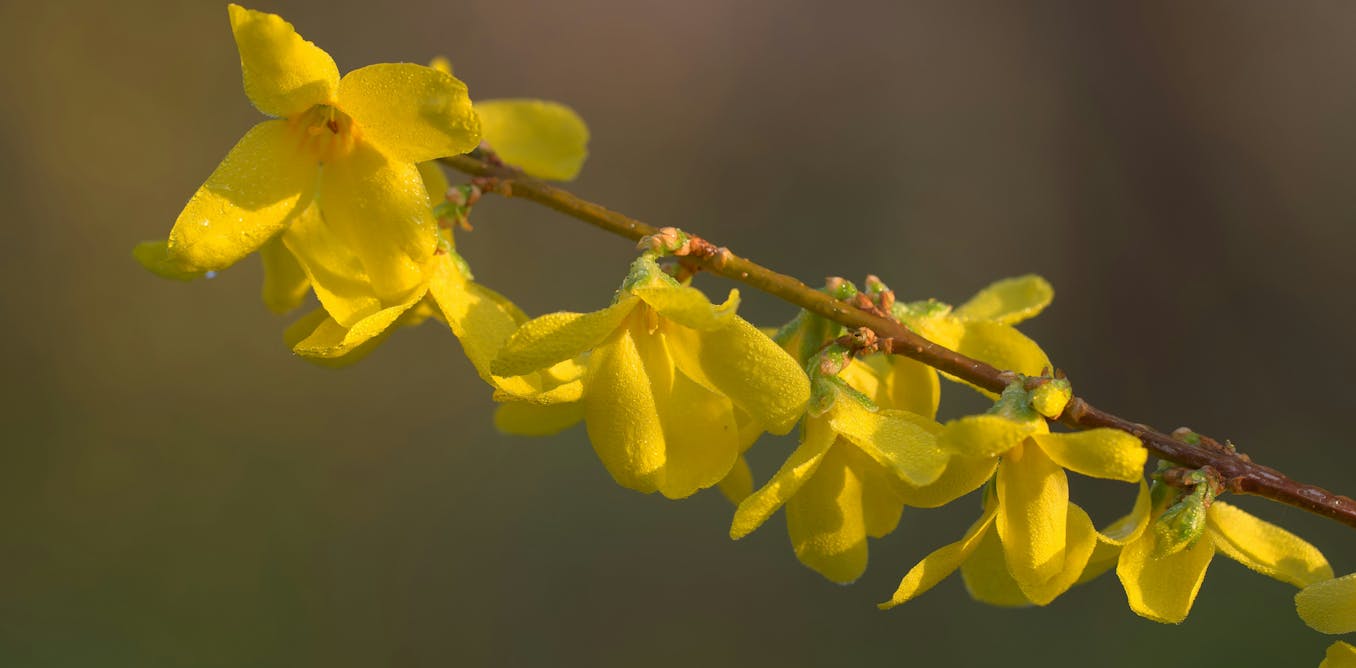
As a gardener, Han is entranced by the names of plants. Many of the book’s short chapters bear the names of those he is growing: Willow Catkins, White Forsythia, Anemones … These names prompt reflection: “Since I have taken up gardening, I try to remember as many flower names as possible.”
Reflecting on these names, Han begins to develop new ideas. He notes that astilbes are called Prachtspiere in German, which translates as “splendid splinters”. Spier means “small, tender tip”. He notes, “Without my garden, I would never have come across the word […] Such words widen my world.”
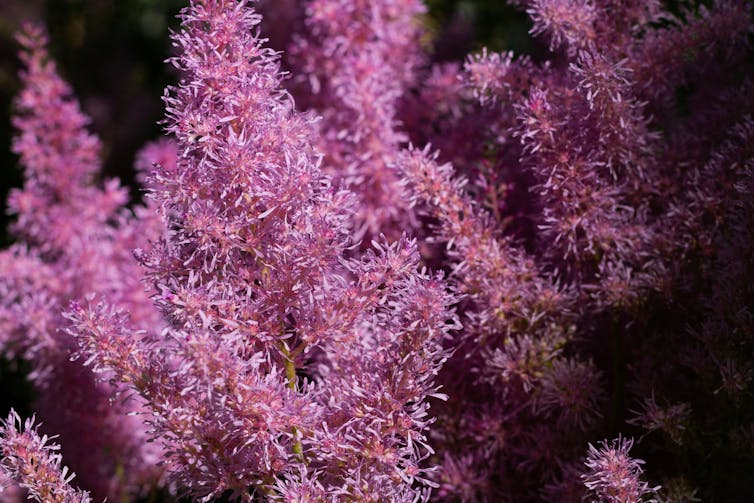
Astilbes, or splendid splinters.
K8/unsplash, CC BY
His world also widens as his attention moves from language to nature more broadly and he starts to see plant life all around him in Berlin.
Before gardening, he writes, “I was in some way indifferent not only toward willow catkins but towards all plants. Today I see my former indifference as an embarrassing blindness.” Gardening opens our eyes to the movement of leaves and opens our ears to the buzzing of insects.
This reflection is complemented by Isabella Gresser’s botanical drawings interspersed throughout the book. The delicate, white line drawings on black paper are accompanied by the botanical names of the flowers in question, allowing the reader to linger.
Song of praise
The movement from the particular to the universal is one of the book’s great strengths. The practical problem of keeping a camellia alive on a snowy night prompts a reflection on care, while waiting for a Japanese allspice to bloom sparks a contemplation on the nature of hope. “Hoping is the temporal mode of the gardener,” Han writes.
Polity
By attending to the most minute bud of a flower Han believes we can begin to develop a “planetary consciousness”. This consciousness is accompanied by “a deep reverence for the Earth.”
This reverence is in turn complemented by one of the oldest philosophical sensations – that of wonder – which Plato described as the feeling that gives birth to philosophy.
In this spirit, Han writes,
We should learn again to wonder at the earth […] In the garden I experience that the earth is magical, enigmatic, and mysterious. As soon as you treat her as a resource to be exploited you have already destroyed her.
Han’s book is part of a long tradition of philosophical reflections on the art of gardening.
The followers of the ancient Greek philosopher Epicurus formed a community called “The Garden” where they practised philosophy among trees and flowers. Chinese literati found solace in ornamental gardens designed to reflect Taoist principles such as the unity of opposites.
It is also part of a recent wave of works in which contemporary thinkers reflect on the philosophical significance of gardens. Italian thinker Giorgio Agamben’s The Kingdom and the Garden (2019), for instance, illuminates the relationship between theological reflections on the biblical Garden of Eden and political theories of liberation.
In Praise of the Earth is a philosophical song, which finds in the most delicate blossom a resounding call for care. “Flowering is rapture,” Han writes and reading this book too, is a rapturous experience.
Comments are closed.