
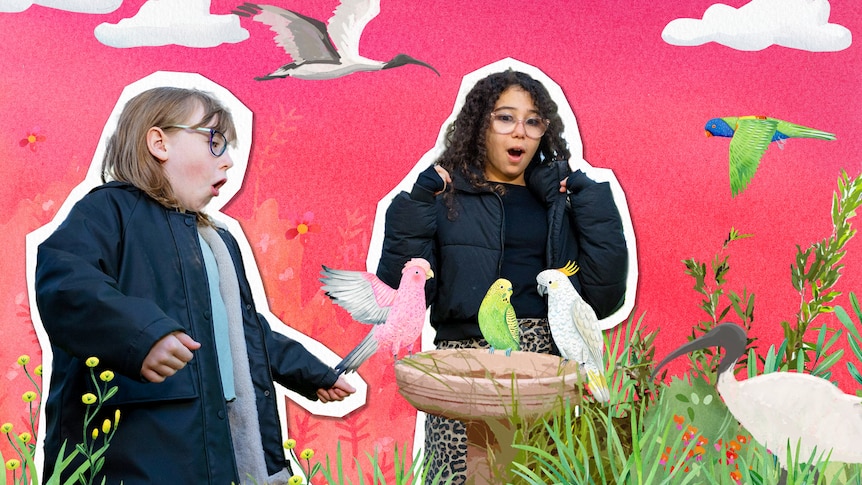
When you invite children to look up, they may notice the sun, the moon or clouds drifting across the sky. With time and curiosity, they’ll begin to spot more; a white butterfly, a spotted moth, or, if you’re lucky, a parrot with a bright orange belly searching for seeds among the trees.With inspiration from the Gardening Australia Junior crew, children will share in opportunities to celebrate birds, bees, bats and moths and all the living things that flutter and fly. By stepping outside together and slowing down, you can help children tune in to the life unfolding above them.Encourage children to fluff their feathers, stretch out imaginary wings, or warble their best magpie call as you head outdoors and look up together.
Explore these Gardening Australia Junior episode together via ABC iview:
Ideas to try with children: Exploring through the Senses
One of the simplest ways to begin is by tuning in to sound.
When you turn on your ears, you’ll often hear birds before you see them – high-pitched squeaks, squawks and chatter echoing overhead. When children notice these sounds, encourage them to scan the sky and treetops.
Together, you might spot:
pink and white galahsbold black cockatoos with red or yellow tailsrainbow-bright lorikeetsor large white sulphur-crested cockatoos, their yellow crests like crowns.
Each sighting becomes a chance to notice difference, pattern and the beauty of each variety.
The following experiences support children to enjoy spotting birds in their own neighbourhoods by engaging sight and sound. 1. Bird Sights and Sounds
Birdwatchers use binoculars and notebooks, but children can become birdwatchers simply by looking and listening closely. As you spend time outside together, invite children to notice:
colourshape and sizemovementand sound
Explore with an expert! Be a birdwatcher with Jason Rodgers of Did You Spot It with Jason and consider taking part in the annual Aussie Bird Count.
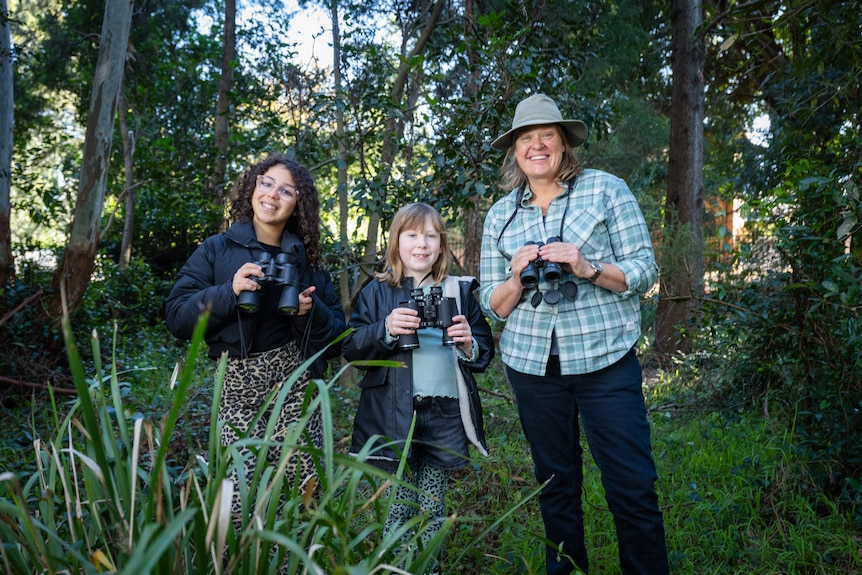
Invite children to look for birds across the colours of the rainbow. You might create a simple rainbow chart on a clipboard with red, orange, yellow, green, blue and purple.
Each time a bird is spotted, children can tick a colour or add a sticker. A single flamboyant parrot may help fill several colours at once.
3. Busy Beaks
Bird beaks come in many shapes and sizes, each designed for different kinds of food.
Share the picture book ‘Busy Beaks’ by Sarah Allen to explore the colours and forms of Australian bird beaks and why they vary.
4. Parrot Places
Birds gather where food, water and shelter are plentiful — flowering trees, creeks, parks and gardens.
Take a walk together and look for special bird places such as trees, schoolyards, parks or waterways.Encourage children to record observations in a notebook, just like a bird scientist (an ornithologist!).Read about endangered parrots, such as Obie the Orange-bellied Parrot (Zoos Victoria’s Early Years Readers, 2022).
If you walk near sunset, you may be lucky enough to witness a “parrot sleepover” – a tree where local parrots gather each evening. As daylight fades, the tree fills with noisy feather-fluffing, snacking and snuggling. Just before dark it can get very loud, then suddenly quiet, with only a few sleepy twitters remaining. A gentle moment to pause and whisper: shhh… parrots sleeping.
Educator links: EYLF Outcomes 2, 4
5. Music and Moths
You can explore moths and butterflies through movement and music. Show children how to place their thumbs together and flap their hands like wings. Experiment with fast and slow movements – busy butterflies during the day, gentle moths in moonlight.
Encourage children to float, flutter, fold their wings and move as if carried on a breeze. Afterwards, offer time to create artwork inspired by moths and butterflies while listening to music.
Music to flutter and float
Search key words online such as ‘fluttering/ butterfly/instrumental/music’. Using specific search terms is a great way to model online safety practices in a meaningful context. Here are some specific music track examples you might like to look up together:
Dreamy night moths: Meditation from Thaïs by MassenetSunny butterfly dance: Tutto e bellissimo by Alberto Giurioli
Art inspiration
Australian Museum – The John Landy Butterfly Collection (non-ABC site).
Educator links: EYLF Outcomes 2, 5
6. Buzzing Bees and … Ghost Bats?!
Bees communicate through buzzing and waggle-dancing, sharing information about where the best flowers can be found. Listening closely helps children understand that sound is a form of information.
Buzz Relay Races
Invite children to buzz their way to a pretend flower and back, passing the buzz along to a friend.Divide into teams and race across the yard, buzzing all the way.
Ghost Bats at Night
Bats use echolocation, sending out sound “pings” and listening for echoes.
Play Bat Pong by sitting in a circle around a bucket or tub. Take turns bouncing ping-pong balls off it and listening to the sound.Swap materials (plastic, tin, cardboard, cellophane) and compare how each sounds.Try identifying sounds while blindfolded.Listen togetherNoisy By Nature: Ghost bats in a ravine at night (09:37)Gardening Australia Junior Podcast: Flying with a fruit bat (9:00)
Educator links: EYLF Outcomes 2, 4, 5
More to Explore
Create calm listening spaces with nature sounds:
Nature Track: Lyrebird songs in a Gippsland rainforestNature Track: Carolling magpies in Western Australia
Celebrate the magpie and its many calls:
Read Waddle Giggle Gargle by Pamela Allen (Puffin Books, 1996)Watch Little J and Big Cuz:
Visit ABC Education online to access short video clips from Gardening Australia Junior, plus classroom planning ideas and provocations aligned with the Australian Curriculum (F–2).
Comments are closed.