
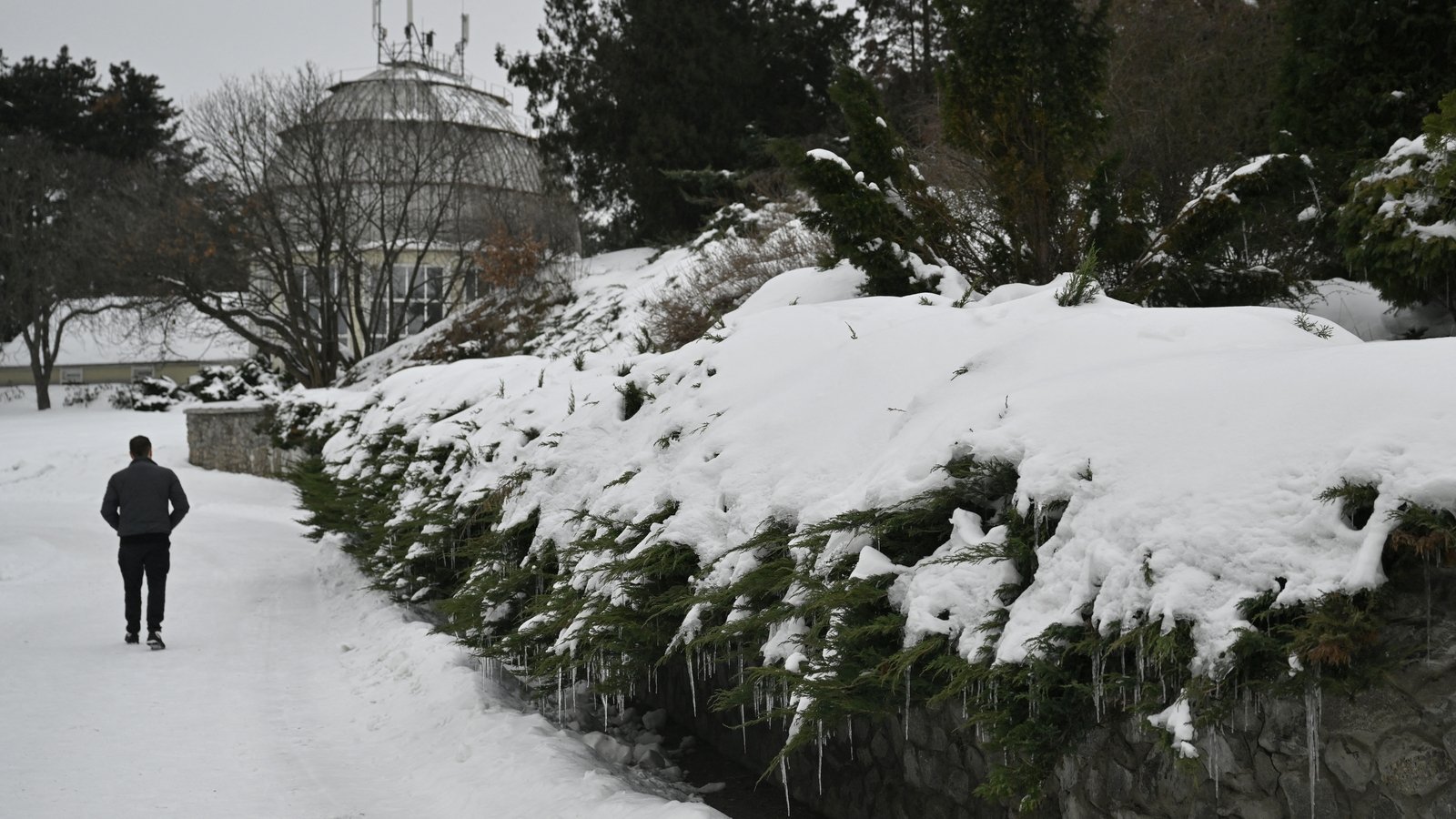
Plants in Ukraine’s National Botanical Garden are withering due to frost and power cuts.
Russia has been attacking Ukrainian energy sites with drones and missiles, plunging thousands of households into darkness during the harshest winter since its invasion began four years ago.
The almost-daily barrages, paired with the cold snap, have put lives at risk and created an unprecedented threat to a collection of almost 4,000 plants in the garden in Kyiv.
Roman Ivannikov has spent around 30 years tending to orchids, azaleas and figs and is dedicated to his work.
“Our children grew up on the paths of this garden. We have poured our lives into this,” the 51-year-old said.
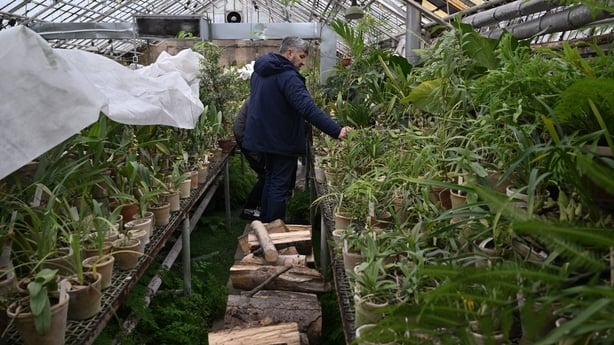
Roman Ivannikov tends plants in the garden
The temperature in the garden’s main greenhouse was 12C.
“It’s not even the lower bound of normal,” said Mr Ivannikov, head of the department of tropical and subtropical plants.
The temperature dipped even lower on four nights over recent weeks, when the heating cut off entirely.
“You can see how many fallen leaves there are … Perfectly healthy leaves that could have kept feeding the plant and functioning for months are falling down,” he said.
The plant, he explained, was optimising energy needs and shedding part of its leaves in the lower tiers so it can keep the leaves at the top and “survive in these conditions”.
Mr Ivannikov, fellow staff and scores of volunteers have been busy fuelling stoves and spreading protective covers on a collection of smaller plants.
Volodymyr Vynogradov signed up to help cut firewood used to heat the greenhouses.
“There needs to be heating for the azaleas,” the 66-year-old said.
“Physically, it’s a little bit of a warm-up … That’s why I decided to help somehow. For myself and for the sake of flowers.”
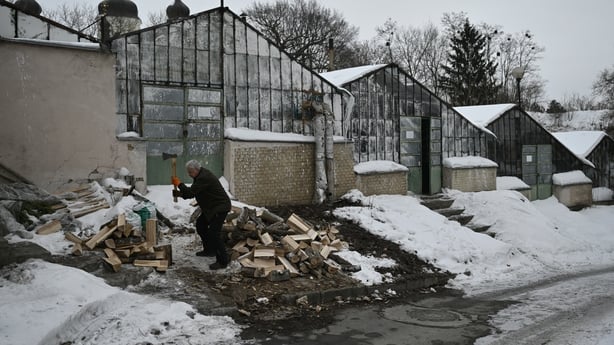
Volunteer Volodymyr Vynogradov chops firewood to heat greenhouses
The garden’s collection has been laboriously reassembled after it had perished during World War II – through decades of purchases, exchanges and numerous scientific missions that took Mr Ivannikov’s senior colleagues across several continents.
They “used to go to places and bring back plants from areas where those forests are no longer there”, making those replanted at the Kyiv garden susceptible to “irrecoverable losses”.
“Those plants have been preserved with us, and that underscores their uniqueness: if we lose them, we won’t be able to restore them,” Mr Ivannikov said.
Individual specimens have already wilted, but the scale of damage is impossible to assess as the destructive impact of the cold could only start to show in weeks or even months to come.
“Flowering intervals will change, plants will bloom but won’t be able to set seed for a year or two. Or, for example, they’ll set seed, but won’t be viable – will be dead,” Mr Ivannikov said.
“We just have to hold on until summer, until spring – make it through however many days are needed.”
His dream, he said, is to create a “large national bonsai collection”, something he had begun laying the groundwork for.
Meanwhile, the garden is offering organised tours and works with military servicemen and displaced Ukrainians who find solace in gardening.
“They feel alive and want to see what comes next. They see a future, they want to keep living – and that’s our mission,” Mr Ivannikov said.
Comments are closed.