
So, our gardening season begins again. Mid-February is the time to start seeds for planting out mid-April or there abouts. After this winter-that-wasn’t (so far), I’m not sure what the planting schedules are going to be later.
Vegetable seed packets will list when the best time to plant a particular seed. Ones that prefer the cool spring weather are often described as being planted when the soil can be worked. But what does that mean?
Soil is workable when it has thawed and the excess water has drained away enough that a handful of compressed soil is easily poked apart with a finger. While most cool season varieties will sprout outdoors if given enough time, it is more reliable to start seed indoors to get a jump on the season.
Varieties that can withstand light frosts and can go out in cooler weather include leafy greens like lettuce, kale, spinach, Swiss chard, arugula, mustards and collard greens; alliums such as onions and garlic; and broccoli, cabbage and cauliflower. All of these can be started indoors. Cool -season vegetables that prefer to be directly planted in the garden include root crops like radishes, carrots, turnips, beets, parsnips, potatoes and legumes such as sugar snap, snow and English peas.
This year, I will be starting Patterson and Walla Walla sweet onions about mid-February to go out by mid-April. I like Patterson onions because they have a good, complex flavor and store for around eight months in my basement. Walla Wallas, our famous regional favorite, don’t keep for more than a couple of months. While they are best planted in the fall, our Spokane weather is normally too cold for them to overwinter, so we plant them in the early spring. In early March I’ll start lettuce, spinach, cabbage and cauliflower to go out near the end of April.
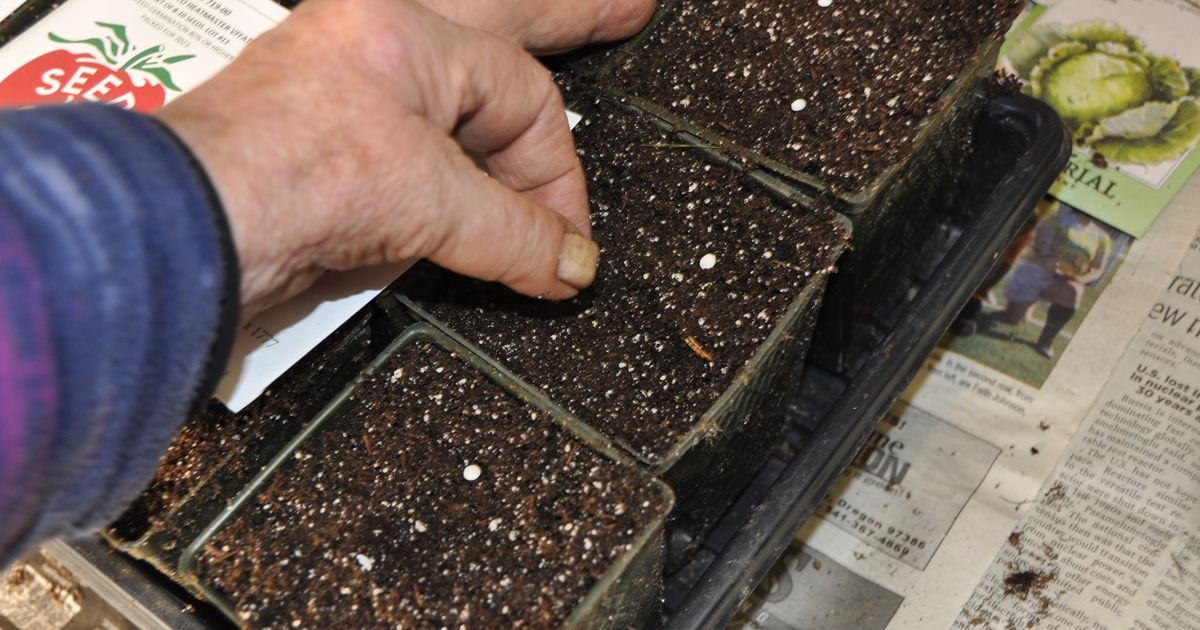
One trick I learned that makes planting tiny seeds easier to space out is to use pelleted seed for carrots, onions, lettuce, parsnips and basil. A pelleted seed has a clay coating that increases its size making it easier to handle and space properly. The coating breaks down quickly but holds a small amount of moisture near the seed. Using pelleted seed, I can space out carrots such that I don’t have to thin them. You can find pelleted seed on Ferry-Morse Sow Easy seed racks at the garden centers or in catalogs like Johnny’s and Territorial Seed.
My seed starting rack is a 6-foot baker’s rack that holds four flats crosswise on a shelf and is lit with 4-foot LED shop fixtures, three to a shelf, The lights can be raised or lowered and are set on a timer set for 16 hours a day.
The rack is located right next to our furnace for the extra heat. I run a collapsible hose from a nearby faucet for watering. I use a fine textured seed germinating soil mix and plant seeds in 4-inch-pots, so I don’t have to transplant them as they grow.
Comments are closed.