
Pantone’s colour of the year
Sigrie Kendrick – Feb 11, 2026 / 11:00 am | Story: 598803
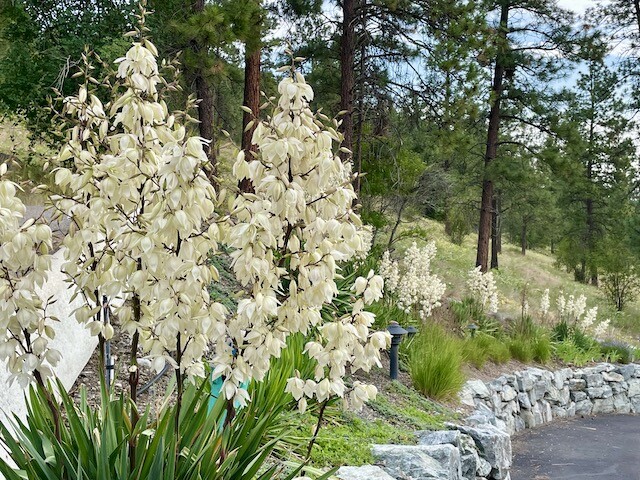
Photo: Judie Steeves
Yucca’s spring flowers are typical of the Pantone 2026 Colour of the Year, and a great option for both form and colour in a xeriscape garden bed.
Pantone’s 2026 Colour of the Year is called “Cloud Dancer” and it is a soft, ethereal white with the barest hint of warmth.
It is also described as a “whisper of tranquility and peace in a noisy world.” It is a colour that speaks to serenity and spaciousness, yet possesses surprising depth. Google, with an assist from artificial intelligence, explains Pantone’s Colour of the Year reflects global design, art, fashion and lifestyle in a forecast of the colour trend for the coming year.
For those of us cultivating water-wise gardens, this shade of colour offers a delightful departure from a xeriscape palette, often stereotyped as garish. Think beyond bright blooms. With careful plant choices a xeriscape garden can shimmer with Cloud Dancer’s luminous beauty.
The genius of white and near-white blooms in drought-tolerant gardens extends beyond mere aesthetics. These pale flowers reflect heat rather than absorbing it, helping plants survive relentlessly-scorching summers.
They also glow in twilight gardens, offering visual drama when more saturated colours fade into darkness. Cloud Dancer’s particular warmth, neither stark white nor cream, finds perfect expression in several remarkable xeriscape specimens.
For shrub structure, consider the Apache plume (Fallugia paradoxa). Native to the southwestern U.S. and northern Mexico, this deciduous, multi-stemmed shrub blooms from late spring into summer. Its white rose-like flowers transition into feathery seed heads that embody Cloud Dancer’s dreamy quality.
These pink-tinged plumes catch light beautifully, creating clouds of soft colour that persist for weeks, adding to the plant’s value. The profuse blooms of Apache plume are nectar-rich, supporting a variety of bees and butterflies.
The shrub itself is remarkably drought-tolerant, thriving in rocky, alkaline soils, making it an ideal choice for prairie, or meadow-style gardens.
Also native to the southern U.S., Adam’s needle (Yucca filamentosa) blooms provide architectural drama in the Cloud Dancer spectrum. Yucca filamentosa sends up impressive five feet to eight feet-tall stalks crowded with creamy white bells in late spring.
The blooms emerge from sculptural rosettes of sword-like leaves which offer year-round interest even when not in flower. These statement-making flowers combine the colour’s warmth with structural presence, proving that water-wise doesn’t mean visually meek.
Adam’s needle adds architectural height in the garden and will thrive under some of the toughest conditions of drought. Over time Yucca filamentosa will form small colonies with its extensive root system making it ideal for slope stabilization.
Oenothera lindheimeri, formerly known as Gaura lindheimeri, commonly called white gaura, wandflower, or bee blossom, deserves special mention. Hardy in Zones 5 to 9, this perennial was awarded the Royal Horticultural Society’s Award of Garden Merit.
Its white to palest-pink flowers dance on wiry stems, creating an effect of butterflies hovering in permanent suspension. The blooms possess Cloud Dancer’s characteristic softness and the plant flowers prolifically from late spring through fall, all while requiring minimal irrigation.
The “see through” effect of white gaura contrasts well with heavier, broad-leaved plants and is an ideal planting choice for cottage gardens and meadow plantings. Modern cultivars offer variations, but the species’ simple white form best captures that ethereal quality of Cloud Dancer.
Don’t overlook ornamental grasses for capturing Cloud Dancer’s essence. Muhlenbergia capillaris (“White Cloud”) produces airy plumes that embody the colour’s namesake quality.
Commonly called White Cloud Muhly grass, this ornamental grass offers late-season interest. Reaching heights of four to five feet when in bloom, this grass is ideally sited in a full-sun location and is not fussy about soils. The seed heads of Muhlenbergia create hazy clouds of near-white that shift and shimmer with every breeze, adding movement and lightness to plantings that might otherwise feel static and heavy.
This ornamental grass is versatile, stunning in a mass planting or even as the anchor of a large container planting.
The Cloud Dancer hue can even be found in xeric ground-covers. For ground-level interest, white-flowered ice plant (Delosperma cooperii “White Wonder’ spreads succulent foliage topped with daisy-like blooms.
This South African native asks almost nothing, thriving in poor soil, full sun, with minimal water needs, all while delivering months of cheerful bloom.
This mat-forming succulent reaches four to six inches in height, with a width of up to two feet. Blooming from early summer into fall, Delosperma flowers open wide in sunshine, their white petals surrounding sunny centres. Ice plants are ideal for use in rock gardens, for the front of xeric perennial borders or in containers.
Designing with Cloud Dancer in mind means embracing negative space and allowing these pale blooms to breathe. White flowers gain impact when given room to glow against contrasting backgrounds of Nature’s Gold dark mulch, weathered stone or the deep green of drought-tolerant conifers.
Evening gardens particularly benefit from this palette, as Cloud Dancer hues capture and hold fading light, drawing the eye to these blooms. Pantone’s choice reminds us that beauty in the xeriscape garden need not shout with hot colours of pink and yellow. Sometimes the most memorable gardens whisper.
Visit the OXA website at www.okanaganxeriscape.org to learn more about gardening successfully in the Okanagan and consider donating to our Refresh campaign, focused on updating the OXA Xeriscape Demonstration Garden.
The Okanagan Xeriscape Association is grateful for the ongoing financial support of the Okanagan Basin Water Board and is proud to be collaborating on the Make Water Work campaign. Check out the Make Water Work plant list at www.makewaterwork.ca
This article is written by or on behalf of an outsourced columnist and does not necessarily reflect the views of Castanet.
Comments are closed.