

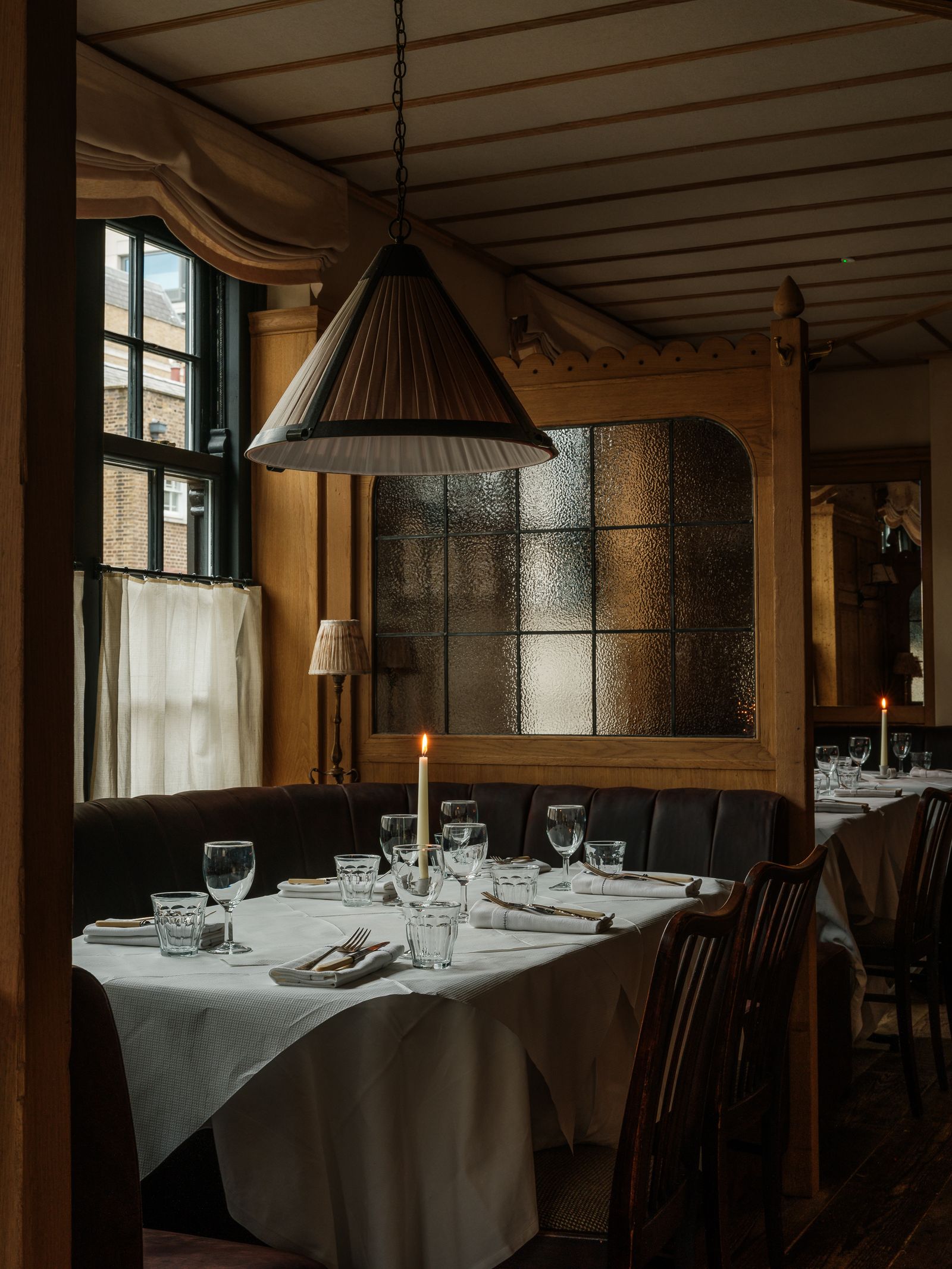
What makes a good pub? The Hart in Marylebone is one of our favourite recent openings.
Dave Watts
The British pub is an institution. For centuries, right across the land, public houses, inns, taverns, alehouses and watering holes of every description have provided travellers and locals with food, drink, shelter and, crucially, a gathering place. However, in recent decades, the British pub has been in decline, and last year things reached crisis point. A perfect storm of economic pressures resulted in a huge wave of closures, with some statistics suggesting that as many as 366 pubs were demolished or repurposed in 2025 – a loss of one pub per day.
Then, at the end of last month, the government announced that pubs would be given a 15 per cent discount on business rates followed by a two-year freeze. Though many believe this is too little, too late, the news does offer a glimmer of hope. There are some real-life, good-news stories, too. Take, for instance, Phil Winser, Olivier van Themsche and James Gummer, who run the Public House Group. Their pubs – The Pelican, The Fat Badger, The Hart and The Hero in London and The Bull Charlbury in the Cotswolds – draw crowds with great food and a lovely atmosphere. Meanwhile, other owners are calling in interior designers to give their spaces the magic touch, and numerous celebrities have become publicans. Of course, the so-called ‘posh pub’ is not for everyone – some would argue that such places are actually to blame for the closure of longstanding locals – but it does suggest that the British pub could have a bright future.
Here at House & Garden, it got us thinking: what makes a good pub? What do we think is really worth saving? And what we can probably do without? The team’s responses to these questions have been refreshingly varied yet decidedly opinionated. Next time you’re enjoying a pint or two with friends with dare you to start the debate by asking ‘what makes a good pub?’.
The settle-in factor
‘Last year, my friend Guy conducted a thorough survey of London pubs, making his way around 50 well-loved and lesser-known establishments and rating them all according to what he admits was a “mystifying” score system. Location and beer selection were important, as was something he called the ‘settle-in’ score. He’s right, the settle-in element is crucial to how you experience a pub. You want to arrive and quickly feel you could prop up the bar for the whole night. Warm service is important – more so, arguably, than fast service. In London, the platonic ideal of a pub has to be The French House in Soho. It’s tiny and yet you always seem to get served in minutes, everyone in there (both the staff and clientele) is having a good time, and the beer comes exclusively in half pints, which is so civilised.’ – Eleanor Steafel, lifestyle director
‘I do think a pub is only ever made better by a sense of warmth and comfort: wood panelling is helpful for this, as are upholstered seats. Booths and nooks are also a welcome addition. It’s hard to picture now, but summer will soon roll around so let’s not forget how essential and wonderful a good pub garden is. Planting and parasols are needed, and a sad little bench on a concrete slab out the back does not count as a “beer garden”.’ – Christabel Chubb, acting deputy digital editor
A sense of history
‘When it comes to London pubs, I appreciate period character. Just as you would expect from its name and its location – a stone’s throw from Smithfield and Hatton Garden – Ye Olde Mitre has a strong sense of the generations of drinkers who have propped up the bar over the centuries. As my husband says, “I can imagine Charles Dickens writing his novels in the snug or the upstairs wood-panelled room.”’ – Caroline Bullough, chief sub editor
Comments are closed.