
Is 3I/ATLAS just a comet — or an intergalactic ark?
A NASA spacecraft has discovered organic chemicals on 3I/ATLAS, which Harvard scientist Avi Loeb claims raises the possibility that the comet is an “interstellar gardener” seeding the universe with life.
“Is it possible that there are microbes or some forms of life on 3I/ATLAS?” Loeb told the Post while outlining his theory. “If such a rock had microbes in it, they would’ve survived.”
Loeb was referring to findings by NASA’s SPHEREx spacecraft, which scans the sky in near-infrared light to glean intel on the universe, BBC’s Sky At Night Magazine reported.
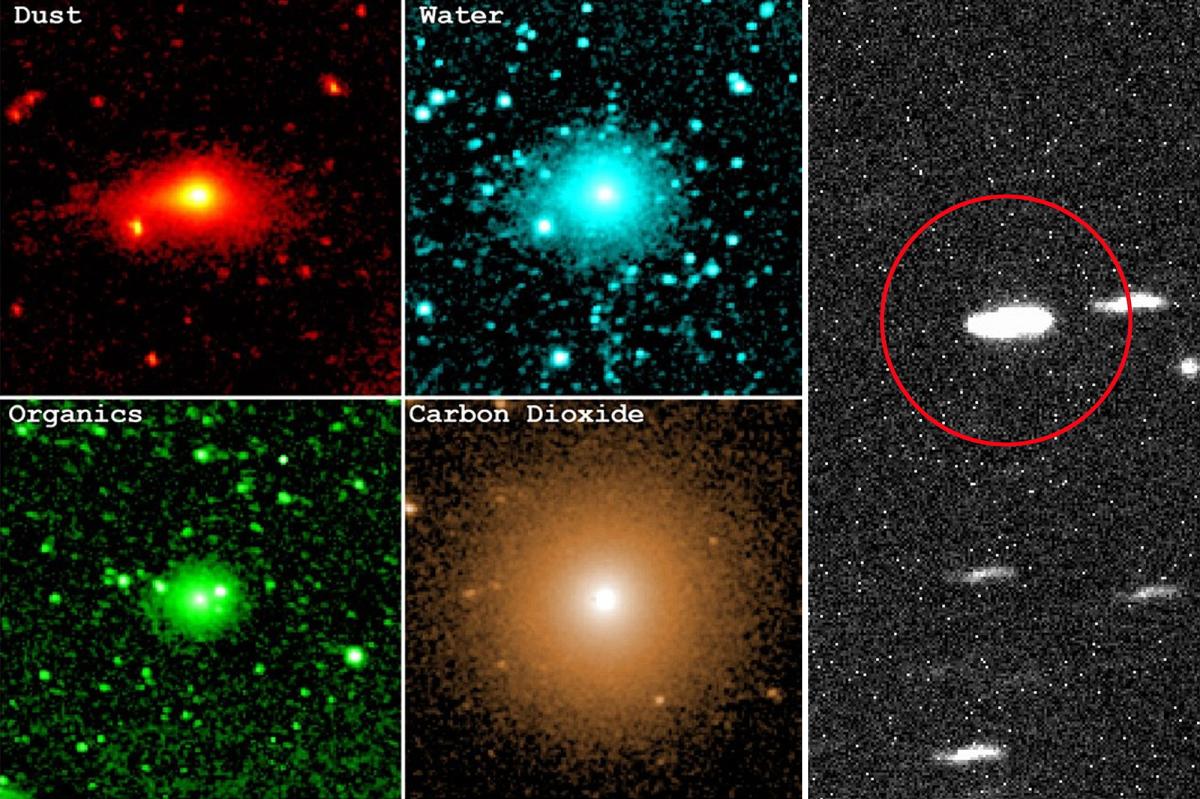
These observations by NASA’s SPHEREx show the infrared light emitted by the dust, water, organic molecules, and carbon dioxide contained within comet 3I/ATLAS. NASA/JPL-Caltech
Astronomers trained the celestial observer on ATLAS to see what we could detect with December observations picking up organic molecules like methanol, cyanide and methane — potential precursors to life on Earth.
They noted that ATLAS’ got spectacularly bright in the two months after its tour of the sun. This occurs when the sun’s energy causes these interstellar snowballs to sublimate water, carbon dioxide and carbon monoxide that had previously been trapped in ice deep below the surface.
“We are now seeing the usual range of early Solar System materials, including organic molecules, soot and rock dust, that are typically emitted by a comet,” said study lead Carey Lisse of Johns Hopkins Applied Physics Laboratory in Laurel, Maryland.
The Deep Random Survey telescope managed to capture images of interstellar object 3I/ATLAS (previously known as A11pl3Z) in July 2025. K Ly/Deep Random Survey / SWNS
Phil Korngut, a SPHEREx scientist at Caltech in Pasadena, California asserted that the Sun’s energy potentially released a “cocktail of chemicals that haven’t been exposed to space for billions of years.”
This piqued the interest of astrophysicist Loeb, who has previously speculated that ATLAS could be an alien spacecraft pollinating the cosmos with interplanetary primordial soup.
3I/ATLAS as observed by NASA’s Hubble Space Telescope on November 30. NASA
In a recent Medium blog post, the scientist said he found the recent discovery of methane unusual given that it has a low sublimation temp and therefore theoretically would’ve evaporated earlier than other gases that were present.
“That’s a puzzle because first of all, methane can evaporate more easily than carbon dioxide that was observed from the beginning,” Loeb told the Post.
This meant that the gas had been buried deep and only came to light due to sun exposure — or conversely, that it was “produced by lifeforms,” he wrote.
“Maybe it’s not as simple as just ice being evaporated by illumination of sunlight,” Loeb posited. “The methane is being produced by something that is thriving, especially when it’s illuminated by sunlight like life that came to life suddenly.
suggested that we follow other “space entrepreneurs’” lead and use this interstellar delivery vehicle to spread our own seed, so to speak. Chris Michel/National Academy of Sciences
In accordance, the scientist believed that ATLAS could’ve been used to disperse microbes throughout the cosmos by “an interstellar gardener with ambitions to spread life technologically.”
What’s more, he suggested that we follow other their lead.
Loeb floated a hypothetical where we launched an “interceptor spacecraft” that was designed to collide with ATLAS during its fly-by of Earth on December 19.
Upon making contact, our spaceship “deposits a capsule containing the seeds of terrestrial life into the belly of 3I/ATLAS” along with radioactive material that keeps the environment warm and allows the interstellar hitchhikers to evolve, multiply and colonize the rock.
When ATLAS hypothetically arrived another solar system, Loeb told the Post, this interstellar delivery vehicle would start evaporating and disperse the Earth microbes a la “dandelion seeds.”
The researcher deemed this idea more feasible and cheaper designing a new rocket, which wouldn’t be able to match the comet’s 137,000 mph speed.
By now, that spaceship has literally sailed. In the interim, Loeb suggests that researchers check for other signs of life in the gas surrounding ATLAS.
Comments are closed.