
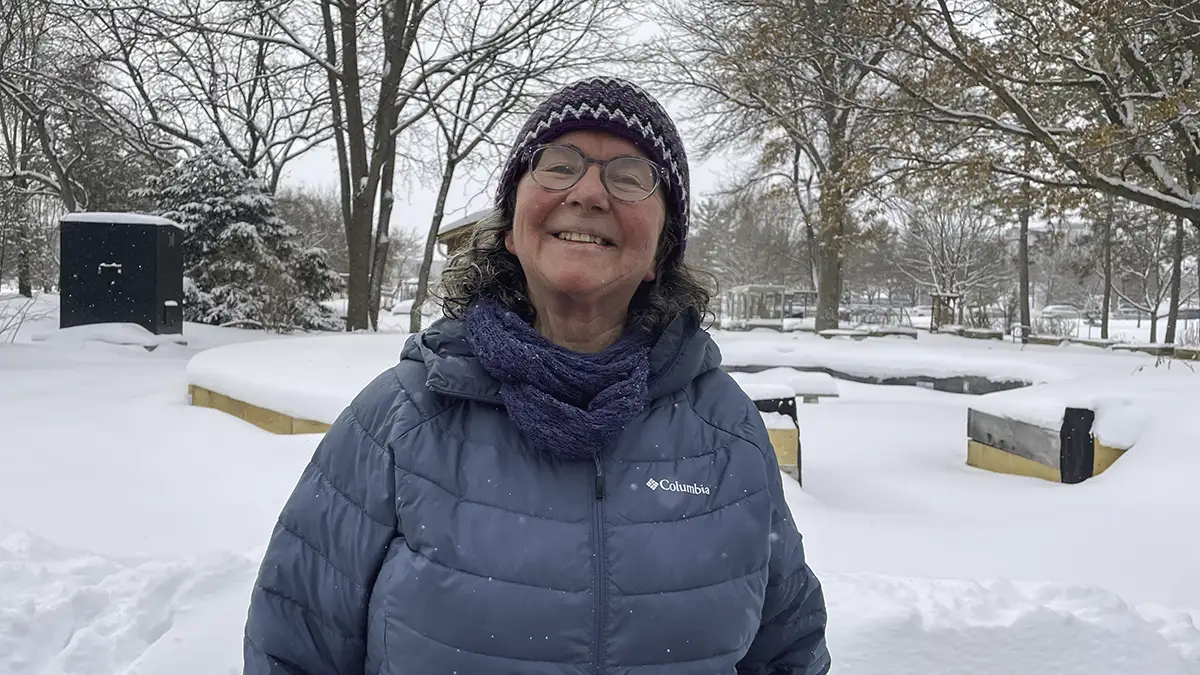
Johanne Ranger still remembers how she got involved with the Brewer Park Community Garden.
“Well, I met this boy,” Ranger recounts, “actually, at Green Drinks, which is kind of an informal, once-a-month get together at some of the pubs in Ottawa. I met Guy Souliere, who’s one of the founders, and at the time it was the second year of the garden, so they were still growing their space.”
The garden site, located just across from Brewer Arena, was approved by the city in May, 2012.
“We don’t have a lot in Old Ottawa South. It’s a lovely neighbourhood, but the backyards are pretty small. So, it’s nice to have that growing space,” Ranger said. “It’s an eight by 10 plot so it’s not a whole lot, but you can still get some stuff out of it.”
Community members grow food in Brewer Community Gardens’ plots and has spaces for pollinators filled with flowers maintained by garden volunteers. This upcoming season, Brewer Park Community Garden organizers say the focus will be on new accessible plots, with expansion under consideration.
Brewer is one of the 27 community gardens operating on City of Ottawa land, a number that may grow because of the city’s Community-led Green Initiatives and Garden Program.
Approved in April 2025, the program offers a streamlined application for residents looking to start a new garden on city land and for existing gardens to apply for expansion. Intake applications for this season closed Feb. 3.
Community gardens and green spaces, they provide an opportunity to access local food or to grow local food, but they also are spaces to learn, to gather, to grow community, to transfer skills from older generation to a younger generation, from one culture to another culture,
Kate Veinot, Just Food
“The issue that I found when I was starting, is it’s difficult to start a garden, whether it’s a pollinator garden or a food garden, because of the land issue. You’re running into a private property or just city-owned land, and you have to make a sort of agreement,” said Nkosinothando Mhlanga, who volunteered with the Frank Street Bee and Butterfly Garden during her time as a student at Carleton University. “So, in that way, the new program does make it easier.”
Mhlanga says the new program will streamline communication with city hall and a simplified application process can only be a good thing. “It makes it easier if you’re someone who doesn’t have background knowledge in terms of how it works. And then you won’t be in trouble for breaking any bylaws by just starting a garden,” she said.
Just Food, a non-profit supporter of 140 Ottawa-based community gardens, has often been a bridge between the gardens and the city. But the organization’s Director of Operations and Neighbourhood Planning Kate Veinot says it’s much more than just that.
“Community gardens and green spaces, they provide an opportunity to access local food or to grow local food, but they also are spaces to learn, to gather, to grow community, to transfer skills from older generation to a younger generation, from one culture to another culture,” she said.
Despite a background in both policy and food, Veinot had never been involved with a community garden until she came across the overgrown Orléans Children’s Garden while on a walk with her young daughter.
Working to clean the garden with family sent Veinot into the world of Ottawa’s community gardens.
“I’d grown up growing food just in my backyard in low pots, but had never been involved with a community garden before,” she said.
Veinot and Just Food worked closely with the city throughout the development of this new program and are hopeful that it will offer more opportunities for aspiring groups.
“We’re really optimistic that this will lead to a really significant and critical shift to open up access to city lands for community gardening,” Veinot said. “Most of all, I hope to see the backlog of requests that have been waiting for answers, that they are addressed as supportively as possible.”
“I think this has been a long time coming,” said Orléans West-Innes Coun. Laura Dudas, who chairs the community services committee. “The city historically had put a lot of red tape around it. There’s so much bureaucracy, concerns about liability, like who maintains it, who’s responsible if somebody gets hurt? What happens if nobody wants to take care of it anymore? Do they just mow it over? There were a lot of concerns by staff.”
 Councillors Laura Dudas (Orléans West-Innes) and Rawlson King (Rideau-Rockcliffe) hope the new program helps gardeners waiting for land approval. [Photo © Abigail Noble]
Dudas and Rideau-Rockcliffe Coun. Rawlson King were involved in passing a motion that allowed gardening on right of ways and support this new program.
“There’s definitely pent-up demand. I have people, residents in the New Edinburgh community in (my) ward, who want to undertake a community garden in New Edinburgh Park and Stanley Park,” King said. “There’s a tremendous amount of community pent-up demand, especially, like Laura was saying, around food security initiatives. Not just growing the food for themselves, but frankly for others in the community who need it.”
Veinot, too, argues that community gardens can be part of a larger conversation about growing food insecurity.
Veinot says in 2023-2024 one in four households in Ottawa experienced food insecurity. That is 24.7 per cent of the city’s population, Ottawa Public Health found. The same report said only 13.3 per cent of the city was impacted by food insecurity the year before.
“There are thousands of people across the city who want to grow food while also reporting food insecurity and the missing piece is access to space to grow food. So having more community gardens, having more green spaces, and having more access for those who want to grow food to be able to grow food is really critical as we work to shift away from this increase in food insecurity that the city is experiencing,” Veinot said.
There’s definitely pent-up demand. I have people, residents in the New Edinburgh community in (my) ward, who want to undertake a community garden in New Edinburgh Park and Stanley Park
Rideau-Rockcliffe Coun. Rawlson King
Although she admits that community gardens are not the only answer, Veinot notes that they do offer affordable access to fresh food. She adds that growing food in communities protects against shortages caused by pandemics or border closings.
Using Just Food’s Plant-a-Row, Share a Row strategy, community gardens are encouraged not just to offer excess food to Food Banks, but also to grow food specifically for donation. Gardens such as the Bells Corners Community Garden (BCCG) make donating food a regular and integrated part of their work. The BCCG donates food weekly during harvests. Last season they donated 2,200 pounds of produce to eight different food banks.
“Having the ability to (grow food) or the access to do so does become a component of reducing food insecurity and shifting away from the reliance on charitable food models, because that’s what we are ultimately working towards.
“We’re working towards supporting community food solutions that shift us away from the need to access emergency food because emergency food is no longer emergency food. It’s now an institutionalized access point that people become reliant on for their food access. So, what can we do to work towards that shift? Because it’s clearly not sustainable as food insecurity continues to rise,” Veinot says.
Comments are closed.