
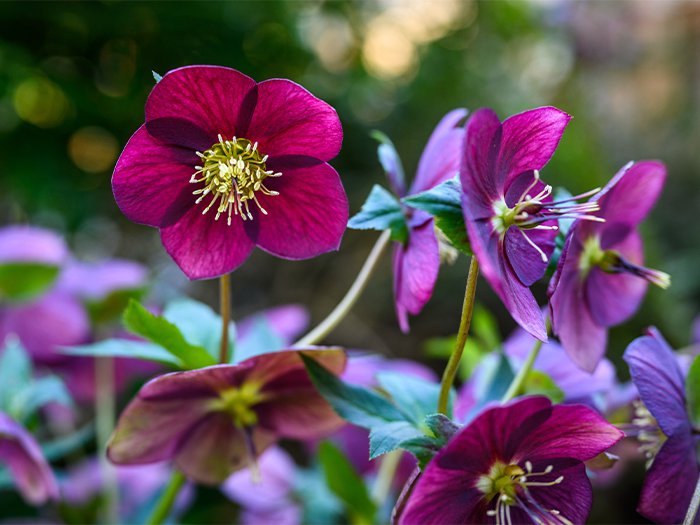
Master Gardener Ann Bartlett gives us a lesson on how the Lenten rose adds color to your winter garden.
When is a rose not a rose? The Lenten rose is not actually a rose, though it is closely related to the Christmas rose. Both are members of the Helleborus family of plants that are native to the Balkans and Caucasus Mountains.
Helleborus niger produces white flowers in early winter and so is known as the Christmas Rose. Blooming in late winter and early spring, Helleborus orientalis, the most popular member of the clan, is associated with the Lenten season.
Each nodding flower may last over a month on the plant, making it a wonderful addition to any shady area that can be appreciated at this time of year.
Older cultivars flower in green, rose, purple, and white. In recent years, hybridizers have worked to expand the color palate and improve the flower form by crossing closely related members of the family. Flowers of these hybrids are larger and have more petals, many being fully double and outward facing.
Colors now span the spectrum to include yellow and black with many lovely, variegated selections. Unfortunately, the newer cultivars are less cold-tolerant than the species.
Tending Your Lenten Roses
Plant Hellebores in shaded to partially shaded locations in the fall or early spring. The plants tend to be a bit slow to become established, but they are long-lived and never require division.
The evergreen foliage remains attractive after the flowers fade. The leathery leaves may be damaged in a cold winter. For rapid rebound, cut back that foliage when the flowers begin to bloom.
The plants want moist well drained soil, but they are otherwise undemanding. Should you want to transplant a Lenten rose, it is best to do so in September or October so that the root system has time to adjust to the new site before warm summer weather returns.
Last spring I had to move one that had been in a spot for eight years. Despite the rain, it really sulked most of the summer. I am happy to report that it is now in bloom.
Hellebores Throughout History
Hellebores were well known in the ancient world as a source of one of the four classic poisons. (Nightshade, hemlock, and aconite are the other three.) They were used medicinally as a purgative.
All parts of the plant are poisonous; thus deer, voles and rabbits give it a wide berth. It is best to wear gloves when caring for them to prevent possible dermatitis. The flowers can be cut and floated in a shallow vase.
In the language of the flowers, Hellebore means scandal, so you don’t want to see it in your tussie mussie!
Comments are closed.