
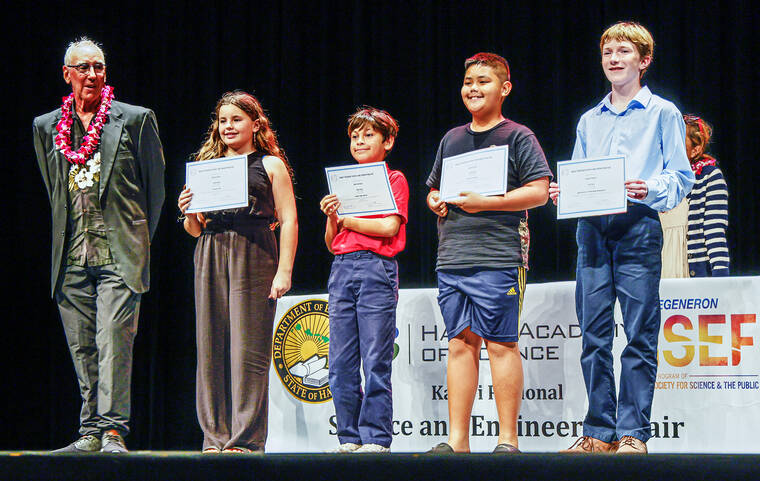
LIHUE — The wind howled through trees and the rain pelted the Kauai War Memorial Convention Hall parking lot where attendees to the Kauai Regional Science and Engineering Fair on Saturday jockeyed their cars for parking closest to the convention hall, minimizing exposure to the wind and rain.
Saturday night’s presentations included about 37 projects from the Junior and Senior divisions that survived the scrutiny and judging from panels of judges and professionals from the community. Dan Matthews, the coordinator of the Kauai Regional Science and Engineering Fair, said there were about 180 students in sixth through twelfth grades that started a research project when school started.
“This resulted in more than 150 research projects,” Matthews said. “Schools on Kauai then ran competitions to determine the best of the best. Of all those projects, only 37 made it to this Regional Fair.”
Following daylong judging, there were 10 projects, plus four alternate projects, advancing to the state fair on Oahu. There was also a long list of other awards earned by the junior and senior division scientists.
“Depending on the success of the Kauai Student Research silent auction, we would like to have these four participate in the state fair,” Matthews said. “We want as many students as possible to be exposed to science fairs outside of Kauai.”
Ron Morinishi, the Kauai Student Research president, said the top project in the Junior Division will represent Kauai in the National Thermo Fisher Scientific Junior Innovators Challenge. That is the nation’s premier science fair competition for sixth, seventh and eighth grade students.
Top award in the Junior Division, and a Thermo Fisher Scientific Junior Innovator Challenge project, was “How Effective is a Homemade Hydrometer,” by Nathaniel Knickel, a student at Island School.
Second place in the Junior Division, and a Thermo Fisher Scientific Junior Innovators Challenge project, was “Stretchin’-N-Movin’” by Anthony Riola and Teiva Hesapene, both students at St. Theresa School.
Third place in the Junior Division, and the winner of the 2024 Lemelson Early Inventors Award of a $100 award, was “The Power of Plastic” that was renamed “Plastic Sand Concrete” by the show’s judges and officials. James Burkhart, a sixth grader at St. Theresa School, submitted the project as his first time at a science fair.
Makayla Oliver, a student at Hanalei Elementary School, was the fourth-place winner for her “Fantastic Flour” project, and Sophia San Agustin, another St. Theresa School student, earned fifth place for her “WHITE noise-BLACKout.”
Kauai High School student Drezdin Taylor audibly grumbled about the mispronunciation, but “Analyzing the Mycorrhizae of Non-Native and Native Hawaiian Trees” was named tops in the senior division and pulled in several other special awards.
“Some of the judges’ comments were ‘that this project took a lot of painstaking work, but was pushing the boundaries of our knowledge regarding tree fungi,’” said House Speaker Nadine Nakamura, who presented the winners of the senior division.
Kauai High School freshman Adelaide Mottley was already thrilled that she secured state qualifying swims for the upcoming state swimming meet. Her excitement was escalated when she learned her project, “Using Fractal Geometry to Identify Super Reefs,” was one of two top senior division projects.
“The judges were impressed by the relevance of your project and the impact its results could have on our island,” Nakamura said. “Your methods and analysis were among the very best at our fair.”
Kauai High School student Kasarah Navor and Joy Lin were named to third place for their project, “CRB-Coconut Rhinoceros Beetle,” and Island School student Cora Rosenthal earned fourth place for her “Can Water Kefir Scobies Survive Without Cane Sugar?”
Island School student Tanner Miller was named to fifth place for his “Impact of Sunscreen Ingredients on Algae” project.
Earlier in the evening, Matthews introduced Waimea High School student Jayna Sams and Island School student Tanner Miller, who submitted their respective projects to the National STEM Festival in November. Both projects were finalists to represent Hawaii in Washington, D.C., this summer at the prestigious national research competition.
“Science moves forward because people are willing to ask questions and challenge what they think they know,” Nakamura said. “Today, we saw the next generation doing exactly that. I hope everyone leaves inspired to keep exploring, keep asking ‘why,’ and keep imagining what is possible.”
Comments are closed.