
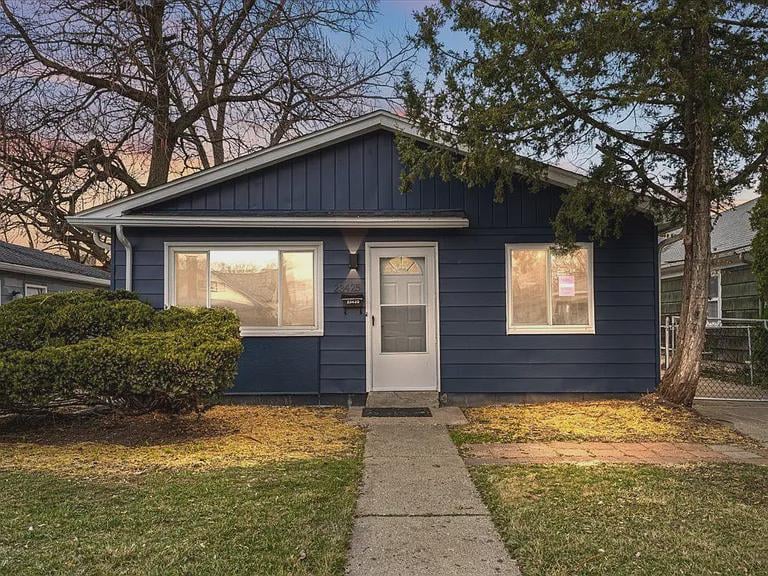
Long story short, I bought this house last summer and am planning exterior work this spring.
I lowkey hate this big bush and this tree: I feel like they're doing nothing for the curb appeal and the tree is quite close to the foundation. I'm already having a tree service come out this spring to remove a tree planted about 2 feet from the side foundation, so I'm not opposed to removing these too. Is it foolish to remove that tiny amount of shade?
I have no idea what plantings to replace the front with. There are a few daylilies that the old owner mowed over 🙄but maybe they'll return. Otherwise, I have a boring blank slate. I like the look of english garden style and I would prefer more native plants. I love things that bloom like hydrangea. Any help appreciated.
(Edit): I don't care about grass and personally I'd prefer to get rid of grass so I don't have to mow it. There is no particular code or HOA or anything in my neighborhood that mandates anything.
by owlaholic68
9 Comments
You are spot on about that tree on the right. It looks like a spruce that has completely outgrown its welcome and at that distance to the foundation it is a structural liability rather than a shade asset. Remove it while you have the crew there. That shrub on the left is a classic example of a foundation planting that was allowed to become a wall. It creates a heavy visual block that hides the architecture rather than framing it.
If you want an English cottage vibe with natives and no grass you need to think about layering. Don’t just scatter plants or you will get a messy look. Create sweeping beds that flow from the house outward. Start with structure like a native Serviceberry or Dogwood for height but pull it away from the house unlike the current tree. Then drift in your Hydrangeas (Oakleaf Hydrangeas are fantastic in Michigan) and mass plantings of Coneflower and Little Bluestem to fill the gaps. I’d recommend running your photo through GardenDream to test out different bed shapes and plant density before you start ripping out sod. It helps you see how much plant material you actually need to replace the lawn so you don’t end up with a sparse dirt patch.
Reddit is a great resource to occasionally consult but I promise you it’s worth hiring a landscaper for a consultation that specializes in natives. $75-150 should get you a couple hours, a list of plants you can begin to brainstorm with and a long term plan of action. Takes a lot of the guess work out and will likely save you lots of time and money in the long run.
I’d get you started with some tips myself, but idk your area very well. That being said, yeah.. remove the tree. You can always plant another further away for more shade. Also you need to define your beds and decide how much room/budget you have for planting.
I will second the answer who said consult a landscaper. I will also add that having just a little grass can do a lot. It will add some order to make it not look too busy. You need something plain that will draw your eyes to the focal points (just like how the shrub sticks out like a sore thumb. You don’t even need much – 10 minutes worth with a reel or battery push mower and another 5 with a battery edger trimmer.
Remove the spruce and bush. Overgrown and out of scale.
THEN call in a landscape architect (not a landscaper – unless they have one on staff and you’re not planning on doing the work).
I’d tell them “Blank Canvas” that walkway might need to go.
Absolutely have tree and shrub removed. You’ll have to dig out and dig out again and again those day lilies yourself. I consider myself pretty good at digging. My day lilies kept reappearing even after staying underground for a good year.
Find your state’s native plant society and use the resources at r/NativePlantGardening. See Doug Tallamy’s work, look at keystone plants at Xerces and NWF, figure out the type of landscape originally present. Do percolation [dig a hole and time how long it takes to drain] and soil texture [jar+soil+water and shake] tests to figure out what sort of plants will be most successful. Take all that info, shake well and make a shortish list of plants you might include. Be sure to research all and look at all the photos and ideally visit native plant gardens to actually see them in all seasons. Some plants like oak leaf hydrangeas and some grasses have an excellent year round presence that you may or may not like. Some have coarse or sparse foliage when not flowering. Others look like space fillers but are sensational seasonally.
Draw out a map of the space and use a sun tracking app so you can place a small tree where it will shade where and what you want shaded. Hard scape is an easy way to guide plantings. Since your inspiration is an English flower garden you might add a low decorative fence a foot or so away from sidewalk for perennials and grasses to poke through. I spy a walk crossing from the driveway, maybe where the misplaced tree is could be turned into a mini patio with ~3′ tall plantings in front proving a bit of privacy. The left side might have a birdbath/pondless water feature to attract the critters and help shape the plantings that’s surrounded with shorter lusher water loving plants You might want to put an arbor and gate over the main entry, chance to grow a vine.
https://preview.redd.it/vb1trzlzxiig1.jpeg?width=1024&format=pjpg&auto=webp&s=d11a905cd6f8cb08506ae38872bdd797e53735ed
I would remove the tree.
I would the. Start planning what you want the finished yard to look like and then complete the plan in stages, I clidin g the removal of the bush when you are working on the zone.
For example, your stoop looks to small to comfortably open the door. I would plan out the hardscaping like paths and porches before planting. Do you want to install drip irrigation?
Plan to plant in layers and in groupings of 3-5 of the same perennials so it looks intentional.
You got a lake house? This looks like a lake house.
Honestly I kinda of love that characteristic “up north” look. I grew up in Michigan and have lived in Ohio for 15 years now and right when I saw the pic of your house I thought it was a post on r/Michigan.
I dont actually think those types of pine
have root systems that will interfere with your foundation, but it would best to contact an arborist. I think they kind of just go straight down a the roots that branch out are more of a surface matt kinda thing. I could be mistaken.
I honestly think if you were to remove that tree you might regret it. My house used to have Similar pines out front and the previous owner cut them down. I honestly wish I had never checked google street view because my lot is just this wide open exposed space and it used to look so cozy with the two pines in the front yard. I went out and bought a cherry tree. I’m on my third one thanks to the deer and this past simmer finally after like 7 years I had a tree survive long enough to bloom. It barely made it there though it’s all scarred up. My point being is the removal of trees is not a decision to be taken lightly. Once it is gone it can take a hundred thousand dollars or 30+ years to get it back.
Keep in mind that they do add monetary value to your property, and unless you plan to stay a long time then it may just be worth living with it. Because in my case. I had an appraiser flat out tell me that had they not cut those trees down I likely would have paid $135,000 for my home instead of the $102,000 that I got it for. Just something to consider. If you’re concerned about the roots talk to an arborist about it to get a better understanding of that type of trees root structure and go from there.
I do think getting rid of that 80’s bush and putting 2-3 hydrangeas there would be a fanatic idea and I would also suggest a couple or 3 canna Lillie’s framing the door maybe 2 on the tree side and one on the bush side. (in pots or in the ground). I think that could look pretty nice actually.
Edit: I showed the house to chat GPT and asked it if the tree was a concern for the foundation. Here’s how that went.
“Bottom line
• This pine is close enough to justify concern, but not an automatic removal
• Foundation damage risk = moderate, slow, manageable
• Structural risk in storms = the real wildcard
• If they plan to live there long-term, this is a “plan ahead” tree, not a “ignore forever” tree
If you want, tell me:
• basement or slab
• approximate height of the pine
• how windy that area gets
That’d let me tighten this from “general risk” to “yeah, I’d keep it” vs “I’d budget for removal in a few years.”
I responded “That’s what I thought. Also the driveway seems old and looks to be in pristine condition and the pine is growing into it. “
Yep — that detail actually strengthens the “this tree isn’t a menace” case, not the opposite.
Here’s why that driveway matters:
What the driveway tells us
• It looks old and largely intact
• No obvious lifting, buckling, or cracking where the pine roots would be
• The tree has clearly been there a long time, growing right alongside it
If pine roots were aggressive surface-lifters, that driveway would be a mess by now. The fact that it isn’t suggests:
• roots are spreading under rather than through
• soil movement has been slow and uniform, not disruptive
That’s a good sign for the foundation too.
⸻
“Growing into the driveway” ≠ bad
Pines tend to:
• send flat, plate-like roots under hard surfaces
• tolerate being constrained without trying to jack things up
Concrete cracking usually comes from:
• maples, poplars, willows
• or freeze–thaw + bad base prep
Not from mature pines quietly coexisting for decades.
⸻
What this likely means in plain terms
• The tree and hardscape have reached a stable equilibrium
• Removing the pine suddenly could actually be more disruptive to soil moisture balance than leaving it
• Any foundation issues that were going to show up likely already would have
⸻
The real watch items (still)
Even with all that:
• Strong wind events
• Root rot (common in older urban pines)
• Major soil disturbance nearby
Those are the triggers that change the risk profile.
⸻
Bottom line
Your instinct was right:
• Old, intact driveway = evidence of benign roots
• Pine is close, but behaving itself
• No immediate foundation alarm bells
This is a monitor, not panic situation.
If the inspector didn’t flag it and an arborist gives it a “stable,” I’d personally leave it alone and enjoy the shade.”
I would remove the bushes from the left and the tree from the right. Then plant either low flowering bushes not taller than 6” below the windows, or just flowers. I would also re-trim the house either in black, charcoal gray, or dark brown.
Maroon also works, but the white must go. This would include both the front door and outer screen door. The general color of the house is really nice. Also, consider installing sod or a sprinkler system on a timer.