
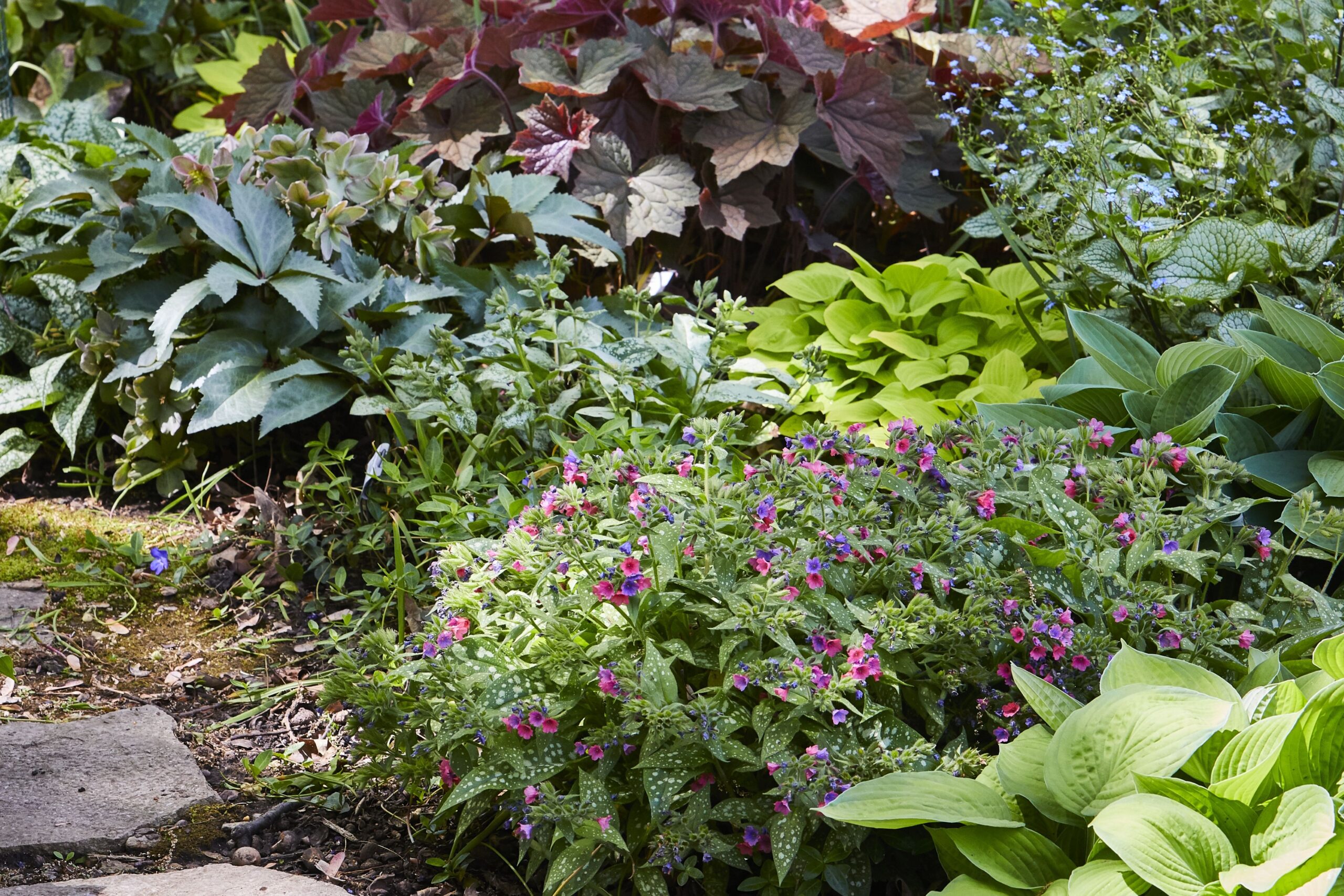
When it comes to spring-blooming perennials in the Better Homes & Gardens Test Garden®, top marks go to those that “aren’t fussy and check a lot of boxes,” says garden manager Sandra Gerdes. She particularly favors varieties with long-lasting flowers and attractive foliage that’ll continue to shine even after the colorful petals fade. Bonus points for excellent drought-tolerance as well as deer- and rabbit-resistance. Here are the most reliable, versatile spring perennials in the Test Garden that deserve a spot in your own garden to welcome the new growing season.
Hellebore
Credit:
Carson Downing
Hellebores (Helleborus spp.) are some of the first perennials to bloom in the Test Garden. They defy winter with flowers that withstand the season’s last frosts. Deer and rabbits don’t touch the dark green foliage of this shade perennial. Gerdes especially likes ‘Red’ from the Ice N’ Roses series or ‘Romantic Getaway’ from the Honeymoon series for their bold flowers. Zones 5-9.
Lungwort
Credit:
Carson Downing
The whimsical spotted foliage of lungwort (Pulmonaria spp.) lights up the shade garden from spring through fall. The flowers of this low-growing perennial, in shades of pink, blue, and purple, fare best in cool weather and pair well with spring bulbs such as hyacinth and glory-of-the-snow. Deer and rabbits don’t bother it. Test Garden favorite cultivars include ‘Shrimps on the Barbie’ (shown here), ‘Spot On’, and ‘Twinkle Toes’. Zones 3-8.
Columbine
Credit: Brie Passano
A wandering perennial in the best way, columbine (Aquilegia canadensis) naturally self-sows, popping up here and there in the garden. The delicate foliage and cheery red and yellow flowers are easy to pluck out if a plant sprouts out of bounds. Grow it in full sun or part shade and keep an eye out for hummingbirds. This native plant is a favorite nectar source. Zones 3-8.
Pasque Flower
Credit: Jay Wilde
Low maintenance plants get high grades in the test garden, and pasque flower (Pulsatilla vulgaris) fits the bill. Purple, or sometimes red or white, flowers dance over the ferny foliage of this zero-maintenance perennial in April or May. When the flowers fade, silky seedheads that look like wispy, wild hairdos decorate the plant into summer. Plant it in full sun to part shade in well-drained soil. Zones 4–8.
Bleeding Heart
Credit:
Grant Webster
This classic perennial has graceful, arching stems of tiny heart-shaped flowers. Growing best in part shade, bleeding heart (Lamprocapnos spectabilis) pairs well with tulips and daffodils. Like spring-blooming bulbs, this bleeding heart goes dormant in early summer when its foliage recedes. Gerdes says ‘Gold Heart’ has especially striking chartreuse foliage that almost appears to glow among the fresh greens of other spring plants. Zones 3–9.
Variegated Fragrant Solomon’s Seal
Credit: Jacob Fox
Variegated fragrant Solomon’s seal (Polygonatum odoratum var. pluriflorum ‘Variegatum’) has attractive green and white foliage. Small, white, bell-shaped flowers dangle from the stems in late spring, emitting a sweet fragrance. This hardy perennial grows in dappled light or full shade. It spreads slowly by underground stems and has vibrant yellow fall color. Zones 3–8.
Bishop’s Hat
Credit:
Grant Webster
A solution for dry shade, bishop’s hat (Epimedium spp.) has heart-shaped leaves tinged with red and purple. Tiny flowers in red, white, or yellow hues decorate this easy-to-grow groundcover in spring. Plant it near the front of a shade border or between hosta, astilbe, and other larger shade perennials where it will slowly spread to fill the gaps in between. ‘Purple Pixie’ (shown here) is a favorite of Gerdes. Zones 5–9.
Siberian Bugloss
Credit:
Kindra Clineff
An elegant perennial with silvery-white leaf veins decorating its heart-shaped leaves, Siberian bugloss (Brunnera macrophylla) is a low-growing shade plant. Its light purple flowers bloom for a few weeks in mid-spring, but it’s the foliage that makes this plant a star from spring through fall. ‘Jack of Diamonds’ and ‘King’s Ransom’ are two favorites in the Test Garden. Zones 3–8.
Comments are closed.