


“Plants Above All,” a mobile of hanging air plants near Selby’s Welcome Center.
The Jean & Alfred Goldstein Exhibition—the 10th annual—is back on the grounds of Selby Gardens’ downtown campus, and it’s a window into the artmaking world of Alexander Calder. It also explores his fascination with the circus, including his connection to the Ringling Bros. and Barnum & Bailey Circus that for years made its home in Sarasota.
Calder, famous largely because of his kinetic sculptures or mobiles, is honored with Alexander Calder: The Nature of Movement, open now through May 31 at the gardens. As always, the exhibit is a chance to see not only the artist’s creations—lithographs, silkscreens, a mobile on loan from the Ringling Museum’s collection—but also to learn more about the man and to discover what the gardens’ horticultural team has put together in the way of living vignettes inspired by him.
In this case, too, the movements of circus performers play a key role. Although there’s no evidence Calder ever visited Sarasota, his High Wire: Calder’s Circus at 100, on view right now at New York’s Whitney Museum, probably drew in part from his attendance at the Ringling Bros. circus in Madison Square Garden, in 1925. (The circus was not ensconced in its Sarasota winter quarters until 1927.)

Bonsai and rocks combine against a vivid red background in the Display Conservatory.
A tour of the exhibit starts at the gardens’ Welcome Center, where a hanging mobile of epiphytes, or air plants, dangles and twirls over visitors’ heads. (Selby is world renowned for its epiphyte collection.) Inside the Display Conservatory, bonsai and rocks melded together with armatures against a red background (the Selby team took up welding for this project) dominate. Music by composer John Cage adds accompaniment.

“Sabal Stabiles” uses sabal palms in a Calder-like sculpture.
Outside, as you stroll the grounds, you come upon the Rooted in Nature vignette, inspired by the gardens’ signature Moreton Bay Fig tree; Red Mangrove, echoing the real mangroves growing along the bay; Passiflora, inspired by passion flowers; Sabal Stabiles, which features twisting sabal palms poking through the central holes in the sculpture pieces; Calder Cascade, resembling fountains in the pond near the Welcome Center; and Bromeliad in Balance, featuring pieces in the bright primary color palette of red, yellow and blue that Calder often favored. Just before entering the Museum of Botany & the Arts, the wired Flowers in Silhouette beckons you in.

“Bromeliad in Balance,” a bromeliad-shaped mount for epiphytic bromeliads.
Once inside the museum, guests will see photos of Calder at work, learn about his affinity for the works of fellow artist Piet Mondrian, and view a large, amusing sketch Calder concocted of that 1925 circus show at Madison Square Garden. They’ll also glimpse those aforementioned lithographs and silkscreens—each one, by the way, lent by Sarasota area collectors.
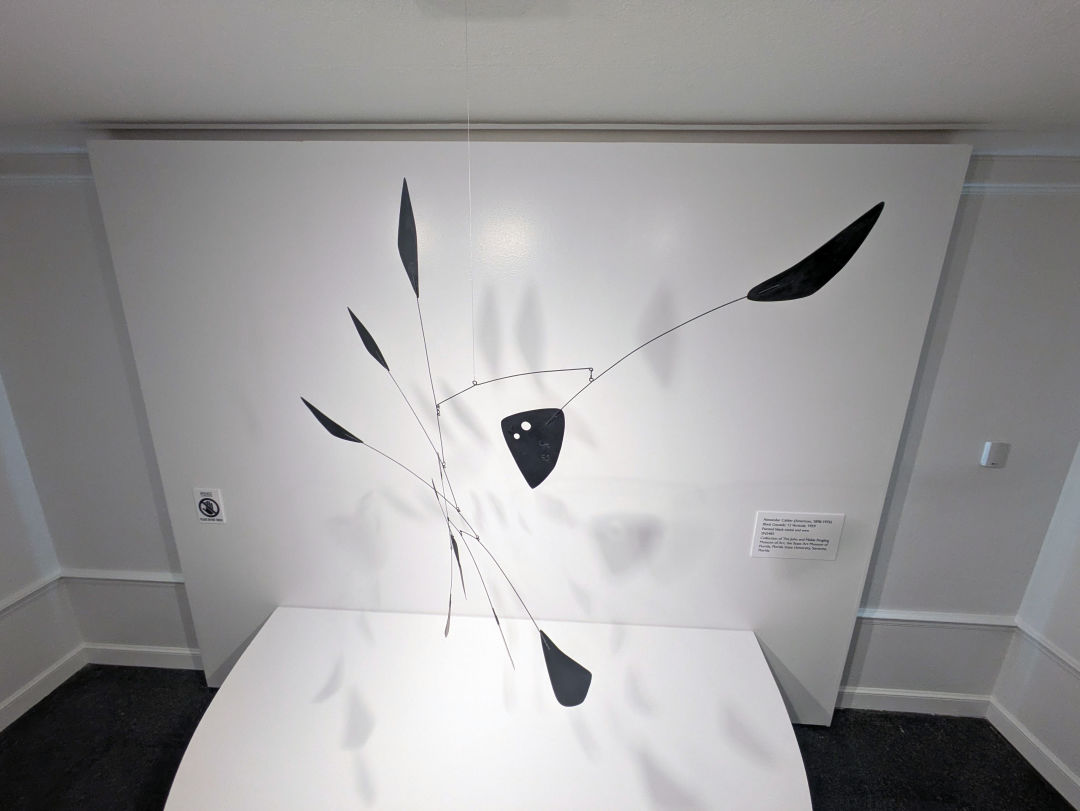
Alexander Calder’s “Black Cascade: 12 Verticals,” 1959, on loan from The John and Mable Ringling Museum of Art, on view in the Richard and Ellen Sandor Museum of Botany & the Arts.
And then, carefully poised and lit to display its movement and shadows against a white wall, is the Calder mobile, Black Cascade: 12 Verticals. It’s a piece that’s long been in the Ringling collection, but one that has not been on view for some years.
You can also expect to find refreshments at the Green Orchid Café playing off the vignette themes, like a “Red Mangrove” mocktail mixing cranberry juices for some colorful sipping. All in all, the connections of moving air plants, Calder’s moving art and his ties to the circus and the environment, make this, well, a “natural” show for Selby.
For more info, visit selby.org.
Comments are closed.