
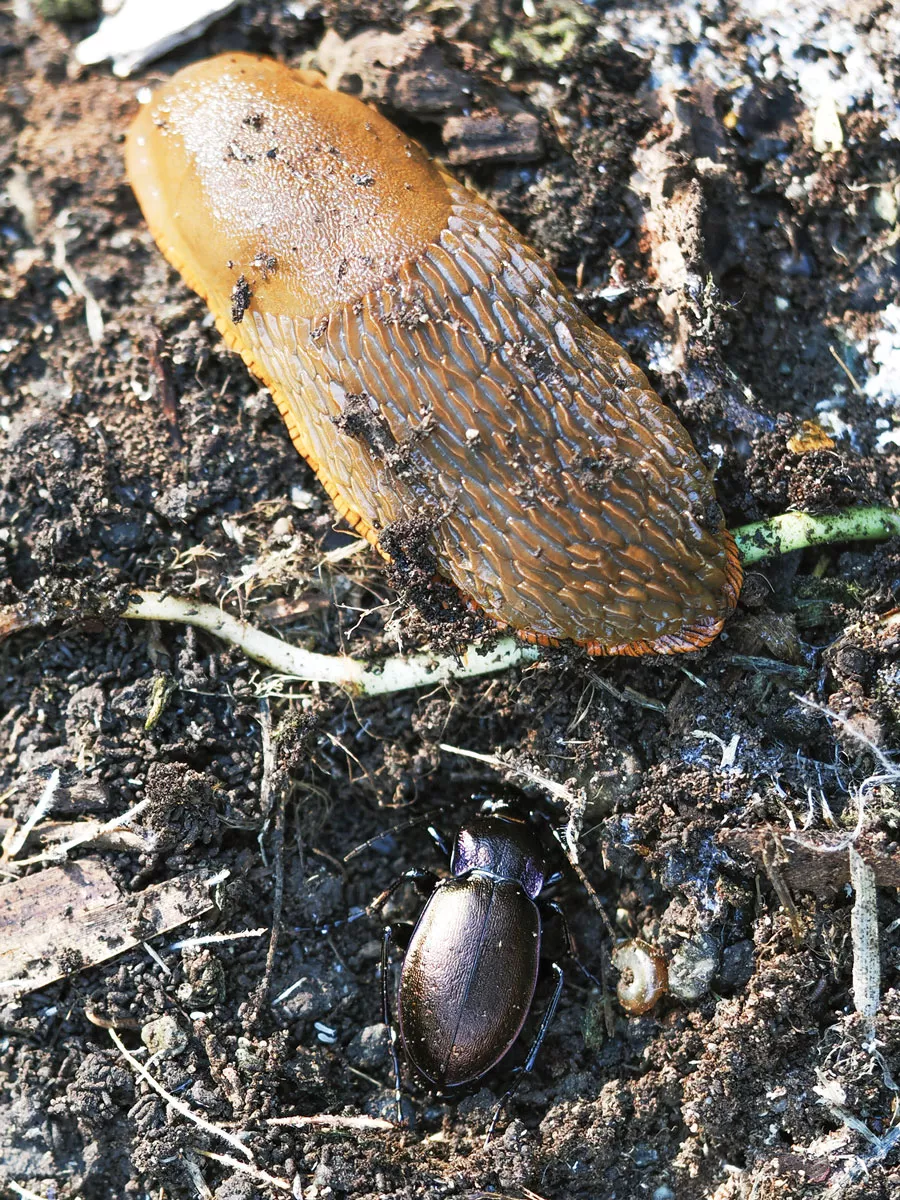
Despite the early morning temperatures in the middle 20s, I made a visit to the winter garden during a lull between rainstorms. Because of the cold and the rain, much of the vegetable garden is muddy and even the winter-hardy cole crops look mushy. But this is the perfect time to check on the garden fauna: slugs, snails, cutworms, beetles and more. All these little beasts are active now and easy to find if you know where to look. So let’s see who is hiding in the garden.
For many years, I have placed non-treated scrap boards in the garden to monitor and control pests. How does this work? Slugs and many other pests prefer to hide during the day and come out to graze on vegetables at night when the air is more humid. The wooden boards, which I place between rows of vegetables, create a dark, damp and protected daytime habitat for various invertebrates. I check underneath them every three to five days to see which garden visitors have been drawn to the boards. At this time of year, there are usually multiple pests, especially slugs and cutworms, upon which I can dispense justice.
Our most common garden cutworm is the caterpillar of the large yellow underwing moth (Noctua pronuba), which was introduced from Europe in 1979. The adult moth has mottled gray forewings and beautiful orange hindwings, and you may notice them taking flight when you mow the lawn or weed the garden. The caterpillars are active all year, even during the cold and wet months. As far as I can determine, they will eat any green plant, and the vegetable garden is their favorite place. I have found the wooden boards to be quite effective in attracting them.
What about all the variously sized black beetles that are also found under those same boards? Garden friend or foe? Very good friends. The snail-killer carabid (Scaphinotus angusticollis), European ground beetle (Carabus nemoralis), and night-stalking tiger beetles, have come by their names honestly, with both adults and larvae being predaceous on slugs and other pests. The snail-killer carabid, for example, is a specialist in killing and eating slugs and snails. Compared to other beetles, it has narrow jaws, head and shoulders that allow it to squeeze deep into a snail shell to dine on fresh escargot.
So how do I know I am really controlling pests by using wooden boards to attract them and their predators? The area around my garden is very wet in winter and covered with vegetation: a nonpareil habitat for slugs and snails. After using the boards for many years, I have noticed that the European brown garden snail has become rare and the slugs have become much smaller in size. By changing the population dynamics (in removing the larger slugs), I am removing the most likely slugs to be reproducing and laying the largest clutches of eggs. Slugs and snails are hermaphroditic; when two slugs mate, they exchange eggs and sperm with each other and both individuals get pregnant. This allows populations to grow very quickly if uncontrolled.
Using the boards makes it easy to corral and dispatch the slugs, cutworms and other pests in your garden, and provides the helpful predaceous beetles with a safe, stable place to rest during the day. It also puts you in a direct relationship with nature. Give the board method a try and find out what is going undercover in your garden.
Pete Haggard (he/him) taught extension courses on Vegetable Gardening at CalPoly Humboldt for many years. He writes with editorial assistance from Jane Monroe (she/her), who wishes the board method would work on aphids. Pete and Jane are the coauthors of the upcoming book ReWilding: Native Gardening for the Pacific Northwest and North Coast.
This article appears in 10 Foliies Anniversary.
Related
Comments are closed.