
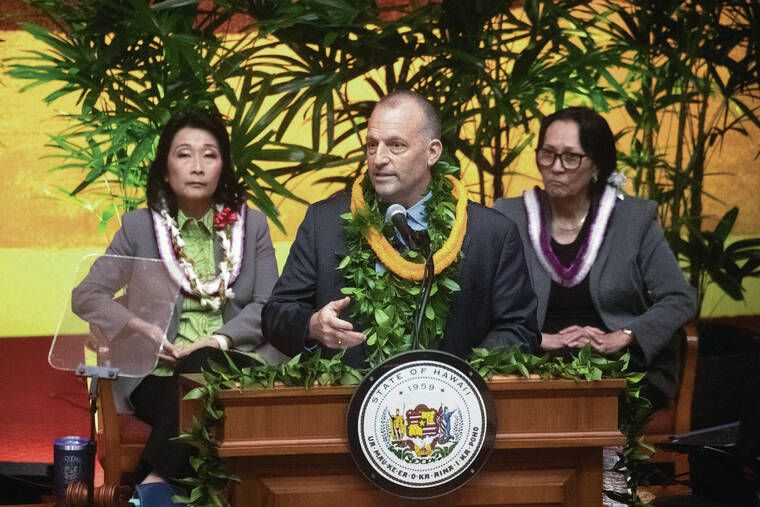
Ahead of Gov. Josh Green’s annual State of the State address last week, online bettors placed $448,667 in “prediction market” wagers on whether he would say phrases that included “affordable,” “affordability,” “mainland,” “cost of living,” “aloha,” “kauhale,” “housing,” “health care,” “tourism” and “volcano” as part of an online gambling phenomenon that would be prohibited under House Bill 2198.
It’s unclear where in the world the bettors placed their online wagers from.
But state Rep. Scot Matayoshi, who introduced HB 2198, doubts that the bulk of them were from the mainland or foreign countries where there would likely be little interest in what Green would say in his speech.
Matayoshi’s staff tracked the wagers on an online prediction market platform that allows users to place wagers on yes-or-no questions on everything from when Kilauea will erupt, who will win elections, which celebrities will die and who will win the Super Bowl.
And there can be large sums at stake.
One person bet $400,000 on a prediction market wager that Venezuelan President Nicolas Maduro would be removed from office — a bet that Matayoshi’s staff tracked. The wager may have paid off in January when President Donald Trump ordered special forces to capture him.
Although prediction market platforms have been around for years, their popularity has soared since 2024, according to the New York Times. Nearly $12 billion was traded on two of the most popular platforms, Kalshi and Polymarket, in December, an increase of more than 400% from a year earlier, the Times reported.
The markets’ rising popularity has gained the attention of state regulators and casino operators throughout the country, who argue that they skirt gambling laws.
Advocates, however, contend that prediction markets are not gambling but “event contracts” based on forecasting rather than games of chance. Platform users “trade” against each other on event questions, and the market operators make money by charging trading fees to those users. Unlike a casino, a prediction market does not act as “the house” and set odds, supporters say.
The prediction market phenomenon originally was aimed at stock market investments.
“That’s what stocks are at their core, betting on the future price of potatoes, for example,” Matayoshi said.
And, just like stock market investing, bets on Green’s State of the State address did not always pay off when the governor failed to say “volcano,” “eruption” or “Trump,” Matayoshi said.
“So they weren’t all winners,” he said.
Only Hawaii and Utah ban all forms of legal gambling, and the emergence of prediction markets represents the latest loophole to skirt Hawaii’s ban, according to the lawmaker.
“It’s pretty sketchy,” Matayoshi said.
HB 2198 was one of 2,457 new bills introduced by last week’s deadline, in addition to hundreds of others that stalled last year but automatically rolled over into the 2026 session.
Many of the new bills, like HB 2198, address new issues, while others revisit long-standing concerns, such as controlling feral chickens, continuing to help financially struggling families, doing more to crack down on illegal fireworks, clean up state government and a long list of other issues.
For instance, multiple bills again attempt to legalize some form of gambling, including Senate Bill 3303, which would create a new general excise tax on online sports and fantasy sports gambling.
HB 1945 would allow gambling aboard cruise ships sailing in Hawaiian waters or even while docked in a state harbor. All cruise ship bets would face a 20% “wagering tax.”
HB 2222 would allow “casino gaming in a single location in the City and County of Honolulu” and imposes an unspecified “wagering tax” on monthly gross receipts.
Matayoshi, (D, Kaneohe-Maunawili), chairs the House Consumer Protection &Commerce Committee and heard details about prediction market betting from a cousin at a family Christmas party.
Like others on the House floor who waited for the State of the State address, Matayoshi received an advance copy of Green’s speech and said it’s just one example of how prediction market betting can be manipulated, unlike traditional bets made in a casino or sports books in places like Las Vegas.
Unlike Las Vegas, though, Matayoshi said there is “no real house that backs up” bets.
“In prediction markets, you have to find someone else to take your bet on the other side, otherwise it doesn’t go through,” he said. “Prediction markets are pretty new, but other states are trying to ban it,” notably Washington and New York.
In Hawaii, Matayoshi said, “they’re using this platform because it’s technically legal right now. It’s a really interesting loophole they’ve threaded through.”
If HB 2198 becomes law, Matayoshi hopes that online prediction market platforms block bets from being made from Hawaii, just as some online companies have blocked products and services in Hawaii that are illegal here.
Clearly, savvy online users can fake IP addresses and locations, Matayoshi said, but Hawaii has to keep trying “to close these loopholes as soon as we find them.”
Comments are closed.