
The science of genetics began not with microscopes or DNA sequencing, but in a quiet monastery garden. In the mid-19th century, Gregor Mendel, an Augustinian friar living in what is now the Czech Republic, conducted a series of plant breeding experiments that would eventually transform biology. At the time, Mendel was not trying to found a new scientific field. He was attempting to understand how traits were passed from one generation of plants to the next. Getty Images
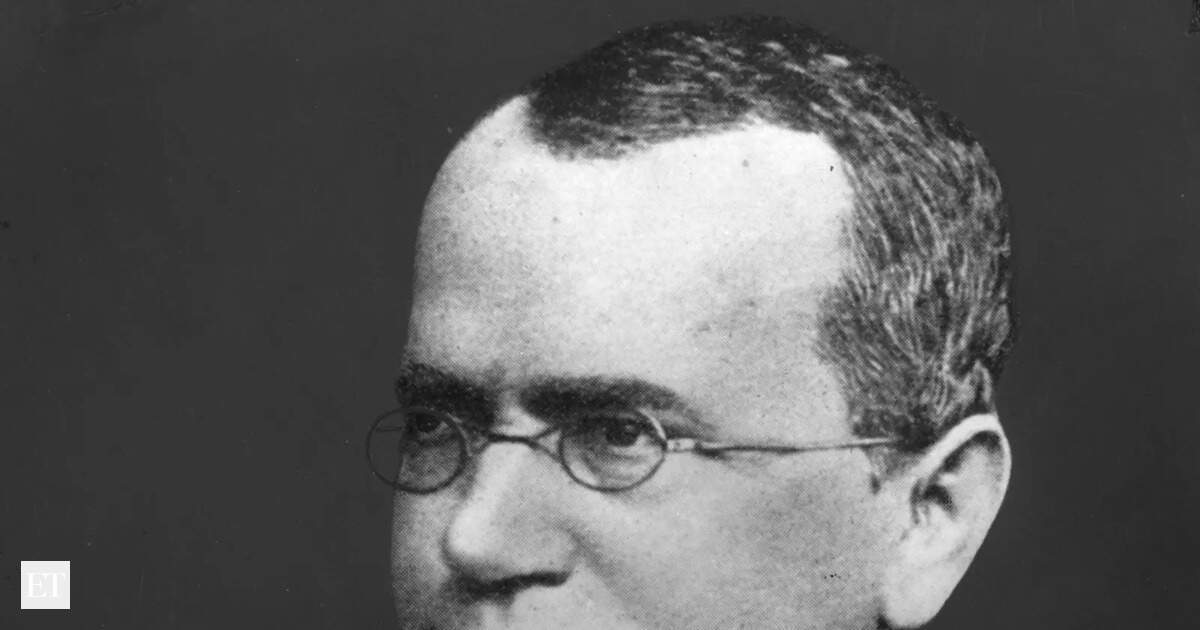
Gregor Johann Mendel (1822 – 1884) the Austrian priest, biologist and botanist whose work laid the foundation of the study of genetics. (Photo by Hulton Archive/Getty Images)
His work took place in the garden of the Augustinian Abbey in Brno, where he carefully grew and cross-pollinated pea plants over several years. What distinguished Mendel from other plant breeders was not the plants he chose, but the way he counted, recorded, and analysed his observations.
Why Pea Plants Were the Perfect ChoiceMendel selected pea plants because they offered clear, easily distinguishable traits. These included seed colour, seed shape, flower colour, and plant height. Each trait appeared in one of two contrasting forms, such as yellow versus green seeds or tall versus short stems.
Pea plants also reproduce quickly and can self-pollinate, which allowed Mendel to control mating with precision. He could prevent accidental cross-pollination and manually introduce pollen when necessary. This level of control was essential for isolating individual traits and tracking them across generations. By focusing on one trait at a time, Mendel avoided the confusion that plagued earlier inheritance studies, which often combined multiple traits and produced inconsistent results.Counting Changed EverythingThe most radical aspect of Mendel’s work was his use of numbers. Rather than describing traits in vague terms, he counted thousands of plants and recorded exact ratios. When he crossed plants with contrasting traits, he noticed that the traits did not blend. Instead, one trait would disappear in the first generation and then reappear in the next. Live Events
Mendel observed that traits followed predictable numerical patterns, most famously a roughly three-to-one ratio in the second generation. This consistency suggested that inheritance followed fixed rules rather than chance. Modern geneticist Daniel Fairbanks has noted that Mendel’s key insight was recognising that inheritance could be studied mathematically, which was highly unusual in biology at the time.
The Laws Mendel DerivedFrom his experiments, Mendel proposed what are now known as the laws of inheritance. He concluded that traits are controlled by discrete units, which we now call genes. Each plant carries two versions of each unit, one inherited from each parent.Mendel also determined that these units separate during reproduction and combine again in offspring. This idea, later called the law of segregation, explained why traits could skip a generation without disappearing. In experiments involving two traits simultaneously, Mendel found that different traits were inherited independently, provided they were not linked. This principle, known as independent assortment, further reinforced the idea that inheritance followed logical rules.Why No One Noticed at FirstMendel published his findings in 1866 in a local scientific journal. The paper attracted little attention. Biology at the time focused on descriptive observation rather than quantitative analysis, and Mendel’s statistical approach felt unfamiliar and abstract.
There was also no known physical explanation for his inheritance units. DNA would not be identified until decades later, and chromosomes were poorly understood. Without a visible mechanism, Mendel’s conclusions seemed speculative to many of his contemporaries. As historian of science Robert Olby later explained, Mendel’s work was not wrong for its time. It was simply ahead of it.
Rediscovery Changed Biology ForeverAround 1900, several scientists working independently rediscovered Mendel’s paper while studying inheritance. Once confirmed, his ideas spread rapidly. They provided the missing framework for understanding evolution, variation, and heredity.
Mendel’s discrete units of inheritance were soon linked to chromosomes, and later to DNA. What began as a gardening experiment became the foundation of modern genetics, influencing medicine, agriculture, and evolutionary biology.
Why Mendel’s Story Still MattersMendel did not set out to revolutionise science. He asked a simple question, chose a careful method, and trusted the data. His work shows that major discoveries do not always come from advanced technology. They can emerge from patience, structure, and attention to patterns others overlook.
The garden where Mendel worked was ordinary; the insight was not. By counting peas, he revealed the hidden logic of life itself, long before anyone knew what genes were made of.
Comments are closed.