
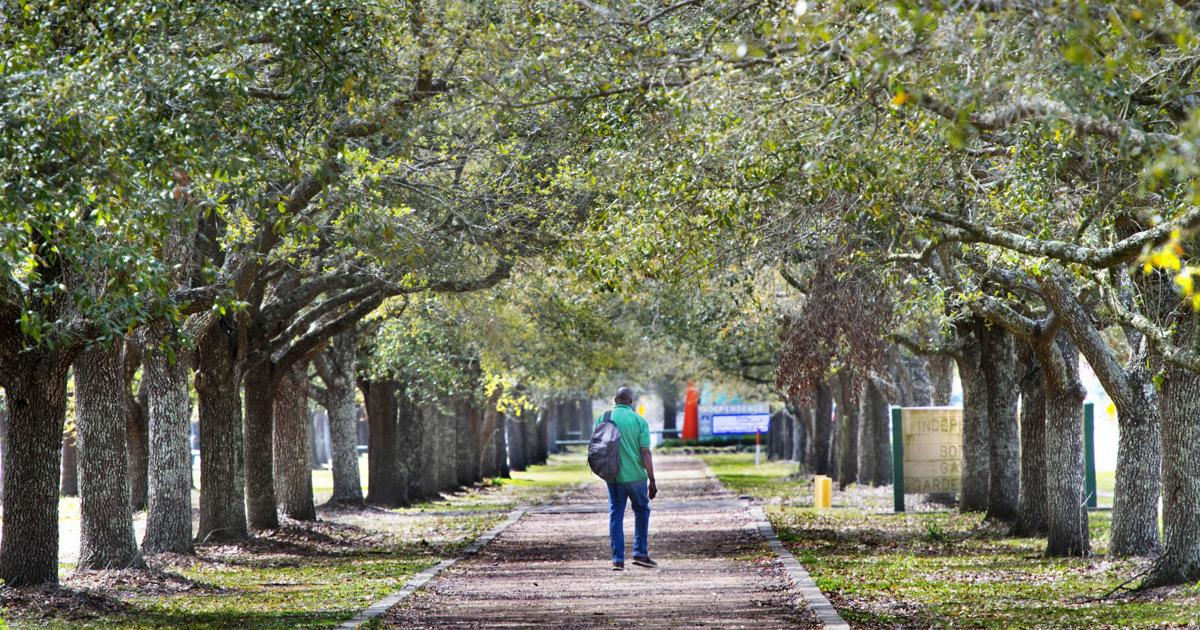
I have a massive water oak growing in my backyard, estimated to be about 65-70 years old. Recently, I discovered some mushrooms growing out of the base of the trunk and contacted an arborist to inspect the tree. I was told that the tree is in good shape and has a few more years left in her, but the arborist advised getting the tree fertilized. This is an expensive undertaking. Is it necessary to fertilize this tree? — Margaret
Fertilizer will not be particularly beneficial in this situation. Mushrooms growing out of the trunk indicate fungal organisms are rotting out the heart of the trunk. Fertilizing the tree will not significantly affect this.
Old water oaks (Quercus nigra) are prone to developing decay in their trunks as they age. Because of this, their life expectancy is generally considered to be about 60 years — they have the shortest life expectancy of commonly grown oak species.
After that, decay in the trunks weakens them, and older water oaks with rotten trunks are probably the most common tree to go over in hurricanes (in addition to pines).
I am surprised that an arborist saw mushrooms growing out of the base of the trunk of a water oak and did not say this was a concern. Given the well-known propensity of old water oaks to develop decayed trunks and blow over, I would have expected a different reaction.
Generally, this would be cause for serious concern. A tree can look perfectly healthy and have a substantially rotten inner trunk. So, trees like your water oak are generally considered for removal, even though they may look fine.
This is a very difficult decision. Large trees provide welcome shade and add to the value of property. But it is not being overly paranoid to be concerned.
Given its large size, you should consider removing the tree in order to protect your home and surrounding structures. Look around and determine what structures/houses on your and neighboring properties would be impacted if the tree blows over.

Imidacloprid is labeled for use on citrus and other fruit trees, and may be used on them to control insect pests – particularly sucking insects like white flies, scale, mealybugs and black flies.
STAFF PHOTO BY TRAVIS SPRADLING
I was wondering if you can please help me out with a recommendation. Can the insecticide imidacloprid be used as a drench for insect control in citrus trees? If so, how should it be applied to help control whiteflies and other insects? — Gary
Imidacloprid is labeled for use on citrus and other fruit trees and may be used on them to control insect pests — particularly sucking insects like white flies, scale, mealybugs and black flies. But I’m only familiar with one imidacloprid-containing product that is labeled for that purpose.
Unless a product has specific information on the label regarding using the product on citrus, you should not use it for that purpose.
BioAdvanced Fruit and Citrus Tree Insect Control contains imidacloprid, and it is labeled for use on citrus trees and a variety of other fruit trees. You should be able to find this at a nursery or you can order it online.
Plant seeds or transplants of cauliflower this month.
STAFF PHOTO BY SOPHIA GERMER
This product is applied as a soil drench. It is mixed with water and poured around the base of the tree. The insecticide is absorbed by the roots and enters the circulatory system of the tree. When sucking insects feed on the sap of the tree, they ingest the insecticide and die, preventing a major outbreak. Follow label directions carefully.
Garden tips
PLANT NOW: In February, plant seeds of tomatoes, peppers and eggplants indoors under lights or in greenhouses to produce transplants that will be planted into the garden in mid to late March mid-April. Plant seeds or transplants of broccoli, cabbage, cauliflower, collards, Swiss chard, kohlrabi, lettuce and mustard. Plant seeds of beets, carrots, radish, rutabaga and turnips where they will grow. Plant potatoes (plant whole or cut tubers). Plant seeds of snap beans in late February (south shore).
GOOD TIMING: Planting vegetables at the right time is important to successful home gardening. For excellent information on when to plant vegetables in Louisiana, do an internet search for LSU AgCenter Louisiana Vegetable Planting Guide and click on the provided link.
FERTILIZE NOW: Fertilize fruit trees such as apple, peach, pear, fig, citrus and plum, fruit bushes such as blackberry and blueberry and grape vines this month. Choose a general-purpose fertilizer or a fruit tree fertilizer and follow label directions. For blueberries, use an acid-loving plant fertilizer.
MORE MULCH: Keep beds mulched to a depth of 2 to 3 inches to control cool-season weeds in beds. Use leaves, pine straw or other available materials. Remember to keep mulches pulled back 8 to 12 inches from the foundation of slab houses and pillars of raised houses to reduce the risk of termites.
PRUNE ROSES: Be sure to prune your roses over the next two weeks but hold off fertilizing until March.
Comments are closed.