
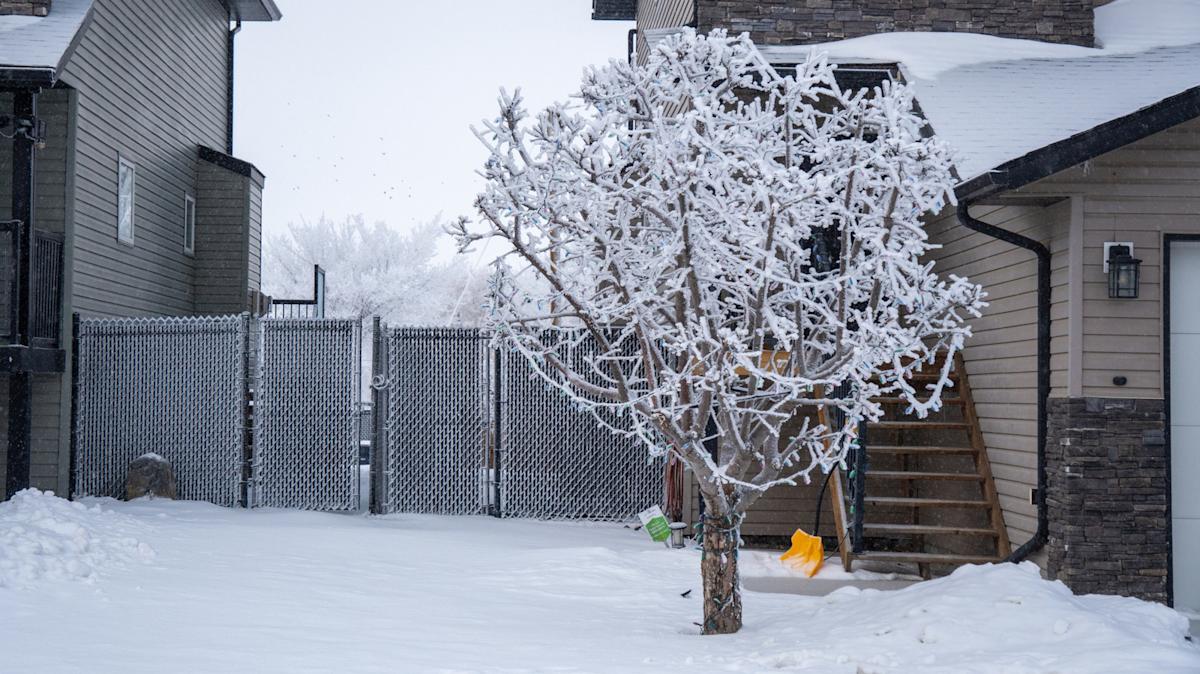
If your fruit trees aren’t as bountiful or healthy as you’d like, it might be time to try one of the oldest, most widely used techniques in fruit tree propagation: grafting. Early records from ancient China and Greece in the 3rd and 4th centuries describe creating choice fruit trees by physically joining a young limb from a tree (a scion) to a different trunk or limb of the same or related species (the rootstock) at their living layer (the cambium) just under the bark. Today, most fruit trees you buy are the result of grafting. If you already have fruit trees, grafting can diversify varieties, increase yields, and lets you fine-tune trees for your growing conditions. Performing this slightly surgical procedure is best done in late winter or early spring. This reduces stress and gives the tree time to heal the new union as it awakens from dormancy. As a bonus, scions often bear fruit within just two years (rather than 5 or so for many fruit trees raised from seeds or saplings).
For grafts to transform your orchard, select scions for traits your current trees lack. Scion twigs can be purchased online and locally, or exchanged among gardeners or neighbors. The key is compatibility: apples to apples, stone fruits to stone fruits, citrus to citrus. Grafting is a great option for rescuing damaged, diseased, or mature trees. By removing a failing limb and grafting a healthy scion, you fill problem areas with new life. Some gardeners experiment with “fruit salad trees,” like one Redditor by grafting several varieties on a single rootstock. And artist Sam Van Aken created a mega-grated “Tree of 40 Fruits” back in the 2010s. You can even graft a branch that acts as a pollenizer for varieties that require cross-fertilization, saving on planting space.
Read more: Unexpected Ways You Could Be Using Hydrogen Peroxide In Your Garden
Getting started with grafting
New growth on a grafted branch of a tree – Mariana Serdynska/Shutterstock
Late winter into very early spring is best for grafting common backyard fruit trees like apples, pears, and stone fruits, conveniently also the best time to prune. The tree is still dormant, just weeks away from sending energy into its limbs. Grafting too early can expose the scion to damaging freezes. Waiting too long can cause heavy sap flow to drown the union site, or high temperatures may dry out the graft site. Ideally, the rootstock is just awakening, and the scion is still dormant.
You’ll need a scion, a compatible, established rootstock, a clean sharp blade, and grafting tape or sealant. The scion should be 12-18 inches long, the diameter of a #2 pencil, and have several closed buds. Make a smooth cut at the base to expose the cambium. Then make a matching incision it on the rootstock — you want the two cuts to line up in terms of size and angle of the exposed cambiums — aligning their green layers. Wrap the site tightly with grafting tape or sealant to prevent air and moisture intrusion.
You want both rootstock and scion to be healthy and established. A rootstock of one to two years is usually large enough, though you may need to wait three years for some nut trees. The right scion might take several years to prepare (unless you buy it at the nursery), to ensure you’re getting the traits you want. Harvest a one- to two-year-old twig also during the winter or early spring, making sure it possesses at least two to four tightly closed buds.
For best results, practice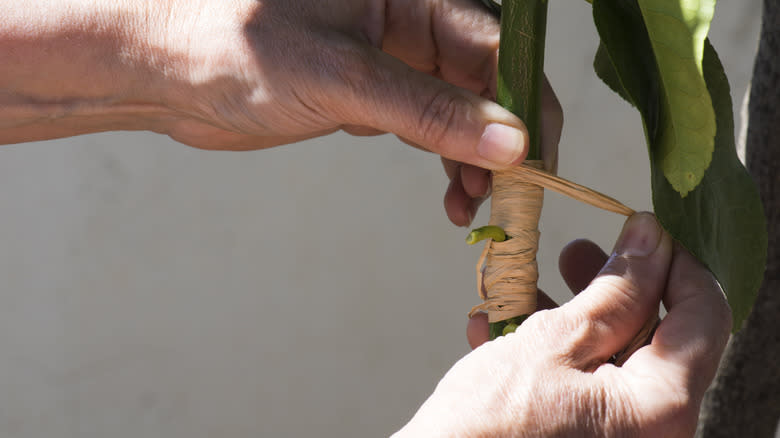
Person sealing a graft on a lemon tree – Manueltrinidad/Getty Images
Think of grafting as delicate tree surgery. The cambium connection must be tight and uniform, the wound must be covered, and in time, a callus will form. Check with your local nursery or extension office for specific tips on your tree types and climate. There are numerous grafting styles and coinciding seasons that might be best for your situation.
Practice on discarded limbs to refine your technique before going for it on your tree. Keep stored scions cool and dormant until grafting; wrapping them in a plastic bag in the refrigerator works well. Failures often stem from misaligned cambium layers, incompatible pairings, or rotting or drying at the union. Patience and precision are your greatest tools, but if you find your trees aren’t setting fruit, there may be other issues to look into. When your grafts set and your trees are fruiting like crazy, protect your investments by taking steps to keep common pests away from your fruit trees.
Want more design inspiration? Join our free newsletter to get the best home and garden tips, design hacks, and DIY projects delivered right to your inbox. You can also add us as a preferred search source on Google.
Read the original article on Outdoor Guide.
Comments are closed.