
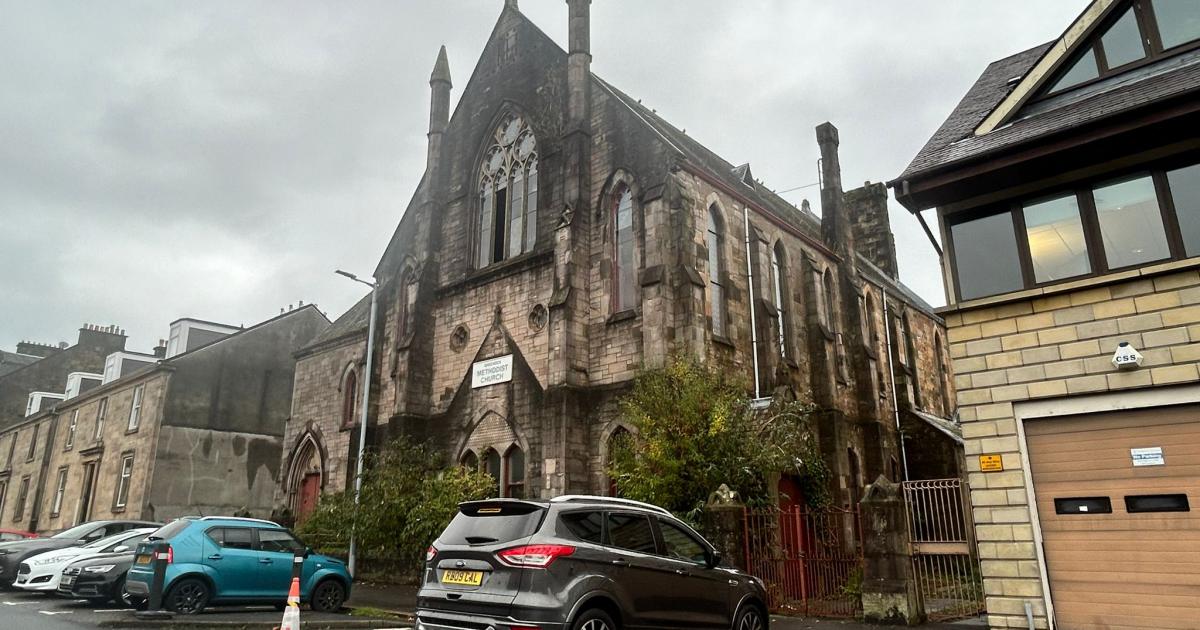
It is the second time the hospice has applied for permission to demolish the former Greenock Methodist property in Ardgowan Street, Greenock.
The church was completed in 1881 and closed in 2017.
Inverclyde Council planners last year refused permission for the demolition of the building saying it would be ‘contrary to the Historic Environment Policy for Scotland’.
The hospice is now making another attempt to secure demolition permission, with their new application including plans to build a community garden.
A supporting statement submitted on behalf of the hospice to the council by Rebecchi Architectural states: “The proposal would create a welcoming space in which the Ardgowan Hospice patients and local community groups can socialise whilst growing vegetables, fruit and herbs within an accessible outdoor environment.
“The church building is in a dilapidated state with cracking to the rear structure. Given the building is not fit for purpose, it is no longer of any use to Ardgowan Hospice.
“Furthermore, each winter slates fall from the roof causing a danger, and the high cost of repairs to a vacant building is not in the interest of the hospice’s patients.
“Therefore, given the hospice currently has a lack of outdoor space, utilising this land for a community garden would provide this in an appropriately convenient location whilst greatly improving the overall character of the area.”
Another document adds: “Ardgowan Hospice purchased the old Methodist Church in 2016 with the clear intention of securing a larger footprint necessary for the building of a new hospice on the combined plots of the church and the adjacent Access building.
“The proposed demolition is not merely an arbitrary change, but a necessary step to enable a significant development that meets acute social and community needs.
“These changes, by necessity, must be completed in phases. The initial phase involves demolishing the church and creating a community garden, which would benefit our patients and their families.
“The hospice’s long-term plans align with Historic Environment Scotland’s broader strategic goals, despite involving the demolition of an unused, dilapidated building, and will contribute to the sustainable development of communities and places.”
A report prepared for the hospice by a retired chartered surveyor claims that converting the building into flats would not be financially viable.
The hospice’s new proposals are now pending consideration by council officials.
Comments are closed.