
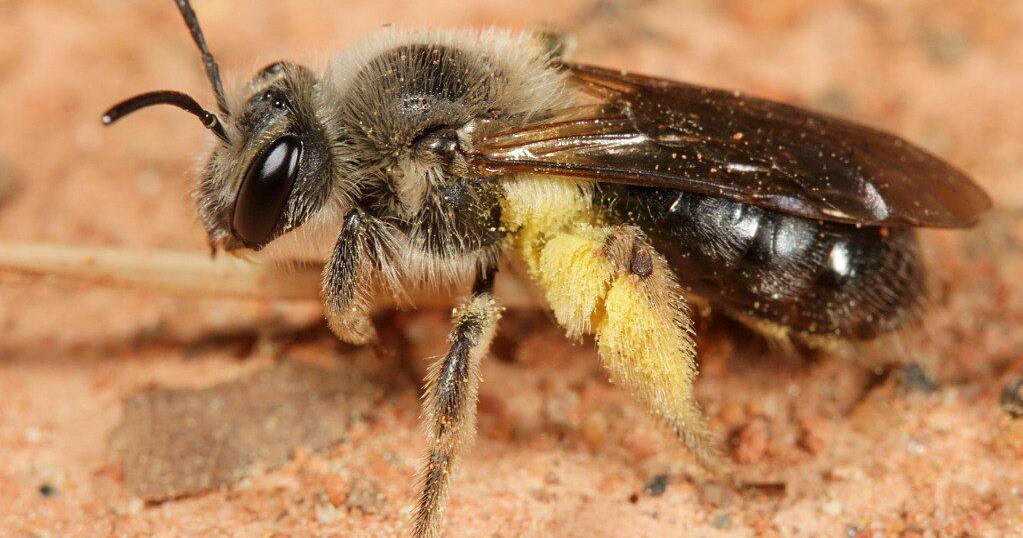
As the days begin to lengthen and the “Persephone Days” come to an end, Lee County residents often notice a flurry of activity in their lawns: small mounds of soil and hundreds of tiny hovering insects. The immediate reaction for many is fear. Are these yellow jackets? Will they sting my kids or pets? The short answer is almost always no. What you are likely witnessing is the emergence of North Carolina’s native ground-nesting bees. These are docile, essential pollinators that are often the victims of a case of mistaken identity.
The Great Mistake: Ground Bees vs. Yellow Jackets
Understanding the difference between ground-nesting bees and yellow jackets is the key to a peaceful garden.
Yellow Jackets are social wasps. They live in large colonies with a queen and “soldiers” who aggressively defend the nest. They are shiny, hairless, and have a distinct side-to-side “wasp waist”. They are scavengers, often bothering you at picnics.
Ground-Nesting Bees, on the other hand, are solitary bees classified in several genera. Most of our 500+ native bee species are solitary. While you might see many holes in one area, each female is a “single mom” tending her own nest. They are fuzzy, helpful for carrying pollen, and have no interest in your sandwich or in stinging you. In fact, most male ground bees can’t sting at all, and females will only do so if physically squeezed.
The Early Birds of the Garden
Ground-nesting bees are some of our most efficient pollinators. Because they emerge in late February and March, they are the primary workers for early-blooming crops like apples, peaches, and blueberries.
Unlike honeybees, which live in perennial hives, these bees are only active for a few weeks. They dig tunnels in well-drained, sunny soil to lay their eggs and store “pollen balls” for their vegetarian larvae. By the time the heat of May arrives, the adults will be gone, and the next generation will be safe underground until next spring.
How to Help Them
If you want to support these “VIPs” (Very Important Pollinators), there are some super easy strategies to encourage them to move in.
Leave the Bare Spot: Bees cannot dig through thick mulch or dense turf. If you have a sunny, thin patch of grass where they like to congregate, consider it a “natural bee sanctuary.”
Build a Bee Bank: If you’d prefer they nest in a specific area, create a “bee bank”—a mound of soil in a sunny spot. Different species prefer different soil types and researchers are still working on which kind is best for which!
Provide a Drink: A shallow “bee bath” with pebbles (so they don’t drown) provides much-needed water for these early foragers.
What if you want them to move?
Sometimes ground-nesting bees choose a high-traffic area (like a walkway or a play area) and you’d prefer they nest elsewhere. The solution is cultural, NOT chemical. You can wait it out, as most species are only active for about four to six weeks. You can also change the habitat. Once they go dormant in late spring, cover the area with a thick layer of mulch or improve your turf health with aeration and seed. Ground bees will not return to an area where they cannot easily reach the soil.
Observe Before You Act
Before you reach for the insecticide this spring, take a moment to watch the “swarm.” If the insects are hovering low to the ground and minding their own business, they are likely your garden’s best friends.
If you aren’t sure what you’re looking at, contact your Local NC Cooperative Extension Office. We are happy to help you identify your “tenants” and ensure that your pollinator population stays healthy and strong.
Resources
Amanda Bratcher is the horticulture agent with NC Cooperative Extension- Lee County Center. You can reach out to the office at 919-775-5624 for more information or questions regarding this article, but also any other questions about your garden, farm, land or plants! We’re here to help! You can check out our website at https://lee.ces.ncsu.edu/events/ for more information and to register for upcoming programs.
Comments are closed.