
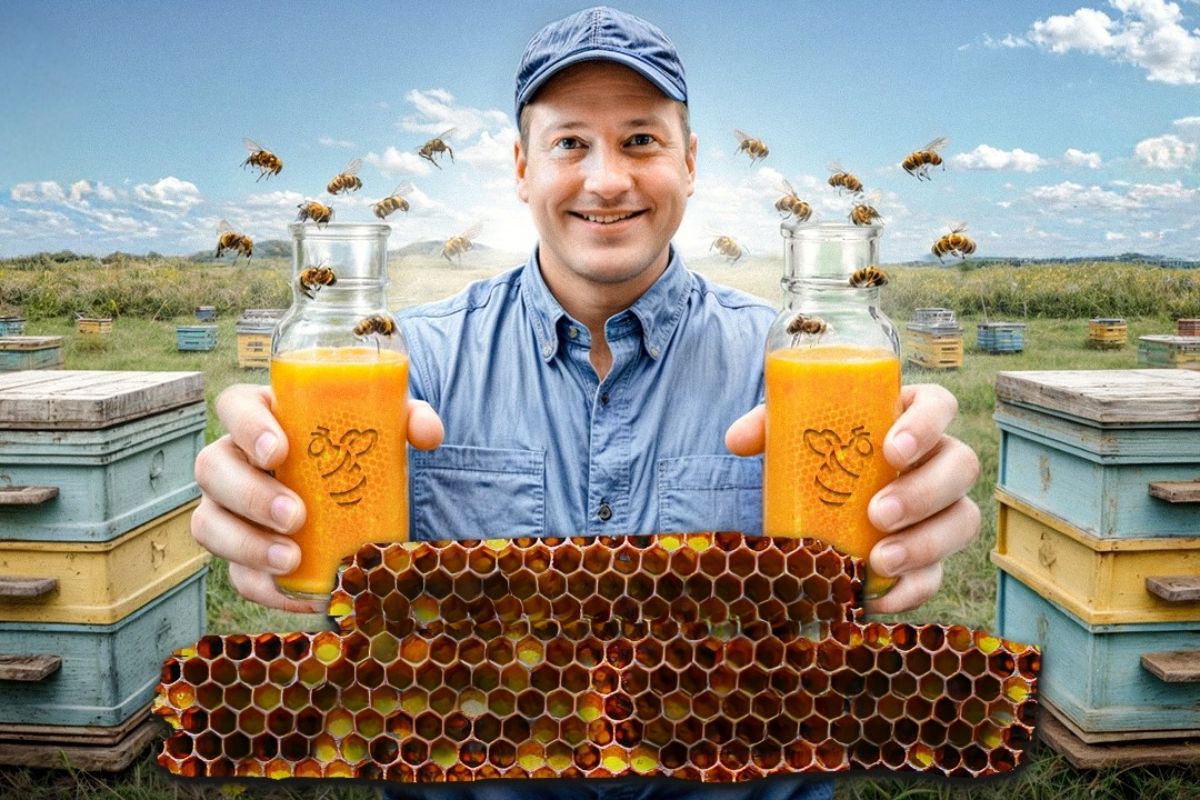
Honey that emerged from the bottom of a property in North Carolina has become an unusually large-scale case for a small producer: US$ 41 thousand per month Starting with an investment of around US$500 and two beehives, the operation is centered around James Hartman, a former member of a US Army bomb squad who pursued beekeeping as a side income until he was laid off from his regular job.
The turnaround didn’t happen in a single leap. and yes, of accumulated decisions and less noisy: increase hives, standardize extraction and bottling, test price and packaging, and seek channels with stable volume. The result shows how applied marketing and backstage infrastructure This can force a honey producer to compete with traditional companies.
From agricultural therapy to scaling up.
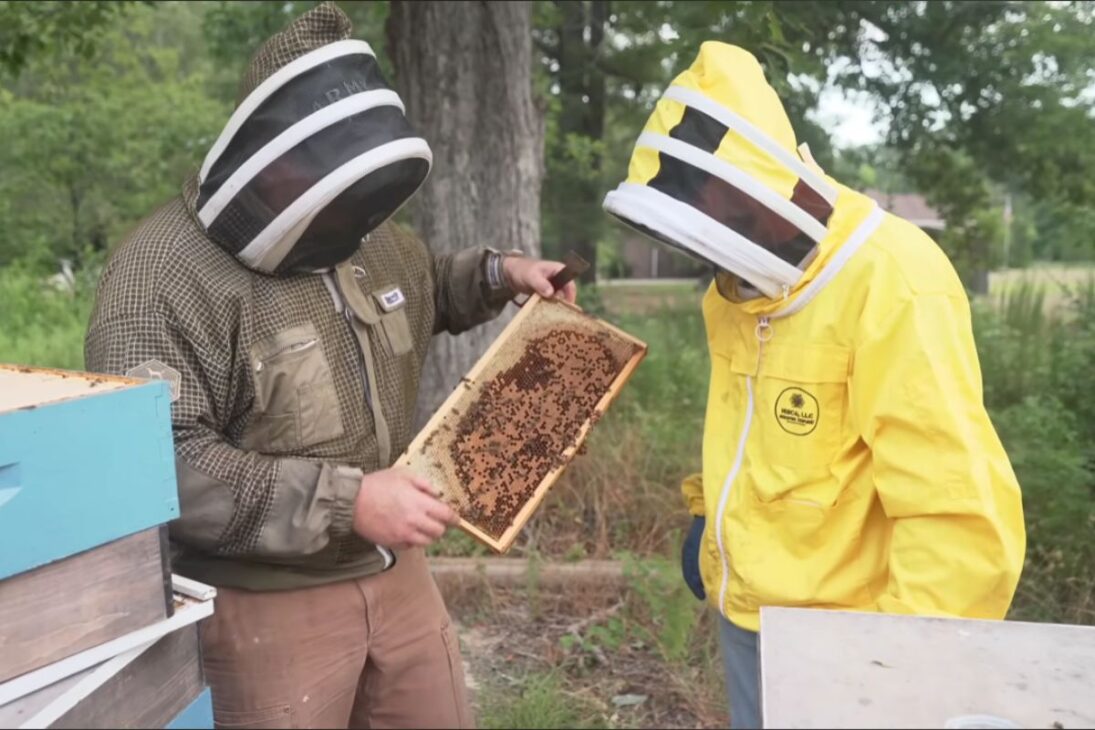
In the spring of 2020, Hartman was introduced to beekeeping by a friend and decided to start small, with two hives, to experiment.
— ARTICLE CONTINUES BELOW —

He links this onset to a period of PTSD and a mild traumatic brain injury attributed to his previous work, saying that beekeeping functioned as agrotherapy because it required attention, slow movements, and constant presence during tasks.
The hobby, however, changed in nature when honey began to be treated as a market product. The farm’s name, Secret Garden Bees, came from the fact that the first beehives were hidden at the back of the property, like a “secret garden”.
From then on, growth was driven by a clear objective: to increase the number of beehives and build a sufficient standard to deliver to supermarkets without having to improvise.
Beehives, bees and productive capacity
The scale begins with the physical base: enough beehives to guarantee volume and regularity. Hartman reported having 62 beehives and described the structure as having brood chambers at the bottom and medium-sized boxes used as honey supers, where the honey accumulates and becomes revenue.
He estimated the cost of assembling a complete box at approximately US$50, including frames.
The supply of bees is also factored into the calculation.
He stated that there are no native honeybees in North America and that, in the United States, Italian bees are common because they are calmer and produce a lot of honey.
For replacement and expansion, he cited purchases of around US$150 and the option of “nuclei,” with five frames, a queen, honey, and larvae, as an initial boost to strengthen new hives.
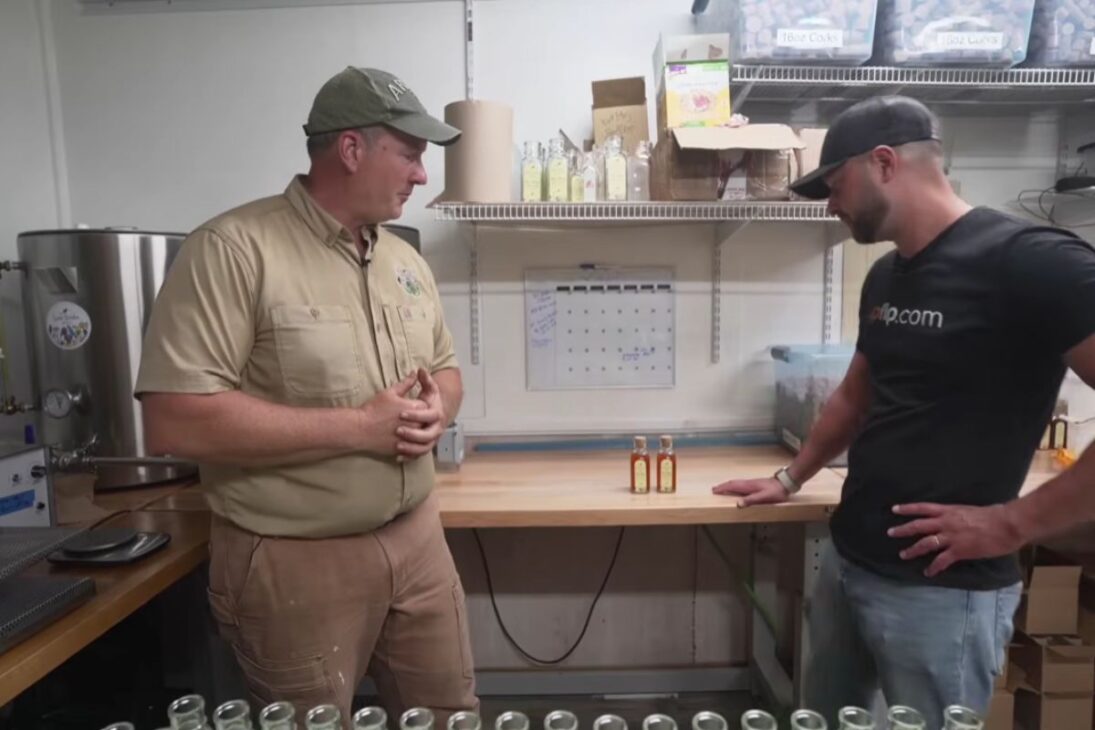
Producing honey in volume requires a routine of extraction and quality control. Hartman described a process involving uncapping the frames, centrifuging in the extractor, filtering, and transferring the honey to a reservoir, removing wax and residue.
Then, the honey is pumped into a thousand-pound holding tank and stored in five-gallon buckets, providing a buffer for ongoing sales.
He said he performs extractions twice a year, around June 1st and October 1st, depending on the season.
Frequency seems simple, but it has a practical effect: planning labor, containers, and storage so as not to waste time during the critical period.
On a large scale, process consistency is just as important as the harvest itself, because any failure translates into product loss and a missed sales window.
Packaging and productivity: when the bottleneck shifts sides.
The major operational difference, according to him, lies in the bottling process. In the beginning, the manual process with buckets and controlled honey output required about 60 to 80 hours to raise 1.000 pounds.
With heated tanks that keep the honey at 104 degrees, as well as a filling machine and other packaging equipment, he stated that the same volume now requires about eight hours.
This difference creates an indirect consequence: time becomes the ability to sell and maintain standards.
When bottling ceases to consume the week’s worth of goods, the producer reverts to being a manager….being able to train staff, organize logistics, and execute marketing consistently.
In supermarkets, where restocking and standardization are constantly evaluated, productivity is not a detail; it’s a prerequisite.
Margin, price, and packaging: marketing without the noise.
The discussion of profit margins emerges as a control indicator. Hartman reported that he started with a margin of around 20% and that, after adjusting scale and processes, he began operating with a profit margin of approximately 40% to 50%.
He attributed the improvement to the standardization of bottling processes, pricing, and organization of internal infrastructure before accelerating the expansion into supermarkets.
The packaging was treated as a positioning tool. He described a premium product in a glass bottle with a cork and seal, with a design process that took over 18 months and included customer preference testing.
In retail, he cited smaller bottles ranging from US$10 to US$14 and larger bottles starting at US$20, mentioning stores that charge up to US$40.
The cost per bottle was quoted at around US$6, reduced to approximately US$4, and increased brand perception was placed as a central part of the marketing strategy, especially when the product needs to justify its price and occupy a competitive space in supermarkets.
Supermarkets and wholesale: the reliability test
The expansion thesis is clear: supermarkets as the engine of volume.
Hartman cited his entry into chains like The Fresh Market and associated the advancement with a process of persistence: talking to managers, obtaining corporate contacts, and calling repeatedly until receiving a response.
In practice, the operation was tested with an initial set of stores, and continuity was established when delivery and turnover proved consistent.
The most visible moment for this channel was a wholesale order quoted at around US$46.000, when the chain expanded the product’s presence from 60 to 170 stores.
He also described a merchandising detail: targeting the fruit and vegetable section, not just the grocery aisle, because consumers who buy fresh food tend to accept higher prices.
In terms of execution, this decision is point-of-sale marketing, but it only works if the hives, bottling, and inventory support replenishment.
Monthly costs, capital, and the silent strategy.
Scale also means fixed costs. Hartman cited monthly expenses of around $7.000, including salaries for two full-time employees.
This number helps explain why the debate isn’t just about producing more: it’s about producing and selling at a rate sufficient to cover costs, maintain margins, and still finance the growth of beehives and equipment.
To reduce the investment burden, he mentioned the use of public surpluses and stock exchanges.
He cited a 2018 law that allows the direct transfer of surplus assets from the government to veterans and exemplified this with a forklift valued at US$40.000 obtained through a US$500 service fee, an F-350 pickup truck for US$1.000, and a trailer acquired for a few hundred dollars, used as a climate-controlled extraction unit.
Regarding the bottling process, he mentioned a set of equipment costing around US$20.000, saying he contributed about US$2.000 of his own money after receiving a grant for small farmers, with the goal of making future growth and standardization in mind.
Risk, losses, and routine: the hidden cost of scale.
Scale also increases risks, and Hartman framed this as a matter of managerial discipline. He stated that he maintains a risk management spreadsheet and insisted that failures are certain in any small business.
A concrete example was an Arctic cold wave the previous winter, associated with the loss of 14 beehives due to freezing, in addition to the existence of USDA insurance to compensate for part of the losses through a claim.
The work routine was also adjusted due to the risks involved. He reported an early mistake when he tried to extract honey during the day, which attracted a large number of bees and made the process unfeasible.
The solution was to move the extraction to the night, starting around nine o’clock and working through the early morning hours while the bees sleep. Beekeeping on a large scale is not idyllic: it involves logistics, scheduling, and mitigation….and these details uphold the standard required by supermarkets.
Direct retail, team, and legal choices
Even with the strategy focused on supermarkets, Hartman described that a portion of sales continues through direct-to-consumer retail, something like 20% to 25%, and that this channel tends to yield about 30% more profit than wholesale.
He also mentioned building a service point on the farm for less than US$1.000 and reported that the space went on to generate an average of US$500 per week, showing how honey can combine volume in supermarkets and margin in local retail, with proximity marketing.
The expansion also brought hiring decisions and legal structuring. He reported the hiring of an agricultural apprentice and stated that on-the-job training programs can cover 75% of the first 960 hours; he also cited a federal tax credit linked to the hiring of a veteran with a disability, with estimated savings of around US$29.000 per year.
In the legal field, he said that the The biggest mistake was starting. As a sole proprietor, I have postponed opening an LLC or S Corp because the subsequent change, after the operation is already structured as a sole proprietorship, tends to be more difficult and bureaucratic.
The story of honey here is less about luck and more about a combination of beehives, disciplined beekeeping, applied marketing, and a cost- and risk-controlled expansion route into supermarkets. If you had a backyard and started with two beehives, what would be your most realistic decision for the first year: double the hives, enter supermarkets, or sell premium honey through direct retail? What would make you choose that path?
Comments are closed.