
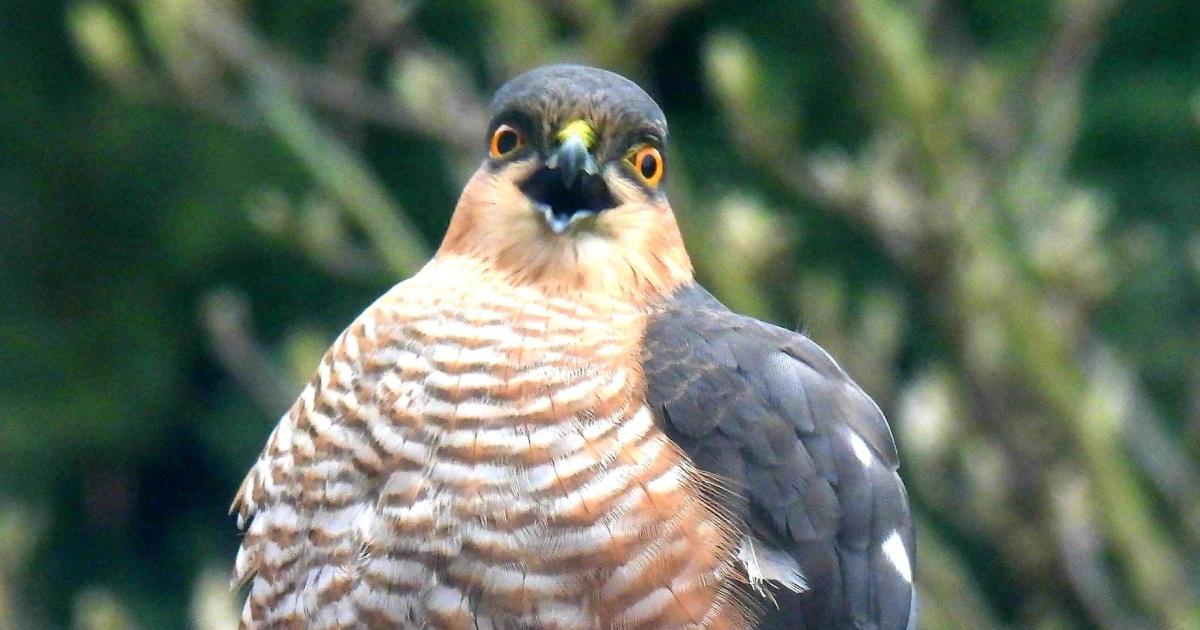
Denise Davies took to the group to share the shots of the “lovely” sparrowhawk, who had visited a garden in Dinmore in north Herefordshire.
Concern was previously raised over the declining numbers of the amber-listed birds, with the population plummeting in the 1950s and 60s, which the RSPB says was due to organochloride pesticides.
“These chemicals built up in the food chain and resulted in the shells of Sparrowhawk eggs becoming very thin and prone to breaking during incubation,” the RSPB said.
The small bird of prey was spotted in a garden in Dinmore. (Image: Denise Davies)
“After these pesticides were banned, sparrowhawk numbers recovered. However, between 1995 and 2023, sparrowhawks declined by 25 per cent and they now feature on the Birds of Conservation Concern Amber List.”
Read more:
Although still listed as a concern, there are said to be 35,000 breeding pairs in the UK.
Though the bird is one of the smallest birds of prey, it is pipped to the post by merlins, which have a total wingspan of between 53 and 58 centimetres.
The small bird of prey was spotted in a garden in Dinmore. (Image: Denise Davies)
In contrast, the wingspan of sparrowhawks is usually measured between 55 and 70 centimetres.
The species has a diet of mostly small birds, including thrushes, sparrows, finches, and even bats.
According to the birdwatching site, goingbirding.co.uk, 13 separate sightings of sparrowhawks were recorded in 2025 in the county, at locations including Lugg Meadows, Wellington Gravel Pits, and Bircher Common.
Comments are closed.