
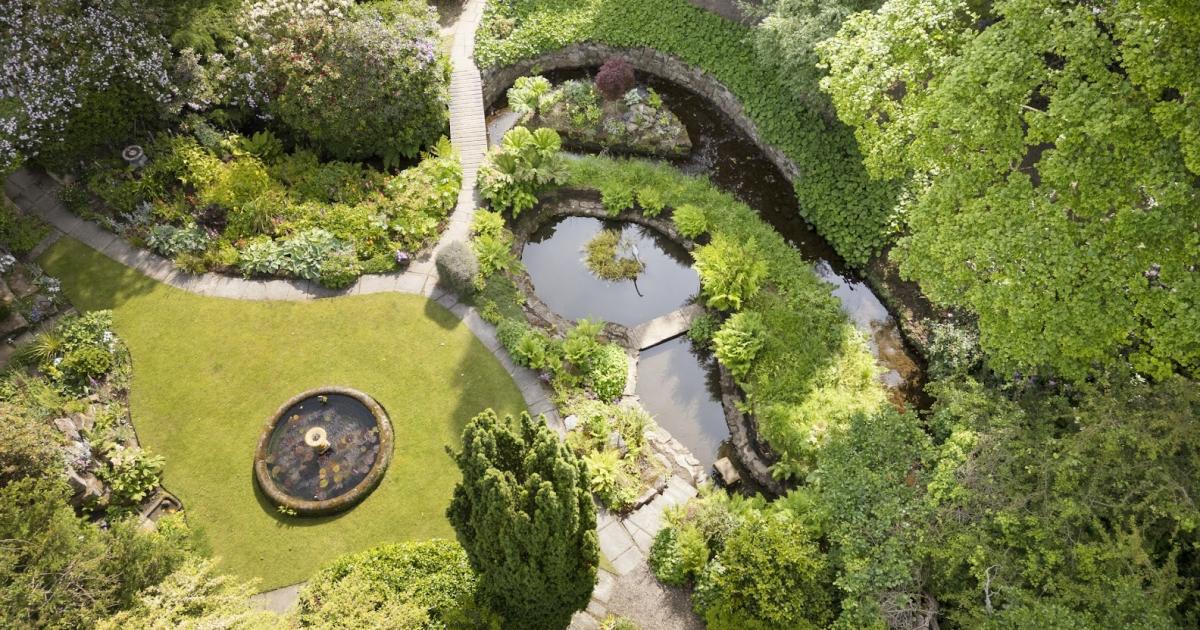
When Mike Heagney’s father first bought Tudor Croft, an Arts and Crafts style house in Guisborough in the early 1950s, its garden was a far cry from the enchanting oasis it has since become.
Decades of care have taken the garden on a remarkable journey of restoration, transforming it into a magical landscape, which includes a stunning carpet of snowdrops as spring nears.
The garden’s recent Grade II listing means this cherished piece of heritage will be protected for generations to come.
Tudor Croft Garden is one of just five parks and gardens among 199 sites to be recognised by Historic England over the past year.
Tudor Croft Garden owner Mike Heagney inspects the latest snowdrops Image: Sam Booth
Created in 1934 for industrialist Ronald Crossley, the garden is described as ‘a rare survival of an inter-war suburban garden in a relaxed Arts and Crafts style’.
Designed to complement the family home, which is also Grade II listed, the grounds remain largely unchanged, providing views across the property and towards the North York Moors.
Among its distinctive features are the Gnome Garden, containing hand-crafted terracotta figures of elves, gnomes, pixies, birds and animals by Walter Scott, and a Secret Garden with a stone-flagged bridge over a pond.
The site also showcases a rare roofed fernery, intricate rockwork thought to be by the Backhouse Nursery of York, a rose pergola built from Crossley bricks and a water garden.
Mike, who owns Tudor Croft, has raised more than £100,000 for charity by opening the garden to the public each spring and summer, and says the restoration has been a joy.
Tudor Croft
‘We’re delighted that Tudor Croft has been listed by Historic England and is now protected for future generations to enjoy,’ he says. ‘Because of the visual connection from the garden to the moors, this listing should also prevent new housing being built adjacent to the site, which would badly damage the garden.
‘The garden was completely overgrown when my father, Tony Heagney, bought the house in 1952.’
He recalls how his parents and their five children moved in 73 years ago, and woke up the next morning to ‘find the entire garden covered in snow’.
‘Tudor Croft now includes dozens of small gardens within the whole, featuring a trout stream, pools, fountains and the finest fernery in Britain,’ adds Mike.
‘It brings us great joy, and we care for it with help from family, staff and our wonderful team of volunteers.
Snowdrops at Tudor Croft Garden. Picture: Gill Davidson/The Northern Echo Camera Club
‘Restoring Tudor Croft to its current beauty has been a magical journey.’
In the 1990s, Mike started a collection of snowdrops and there are now more than 300 varieties in the collection. There will be a chance to view the garden’s renowned collection this month, on February 7 and 8.
Admission is £10, with children admitted free.
Historic England describes Tudor Croft as ‘a good example of a suburban garden with a contemporaneous family house designed for an industrialist, with Crossley bricks used to build the house and garden features, including the rose pergola’.
Mike Heagney says it has been a joy to restore Tudor Croft. Picture: Gill Davidson/The Northern Echo Camera Club
In its listing, the heritage body says it has ‘a carefully considered layout with the house at the highest point overlooking the rear sloping garden, allowing far-reaching views to the natural landscape beyond, with the summits of Highcliffe and Roseberry Topping deliberately appropriated as part of the design’.
It adds: ‘The attention to materials and textures complements the Arts and Crafts aesthetic of the house, with plentiful use of bricks, masonry fragments from Gisborough Priory, millstones set in stone paving and rockwork, including rare textured magnesium limestone found only along the local coast.
‘The accomplished designs of the rare roofed fernery and the rockwork, and associated civil engineering of the water gardens, bear the hallmarks of the Backhouse Nursery of York, famous for their consummate rockwork and expertise in plants, notably alpines and ferns.
‘The less formal, more intimate and relaxed style of the garden, inhabited by numerous terracotta gnomes and other animals handcrafted for Crossley, epitomises the 1930s devotion to outdoor leisure and is in contrast to the formal structures of hard landscaping and garden rooms seen in earlier Arts and Crafts gardens.’
Tudor Croft is lauded as a ‘rare example of a largely intact 1930s garden in England’.
Tudor Croft
The listing places Tudor Croft among 19 ‘unusual historic buildings and places’ highlighted by Historic England.
Dudderhouse Hill Neolithic long cairn, at Long Scar in the Yorkshire Dales, is also recognised. It is now a scheduled monument, securing its status as a nationally important archaeological site protected by law.
Historic England says it ‘provides important evidence of early prehistoric communities in northern England’.
It adds: ‘This partly turf-covered mound of stone, dating to around 3400 to 2400 BC and measuring 23 metres long and 12 metres wide, is one of the oldest visible monuments in the landscape and offers a rare insight into prehistoric ritual and burial practices.
Tudor Croft
‘Until the 1990s, experts believed long cairns were absent from the Yorkshire Dales, assuming that Neolithic communities in the area used natural cave systems for burial instead.
‘However, fieldwork over the past two decades has identified a small number of these ancient monuments across the region.
‘First identified in 2008, the Dudderhouse Hill long cairn displays evidence of structural arrangements, including large stone slabs and edge-set stones suggesting internal compartments. Remarkably, the cairn’s orientation appears carefully planned with its axis aligned towards Pen-y-ghent, a prominent peak, whilst mirroring the Ingleborough to Simons Fell ridge to the north-west.’
Heritage minister Baroness Twycross says these heritage sites have played a part in ‘shaping our national stories over the centuries’. She adds: ‘I’m proud that we’re safeguarding our rich history so future generations can continue to enjoy it.’
Historic England says: ‘These newly protected places demonstrate the remarkable diversity of England’s heritage.
‘They connect us to the people and events that shaped our communities.’.
Tudor Croft Garden, 1 Stokesley Road, Guisborough TS14 8DL
Comments are closed.