
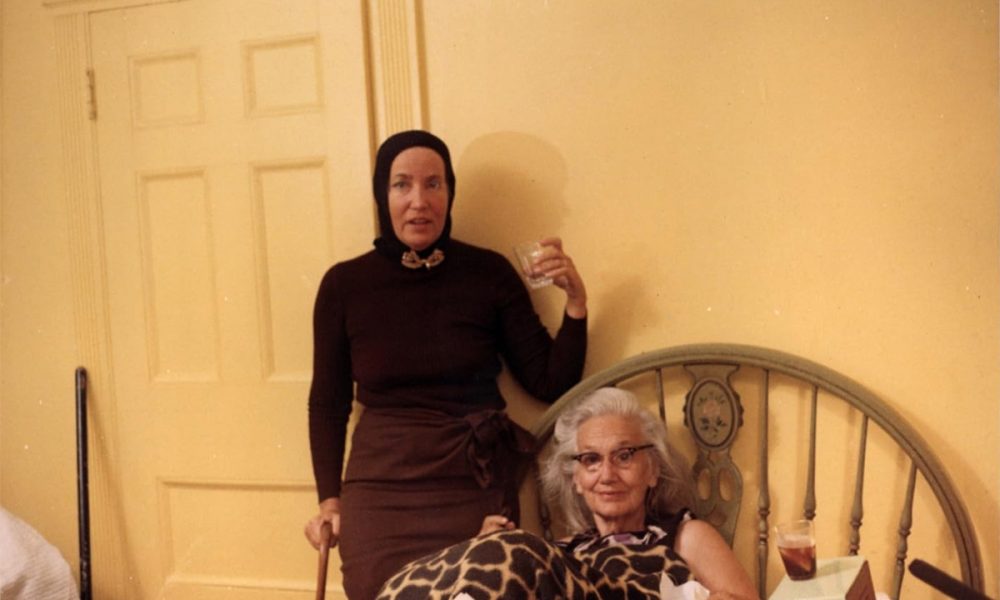
If we were forced to declare why “Grey Gardens” became a cult classic among gay men, it would be all the juicy quotes that have become part of the queer lexicon.
Celebrating the 50th anniversary of its theatrical release this month, the landmark documentary profiles two eccentrics: Edith Ewing Bouvier Beale and her daughter, Edith Bouvier Beale (known as “Big” and “Little” Edie, respectively), the aunt and cousin of former first lady Jaqueline Kennedy Onassis and socialite Lee Radziwell. Once moving within an elite circle of American aristocrats, they had fallen into poverty and were living in isolation at their run-down estate (the Grey Gardens of the title) in East Hampton, Long Island; they re-entered the public eye in 1972 after local authorities threatened eviction and demolition of their mansion over health code violations, prompting their famous relatives to swoop in and pay for the necessary repairs to avoid further family scandal.
At the time, Radziwell had enlisted filmmaking brothers David and Albert Maysles to take footage for a later-abandoned project of her own, bringing them along when she went to put in an appearance at the Grey Gardens clean-up efforts. It was their first encounter with the Beales; the second came two years later, when they returned with their cameras (but without Radziwell) and proceeded to make documentary history, turning the two Edies into unlikely cultural icons in the process.
On paper, it reads like something painful: two embittered former socialites, a mother and daughter living among a legion of cats and raccoons in the literal ruins of their former life, where they dwell on old memories, rehash old conflicts, and take out their resentments on each other, attempting to keep up appearances while surviving on a diet that may or may not include cat food. Truthfully, it is sometimes difficult to watch, which is why it’s easier to approach from surface level, focusing on the “wacky” eccentricities and seeing the Beales as objects for ridicule.
Yet to do so is to miss the true brilliance of a movie that is irresistible, unforgettable, and fascinating to the point of being hypnotic, and that’s because of the Beales themselves, who are far too richly human to be dismissed on the basis of conventional judgments.
First is Little Edie, in her endless array of headscarves (to cover her hair loss from alopecia) and her ever-changing wardrobe of DIY “revolutionary costumes,” a one-time model and might-have-been showgirl who is obviously thrilled at having an audience and rises giddily to the occasion like a pro. Flamboyant, candid, and smarter than we think, she’s also fearlessly vulnerable; she gives us access to an emotional landscape shaped by the heartbreaks of a past that’s gradually revealed as the movie goes on, and it’s her ability to pull herself together and come back fighting that wins us over. By the time she launches into her monologue about being a “S-T-A-U-N-C-H” woman, we have no doubt that it’s true.
Then there’s Big Edie, who comes across as an odd mix of imperious dowager and down-to-earth grandma. She gets her own chance to shine for the camera, especially in the scenes where she reminisces about her early days as a “successful” amateur vocalist, singing along to records of songs she used to perform as glimpses emerge of the beauty and talent she commanded in her prime. She’s more than capable of taking on her daughter in their endless squabbles, and savvy enough to score serious points in the conflict, like stirring up jealousy with her attentions to beefy young handyman Jerry – whom the younger Edie has dubbed “the Marble Faun” – when he comes around to share a feast of boiled corn-on-the-cob with them. “Jerry likes the way I do my corn,” she deadpans to the camera, even though we know it’s meant for Little Edie.
It’s not just that their eccentricities verge on camp; that’s certainly an undeniable part of the appeal, but it falls away quickly as you begin to recognize that even if these women are putting on a show for the camera, they’re still being completely themselves – and they are spectacular.
Yes, their verbal sparring is often shrill and palpably toxic – in particular, Big Edie has no qualms about belittling and shaming her daughter in an obviously calculated effort to undermine her self-esteem and discourage her from making good on her repeated threats to leave Grey Gardens. We know she is acting from fear of abandonment, but it’s cruel, all the same.
These are the moments that disturb us more than any of the dereliction we see in their physical existence; fed by nostalgia and forged in a deep codependence that neither wants to acknowledge, their dynamic reflects years of social isolation that has made them into living ghosts, going through the habitual motions of a long-lost life, ruminating on ancient resentments, and mulling endlessly over memories of the things that led them to their outcast state. As Little Edie says early on, “It’s very difficult to keep the line between the past and the present. Do you know what I mean?”
That pithy observation, spoken conspiratorially to the Maysles’ camera, sets the tone for the entirety of “Grey Gardens,” perhaps even suggesting an appropriate point of meditation through which to contemplate everything that follows. It’s a prime example of the quotability that has helped this odd little movie endure as a fixture in queer culture; for many LGBTQ people, both Edies – born headstrong, ambitious, and independent into a social strata that only wanted its women to be well-behaved – became touchstones of frustrated longing, of living out one’s own fabulousness in isolated secrecy. Add to that shared inner experience Little Edie’s knack for turning scraps into kitschy fashion (and the goofy-but-joyous flag dance she performs as a sort of climactic topper near the end), and it should be obvious why the Maysles Brothers’ little project still resonates with the community five decades later.
Indeed, watching it in today’s cultural climate, it strikes chords that resonate through an even wider spectrum, touching on feminist themes through these two “problematic” women who have been effectively banished for refusing to fit into a mold, and on the larger issue of social and economic inequality that keeps them trapped, ultimately turning them against each other in their powerlessness.
With that in mind, it’s clear these women were never filmed to be objects of ridicule. They’re survivors in a world in which even their unimaginably wealthy relatives would rather look away, offering a bare minimum of help only when their plight becomes a matter of public family embarrassment, and the resilience they show in the face of tremendous adversity makes them worthy of celebration, instead.
That’s why “Grey Gardens” still hits close to home, why it entertains despite its darkness, and why we remember it as something bittersweet but beautiful. By the end of it, we recognize that the two Edies could be any of us, which means they are ALL of us – and if they can face their challenges with that much “revolutionary” spirit, then maybe we can be “staunch” against our adversities, too.
Comments are closed.