

“Is it safe to eat vegetables from gardens in Yellowknife?” A group of scientists working out of the territory say that while it is safe there are some “low” risks associated with growing local produce.
Their project focusses on examining garden soils and vegetables, testing for arsenic and other metals associated with regional mining activity.
The ongoing study began back in 2020, led by researchers from the Aurora Research Institute, Queen’s University and the Royal Military College of Canada.
The researchers say it is the “most thorough and detailed” investigation of garden soils and vegetables in the Yellowknife region to date.
The study began in response to findings of elevated concentrations of arsenic and other mine related contaminants in area soils.
“Contamination from arsenopyrite-bearing gold has resulted in soil concentrations much higher than Canadian guidelines. This has led to the investigation of arsenic uptake from garden soils into vegetables grown in Yellowknife and the potential human health risk from the consumption of these vegetable,” said the researchers.
A study published in 2021 headed by Michael J. Palmer, one of the lead researchers from the Aurora Research Institute, found high concentrations of arsenic in soil within specific locations around the city.
“High concentration levels of arsenic (up to 4700 mg kg-1) were found in soil located public areas, close by to decommissioned roaster stacks. The scientists found that this was the case even 60 years after emissions were occurred from the stacks. The data showed that surface soils within 15 km of Yellowknife contained anthropogenic arsenic trioxide (As2O3), produced by roaster stack emissions.”
Despite the findings, data showed that growing vegetables past a certain radius from the decommissioned stacks was safe.
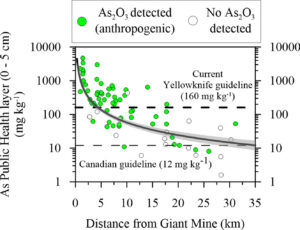 Data from a study led by Micheal J Palmer showing concentrations of lead in soil decreased progressively within 10 km increments of decommissioned stacks. The study was first published in 2021 https://pubmed.ncbi.nlm.nih.gov/33652309/
The researchers found that the further from the mine sites the soil samples were, the lower the contamination level. Once past a certain radius of past mine activity, the soil tested showed levels were substantially lowered.
Within 30 km of the city, data from the study showed that the concentration of arsenic in the top soil layer of soil (0 to 5 cm deep) ranged from less than 2 mg to 4 700 mg per kg of soil sampled.
Within 20 km of the city, 95 per cent of top layer soil samples exceeded the national guidelines for residential soils. The guideline has a limit of 12 mg of arsenic per kg of soil.
Beyond the 20 km radius, about 49 per cent of soils exceeded the national guideline.
The government of Canada’s draft guidelines on safe arsenic levels, refer to the study led by Palmer in 2021.
While the presence of arsenic in soil continues to exist at various levels in city soil, the group of scientists said that based on their latest findings, risks associated with eating locally grown produce are “very low.”
The researchers announced that they plan to host a public discussion on Feb. 10 to talk about the latest results of the study and its findings regarding the risks associated with eating garden-grown vegetables in Yellowknife.
The public discussion is scheduled to held at the Northern United Place Auditorium in Yellowknife at 7 p.m. MT
Comments are closed.