
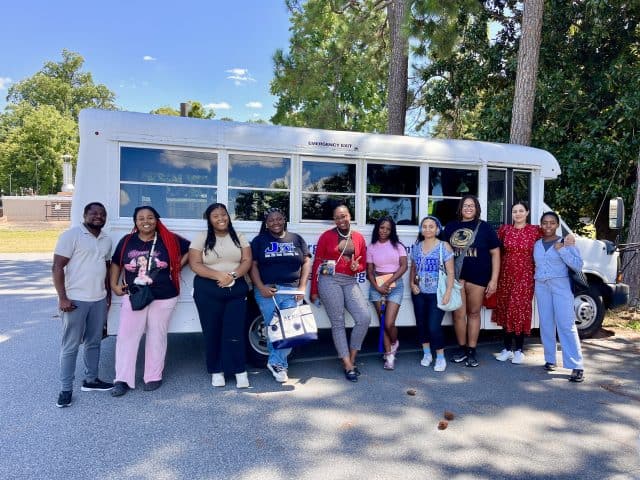
On a humid morning last August, a group of college students stood in a patch of dark, patient soil behind a row of campus buildings, their hands streaked with earth and their notebooks smudged at the corners. They had come to learn how to grow tomatoes and peppers, but by the end of the summer they would also learn how to read a city—its inequities, its histories, its quiet acts of resistance—through the lens of food.
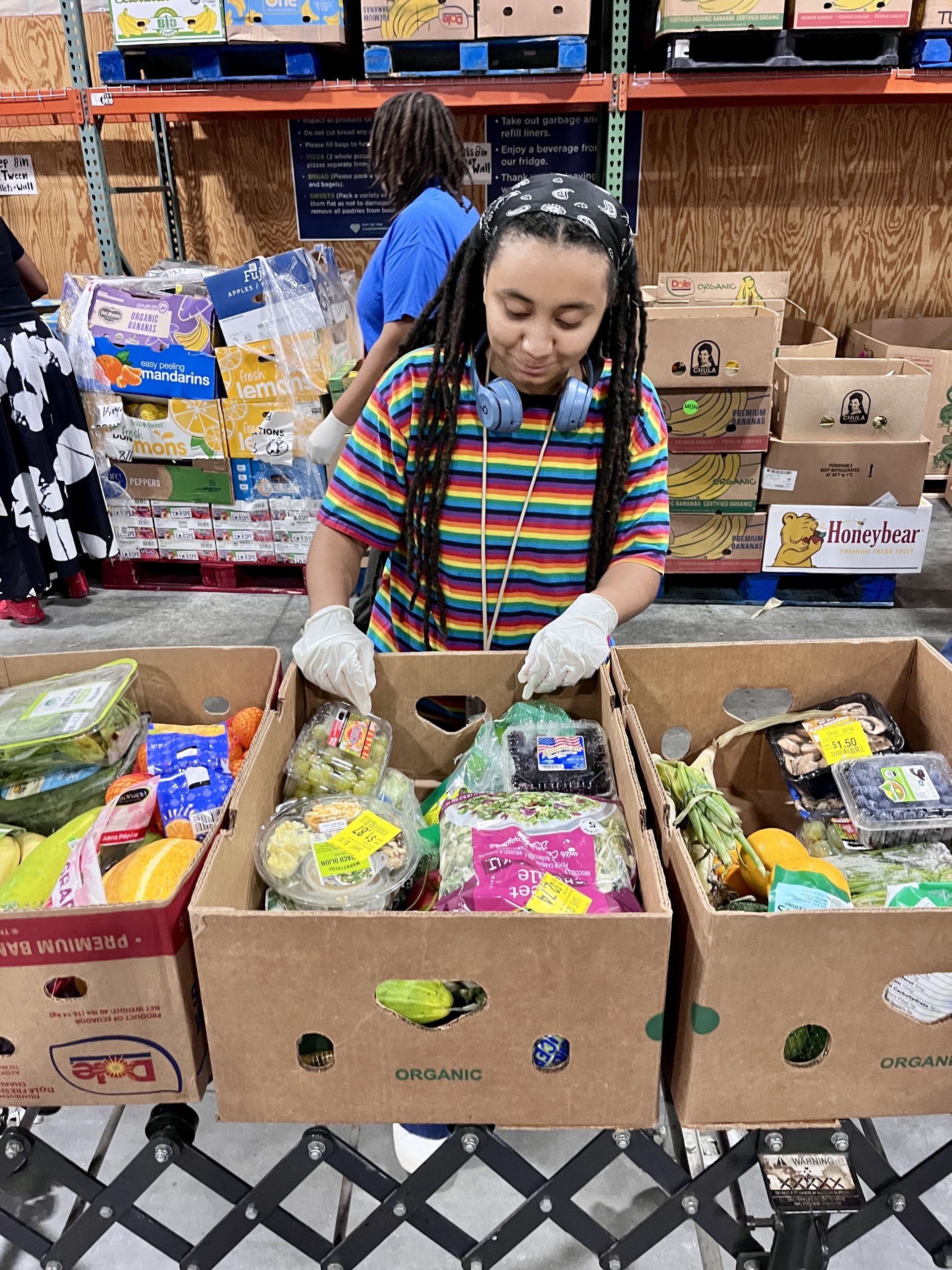 A Bennett College student prepares fresh produce as part of the Gardening and Food Justice course’s community engagement work.
The course, Gardening and Food Justice, was part botany lesson, part civic education, part road trip. Students learned the mechanics of compost and crop rotation from Master Gardener Terence Wood, but just as often they learned from community leaders who treat food as a language of dignity.
Understanding Food Justice in Our Community
“We were definitely on the road,” one student laughed, remembering a schedule that rarely kept them in a classroom for long.
The class met with Brayndon Stafford of the NC Black Alliance to discuss what he calls food apartheid—the deliberate mapping of scarcity onto Black and low-income neighborhoods. They packed boxes with fresh fruits and vegetables at the Out of the Garden Project for families who rely on monthly distributions to fill empty cabinets. They walked the aisles of the Curbside Farmers’ Market on Lindsey Street and the sprawling Piedmont Triad Farmers’ Market off I-40, interviewing farmers about how farming has changed through the years, soil prices, unpredictable weather, and the thin margins between abundance and loss.
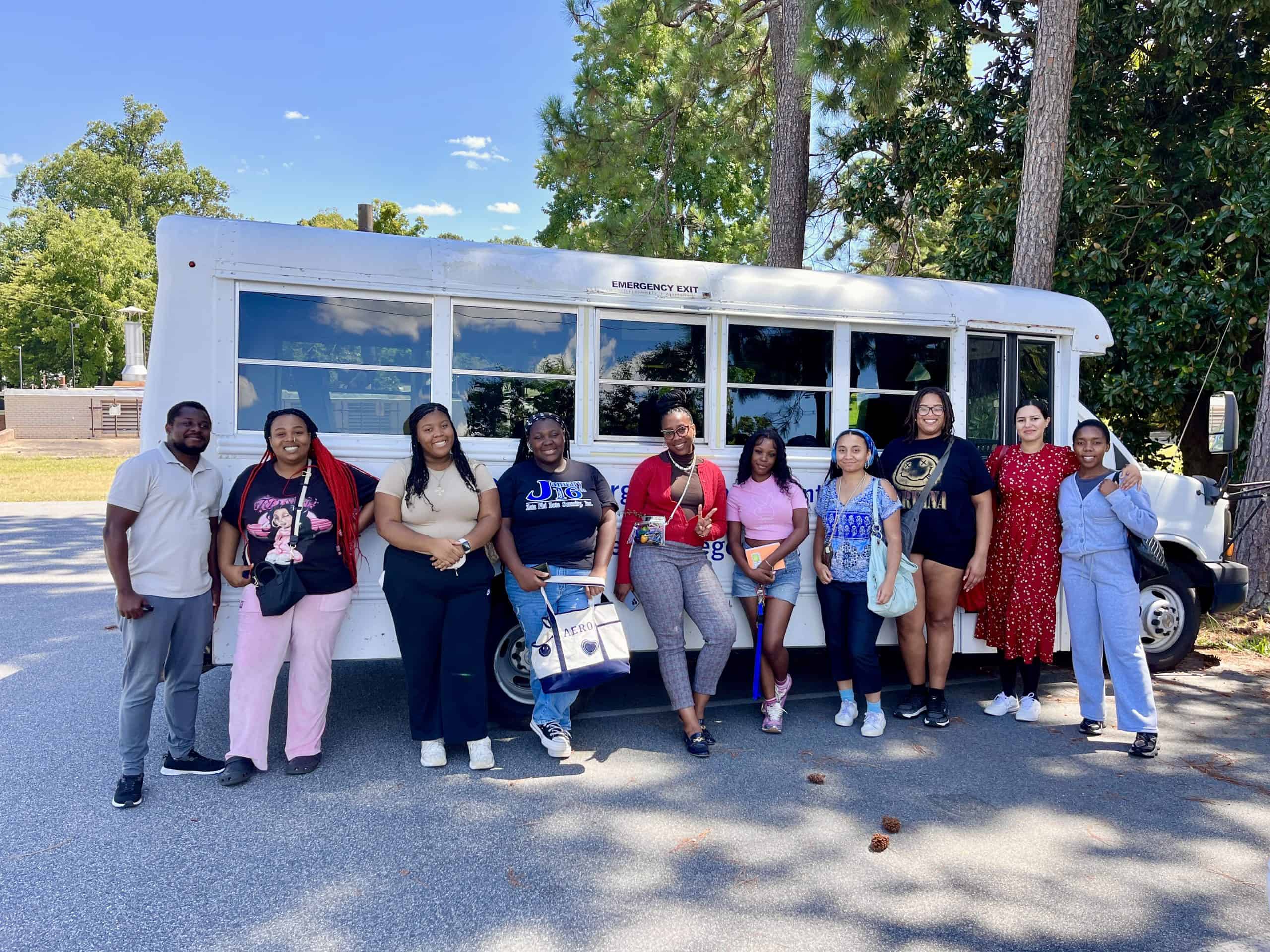 Students in Bennett College’s Gardening and Food Justice course during a community-based learning trip in Greensboro.
At A Simple Gesture, students confronted the paradox of food waste: how perfectly edible food can be discarded while neighbors go hungry. Director Laura Oxner also delivered a message of hope, discussing how a network of local volunteers work to recover discarded food and drive it to organizations and families in need. At the PDY&F Community Garden, James Gardner spoke about land as inheritance and responsibility. The students volunteered planting varieties of lettuce and greens in tall self-watering hydroponic towers. A tour of Guilford College’s farm and composting program revealed a quieter revolution—in their cafeteria- they eat what they grow, and their banana peels and coffee grounds returning to earth instead of landfills.
The lessons layered upon each other like layers of mulch ready for seeds and the harvest.
Back on campus, the students tended their own raised beds—now in their second year. The garden is modest, a few rectangles of hope bordered by wood fencing and serenaded by the low hum of cicadas. Over the summer, the garden produced enough tomatoes, peppers, eggplant, and greens to share with faculty and staff, though not yet enough for the broader community. That, the students decided, would be next.
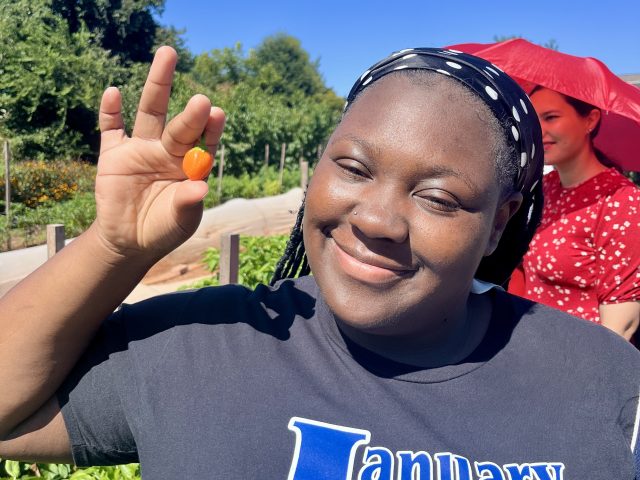 A student harvests fresh produce grown through Bennett College’s Gardening and Food Justice course.
Dr. Hayes says, “Putting our hands in soil is transformative—it feels good to plant and harvest. There’s something empowering about learning how to grow your own food. And I love to watch students eat cherry tomatoes off of the vine!”
“When we teach about social problems, the best thing we can do is take students out into the community. Because while the community demonstrates the inequities and problems, it also shows us how leaders rise and create to meet those needs and challenges. That combination teaches students the importance of understanding the reality and how to be part of the solution.”
Winter has since quieted the beds. Only a few hardy plants remain, waiting out the cold. In March, the soil will be turned again, and the cycle will restart. Gardens, like justice, experiences seasons.
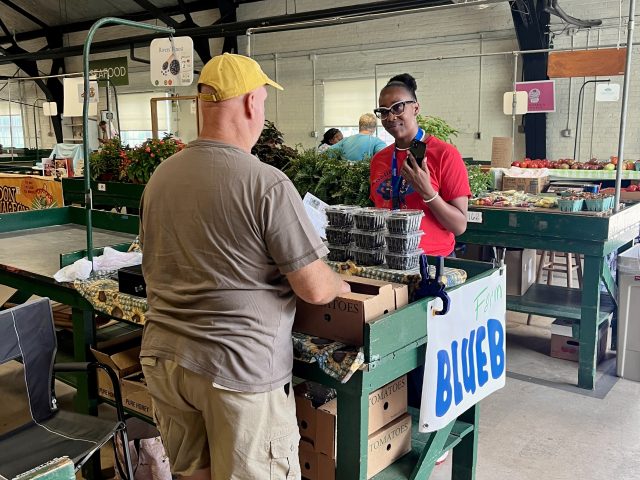 A Bennett College student engages with a local farmer while learning about food systems and sustainability.
For the students, the class altered how they see Greensboro. Grocery stores are no longer neutral buildings; bus routes are not just lines on a map; a tomato is not merely a tomato.
“A few years ago, my family waited in lines to receive food support. At Out of the Garden, I packed boxes of fresh food to help other families in need. This was a full-circle moment for me. This class made me want to get involved more,” said a graduating senior.
Snothando Ngcobo said, “This class completely shifted how I understand food and food justice as a South African in the United States. Learning about regenerative farming made me realize that the knowledge my grandfather passed down to me never ‘expired’, it was regenerative farming long before it had a name. He practiced it in our home garden, and seeing those principles affirmed in this class was powerful. One moment that really stayed with me was visiting Mr. Gardner’s garden. Seeing the different kinds of organic manure (fish and chicken manure) he used, instead of synthetic or non-organic manure, showed me how food justice is rooted in caring for the land, honoring traditional knowledge, and building healthy communities from the ground up.”
Jordan Harris-King said, “A moment that made me really click with food justice was when we learned about all the root causes of food insecurity, and I knew at that point I wanted to find ways to make my way of obtaining food better for myself, my community and my environment.”
Tyrica Flair said, “Food justice is human justice. Sustainability is our responsibility.”
“There is no single defining moment in the Gardening and Food Justice course. Every trip, every encounter, and every individual involved mattered. Advocacy through education and action is cumulative. Each experience chips away at systems of marginalization surrounding what should already be a basic human right: access healthy food choices and knowledge.”
Students learned how to garden, but they also learned how to listen—to elders, to farmers, to neighborhoods, to the stubborn wisdom of seeds that insist on growing even in unlikely places.
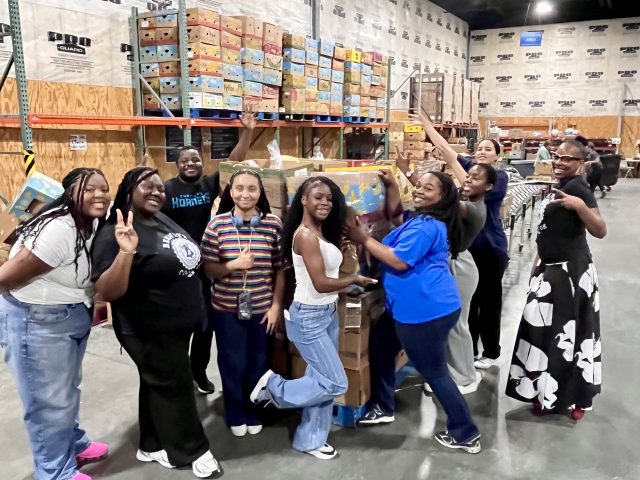 Students volunteer together while packing fresh food for families as part of the Gardening and Food Justice course.
In Greensboro, a small patch of soil became a classroom. And a classroom, unexpectedly, became a garden for justice.
For more information, about the Bennett College class “Gardening and Food Justice” contact:
Dr. Anne C. Hayes (she/her)
Executive Director of Global & Interdisciplinary Studies
and Sustainability Lead
Bennett College
900 E. Washington Street
Greensboro, NC 27401
Office (336) 517-2243
Comments are closed.