
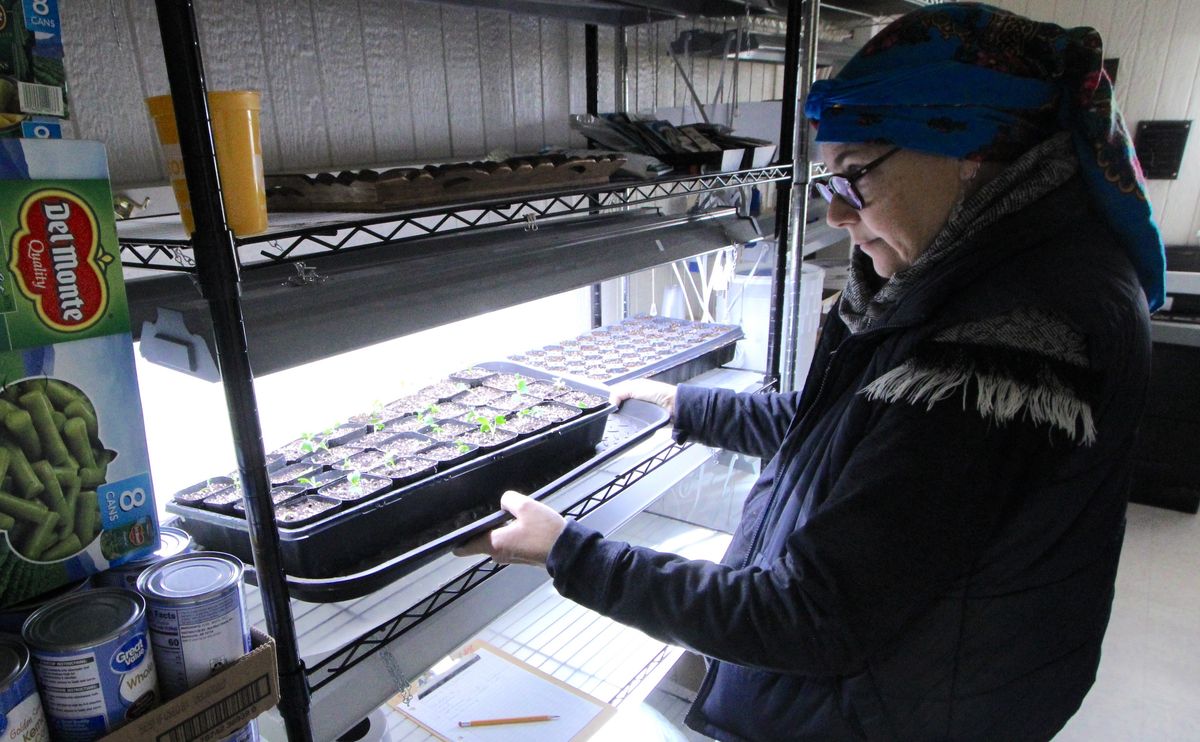
Staying true to the nonprofit’s roots, gardeners at Seeds of Hope Wilson gathered last month to transplant seedlings and plant seeds indoors for the organization’s community garden.
“This is year five for January seed planting. Today we’ve got Swiss chard, collards, red and green cabbage, calendula, kale, broccoli and cauliflower,” said Julia Newton, garden coordinator for the last five years. Newton was training her successor, Jake Willson, who has taken the job as incoming garden coordinator.
“Today we are starting seeds for our early spring garden. We do that by looking at the list of what grows mostly this time of year, which is mostly greens and radishes and different things like that,” Newton said.
The team, including garden manager Claudia Reyes and volunteers Lorena Bravo and Dona Josefina, coordinates to fill pots with healthy soil, separate and transplant small seedlings before placing them under grow lights.
“Our garden managers have been here for the past five years,” Newton said. “They know what to do and how to do it, and it is just wonderful to see the process happening year after year.”
Every plant will ultimately end up in the community garden producing fruit and vegetables for neighbors.
“Our seeds have been sown with intention,” said Luisa Simpson, who is the new executive director at Seeds of Hope. “Knowledge has been shared generously. And time and time again, I’ve seen hope in humanity restored when many hands come together for the good of our neighbors. This work reminds me that community is not just a place — it’s a collective heartbeat, strengthened every time we choose compassion, collaboration and care.”
Newton said this early process of planting and growing seedlings is important for two reasons.
“It’s much less expensive to buy seeds and start them ourselves and plant those seedlings out into the garden,” Newton said. “A pack of seeds costs about $3, whereas a four-pack or six-pack of seedlings costs about $3. So it really lets us grow lots and lots of plants to plant in our garden and to share with others without a lot of expense.
“The other thing is, it allows us to grow cultural varieties — varieties of plants and herbs that are specific to folks in the neighborhood, whether they be Hispanic herbs or plants that might be plants that people in the neighborhood might be familiar with,” she continued. “We want to encourage people to come to the garden and harvest and eat our crops, so we want to plant things that people want to eat.”
When the seedlings get their first true leaves, the gardeners up-pot them and leave them under the lights for about four weeks inside before they get planted outside in the garden.
The early spring crops that are direct seeded can go into the ground in middle to late February.
All of the seedlings will eventually be transplanted into the Seeds of Hope Community Garden, located at the corner of Viola and Carroll streets.
LEARN FROM EXPERIENCE
Newton said that for folks who want to start seeds for their garden, there are a few important rules to follow.
“One is to plant the right kinds of seeds at the right time. You want to plant cool season seeds in the cool season. You don’t want to start tomatoes yet. It’s too early,” Newton said. “You also want to have enough light for your seedlings to grow well.”
Seeds of Hope has invested in inexpensive seedling-starting stations that are set up on wire shelves under LED grow lights.
“You don’t need fancy grow lights to start seedlings,” Newton said. “You can just do it under shop lights.”
Newton said a common problem people have with their seedlings they grow at home is that the plants are leggy when they are started in front of a window or glass door.
“They are too tall, and they are stretching for the light,” Newton said. “A window is often not enough, so when we start seeds, we put them directly under the lights, and the seedlings are short and stocky and strong instead of being tall and skinny and easy to break.”
Inexpensive grow lights cost less than $20 to $40, with expensive sets having a much larger price tag.
But rest assured, windows often work just fine, especially for smaller gardens.
THE JOY OF GARDENING
“There are few things so satisfying to me a eating something that I planted from seed and grew,” Newton said. “This is something that human beings have been doing for tens of thousands of years, and it really makes me feel connected to the earth and to the human race to plant a seed, watch it grow and then eat the fruit at the end.”
Bravo said she was not a gardener before working at Seeds of Hope. “I didn’t know we could do all year. I was just thinking just in summertime.”
Bravo said Newton encouraged the team to think about gardening as a year-around endeavor.
Seeing what the plants mature and produce is the real joy, Bravo said.
“I see that a little tiny seed can do all of that, it’s amazing,” Bravo said. “You can have some food, some fruit, some vegetables … Seeds of Hope does a great job. When I was moving here, I wanted friends, and I have got friends. I feel like it is a family here.”
Willson moved to Wilson from New Mexico and joined the Wilson County Extension Master Gardeners, where he met Newton and then started volunteering at Seeds of Hope.
“My passion is growing vegetables,” Willson said. “I am really interested in growing vegetables and making food available to people who need it, so when the opportunity came up to be involved here, I was thrilled. It really is a good fit for me.”
Willson said gardening is a healthy activity.
“It is physically good for you and nutritionally good for you, and I think spiritually good for you. It’s my passion,” Willson said. “I have been gardening for many years. You are never at the end of it. Each year there is something new to be learned and something new to be tried. To me it is incredibly satisfying to watch that whole process. That’s what gardening is all about.”
Comments are closed.